[June 2025 Update] How AI Agents Are Supercharging Business: A Deep Dive from Major Companies' Initiatives to Real-World Use Cases (1)
- Agentic AI is autonomous AI that understands goals on its own and plans, acts and learns, and OpenAI places it at Level 3 of its five-level roadmap to AGI.
- In healthcare, UiPath's agent reportedly cuts prior authorization time by up to 50%, and Modastera's MAEA shortens medical AI development from months to days.
- In finance, KeyBank finished data extraction equal to nine years of work in 14 days, and Daiwa Securities cut 52 hours of email handling work per month.
- 14 days
- Time KeyBank needed for data extraction equal to nine years of work
- Up to 50%
- Reduction in prior authorization time with UiPath's agent
- 93%
- PKSHA Technology's data entry accuracy (trial at a major life insurer)
- 52 hours/month
- Work hours Daiwa Securities saved with KARAKURI assist
Introduction
AI agents have finally begun to rewrite the future of business. A wave of AI agents that go beyond simple AI tools, acting on their own and supercharging business, is arriving right now. This article takes a deep dive into AI that thinks and acts on its own: the basics, the initiatives of the world’s leading companies, and the remarkable use cases emerging in industries such as healthcare, finance and HR. It is a must-read guide to leading the future, covering the latest trends, the market outlook and the challenges.
Major Companies’ Agentic AI Initiatives and Services
You have probably been hearing the term “agentic AI” a lot lately, but do you know what makes it truly remarkable? Agentic AI takes the concept of generative AI one step further, and as that “next stage,” it is drawing a great deal of attention in the business world right now. Conventional generative AI is good at “generating content based on instructions given by a user.” Agentic AI, by contrast, can deeply understand goals on its own, plan and carry out tasks, and then learn from the results to improve autonomously.
This groundbreaking autonomy, the ability to “think and act on its own,” lets AI pursue complex goals without detailed human instructions. It is as if a capable business partner that finds problems and carries out solutions on its own has been born. Major companies around the world have high hopes for agentic AI and are actively developing and adopting it. There is little doubt that agentic AI will play a central role in business from here on.
The Impact of Agentic AI: How It Differs from Generative AI and How It Relates to AI Agents
Did you know that “AI” actually comes in many different types? In particular, “generative AI,” which has been the talk of the town lately, and “agentic AI,” now hailed as a game changer in business, may look similar, but they differ greatly in their roles and capabilities.
Generative AI Is a “Smart Assistant That Waits for Instructions”
Let’s start with generative AI, which many of you use every day through tools such as ChatGPT. It is like an assistant that carries out your instructions faithfully and very intelligently.
A passive system: To generate text, images or code, you need to give it specific instructions in the form of a “prompt.”
It does nothing without input: Unless you say something to it, it basically takes no action.
Strong at one-off tasks: It is extremely strong at clear, one-time tasks such as “write a text about X” or “continue this image.” However, it is not good at setting long-term goals on its own and continuing to act toward them.
Agentic AI Is a “Super Command Center That Runs Business Autonomously”
So why is agentic AI attracting so much attention as the “next stage”? The answer lies in its autonomy, which sets it apart from generative AI. Like a human, agentic AI deeply understands the “final goal,” makes its own plan to reach it, carries the plan out, evaluates the results, and learns and improves to find better ways. This is a completely different dimension from AI that waits for instructions, and truly a groundbreaking evolution.
It acts on its own to reach goals: Generative AI’s job ends once it outputs content. The greatest appeal of agentic AI is that it keeps carrying out a range of actions autonomously until the goal is reached. For example, it does not just write meeting minutes; it also drafts the next actions from the discussion and even contacts the relevant departments.
It uses generative AI as its “brain”: At the core of an agentic AI system, a large language model (LLM) such as ChatGPT is often built in as the “reasoning engine,” in other words, a “smart brain.” But agentic AI is not just generative AI. It uses the outstanding reasoning power of generative AI as its “brain,” and by connecting to external tools and adding learning capabilities, it works as a powerful system that can carry out more complex and advanced missions. We can confidently call this a breakthrough that fundamentally changes how we do business.
This is where the term “AI agent” often causes confusion.
In fact, “AI agent” often refers to a small program that performs a specific task, something that has existed for some time. Chatbots and voice assistants, for example, efficiently carry out predefined tasks. They were passive: they acted when told to.
What agentic AI achieves is the autonomous evolution of these AI agents: agents that can now find goals proactively and carry out solutions on their own. In other words, agentic AI refers to the whole system in which these autonomous AI agents work together and cooperate to achieve complex goals. If each AI agent is a set of “smart hands and feet,” agentic AI is the “command center that oversees the whole,” and it will be the key to supercharging the business of the future.
Agentic AI Strategies of the World’s Tech Giants: A Close Look at Major Companies
As explained above, agentic AI has the potential to supercharge the future of business. How are the world’s tech companies moving at the forefront of this groundbreaking technology, and what visions do they have? This section digs into how each company is approaching agentic AI, including its strategy and specific services.
OpenAI: A Vision That Leads “Agentic AI,” the Next Evolution of Generative AI
Let’s start with OpenAI, which sets the direction for the AI industry. OpenAI sees agentic AI as a very important “next stage of generative AI.” It defines agentic AI as a system that can autonomously pursue complex goals and act efficiently on people’s behalf, without detailed human instructions.
A key point in OpenAI’s vision is that agentic AI “pursues goals defined by humans, in environments determined by humans.” This shows that agentic AI is not conceived as fully autonomous AI escaping human control, but as something that makes the most of its abilities within a framework set by people and strongly supports us in reaching our goals. This principle is a very important idea that shows how AI will evolve as a human partner. AI that autonomously pursues the goals we set could dramatically raise work efficiency, which is very exciting.
In addition, OpenAI’s five-level roadmap toward its ultimate goal of AGI (artificial general intelligence) places agentic AI (“Agents”) at Level 3, which suggests that agentic AI is an essential evolutionary step on the path to AGI.
OpenAI’s Agentic AI Push: Specific Initiatives and Services
To realize this ambitious vision, OpenAI is already actively rolling out specific projects and services.
The “Codex agent” announced at a developer conference: The Codex agent, announced at an earlier developer event, aimed not only to generate code but also to automate more complex programming tasks. It was an initiative with the potential to dramatically raise developer productivity.
Plans for “Operator,” an AI that carries out complex tasks: OpenAI plans to offer “Operator,” an AI that can autonomously carry out complex, multi-step tasks ranging from writing code to booking tickets.
The “OpenAI Agents SDK” development kit: OpenAI provides a development kit called the “OpenAI Agents SDK” so that developers can build their own agentic AI systems. This will speed up the development of custom agents for a wide range of needs, and the range of agentic AI applications will evolve remarkably.
Helping spread the term “agentic AI systems”: The white paper OpenAI published helped popularize the term “agentic AI systems” around the world, and it is clearly accelerating breakthroughs in this field.
These OpenAI initiatives go beyond technology development. They lay out a concrete picture of how agentic AI will spread through society and supercharge the way we work and live.
Microsoft: Driving an “Agentic World” with GPT at Its Core
No discussion of AI’s evolution is complete without Microsoft. Backed by its strong partnership with OpenAI, the company has deeply integrated GPT technology into its own services and set out an ambitious vision of an “agentic world.” As CEO Satya Nadella has said, the goal is a richer world in which AI agents handle a wide range of tasks on our behalf.
Microsoft’s Agentic AI Strategy: Specific Initiatives and Remarkable Applications
To build this “agentic world,” Microsoft is developing and deploying agentic AI through many approaches. Here are its specific initiatives and the services that are already in use or planned.
Building “your own agent” with Copilot Studio: Microsoft offers “Microsoft Copilot Studio,” which lets users easily create their own AI agents. Because it lets companies develop custom agents for their business needs without specialized programming skills, it speeds up corporate DX (digital transformation). Integration with Copilot and WSL (Windows Subsystem for Linux) has also been strengthened so that Windows becomes the best foundation for agentic AI development.
Agentic AI use cases that streamline daily work: The company has already introduced specific agentic AI use cases, such as the “Facilitator agent” in Teams and “self-service agents” that handle internal tasks autonomously.
Facilitator agent: It autonomously takes meeting minutes, extracts key tasks and organizes decisions, dramatically improving follow-up after meetings.
Self-service agents: AI autonomously handles routine work that used to take people time and effort, such as ordering PCs, sending complex emails and answering questions based on company policies, so employees can focus on more creative work. This is a striking gain in efficiency that helps streamline back-office work.
A comprehensive ecosystem that combines data integration and security: For agentic AI to show its true value, it must connect with many kinds of data. To integrate the data layer, Microsoft links Cosmos DB with Foundry, and it offers Copilot agents across Power BI and Microsoft 365 services. Microsoft Discovery uses knowledge graphs to reason about scientific knowledge, enabling advanced use of information. On the security side, it ensures safe access to system functions through MCP (Microsoft Cloud for Sovereignty), and it expects agentic AI to be used in many specialized areas, such as SRE (site reliability engineering), SWE (software engineering) and code review. It is also worth noting that Microsoft offers “AutoGen,” an open-source agentic AI framework. This is a strong driving force that helps the whole developer community grow and further accelerates innovation in agentic AI.
These Microsoft initiatives show that the company is not just developing individual AI features but is concretely designing a future way of working in which people and AI work together to carry out complex workflows efficiently.
Google: Driving “Personalization” and “Business Transformation” with Gemini at Its Core
As a company at the forefront of AI technology, Google’s moves are always watched closely around the world. In agentic AI in particular, it builds on the large language model (LLM) technology it has developed over many years and aims to create AI that thinks and acts like a human. The future of agentic AI that Google envisions could greatly change how we use information, how we learn and how we do business.
Google’s Agentic AI Goals: Next-Generation AI Powered by Gemini and the Knowledge Graph
Like ChatGPT and Claude, Google uses a powerful large language model (LLM) as the foundation of its agentic AI. Its latest model, “Google Gemini,” plays the central role.
Context understanding and multi-step planning: Google is focusing on new AI models that do more than generate words: they deeply understand more complex context, plan multi-step tasks on their own and carry them out under human supervision.
Deeper “intelligence” through the knowledge graph: Google’s long-standing strength, the knowledge graph, is another key element behind the intelligence of agentic AI. Applying this technology to search improves the ability to grasp user intent accurately and present highly relevant information, rather than just matching keywords. When agentic AI gathers information and makes judgments on its own, the knowledge graph becomes a powerful “source of knowledge.”
Remarkable Use Cases of Google’s Agentic AI and a Growing Network of Partners
Google is not only developing core technology but also presenting one concrete agentic AI application after another and moving them into practical use.
A personalized “learning assistant”: “LearnLM,” developed by Google DeepMind, is a leading example of a personal learning assistant that suggests the best learning content for each learner’s level of understanding and progress. It is a remarkable evolution that could dramatically improve the learning experience, almost like having your own private tutor. AI that makes individual learning and customer support this personal looks incredibly convenient.
Customer support AI that supercharges the customer experience: One of the most promising uses of agentic AI is customer support. By assessing each customer’s situation and combining it with attentive dialogue, it enables support personalized for each individual.
Strong partnerships that strengthen the whole ecosystem: Google Cloud works with partners across a wide range of industries, such as H2O.ai and OPPO, to help deliver agentic AI solutions. This is expected to bring Google’s technology into many business settings and greatly strengthen the AI ecosystem as a whole.
By combining the evolution of its core LLMs with the knowledge graph, its long-standing technology for organizing information, Google is pursuing both the “intelligence” and the “autonomy” of agentic AI.
ServiceNow: Opening Up the Future of “Enterprise AI” in a Strong Partnership with NVIDIA
ServiceNow, which has a huge presence in the enterprise space, that is, IT solutions for businesses, has not missed the agentic AI wave either and is pursuing groundbreaking advances at its forefront. Its particular focus is a strategic partnership with NVIDIA, the AI chip giant. Through this strong partnership, ServiceNow aims to fundamentally redefine enterprise intelligence, in other words “smart business processing,” and bring agentic AI into companies.
ServiceNow’s Vision for Agentic AI: Optimizing Business with a Control Tower
ServiceNow does not just provide AI agents; it focuses on building the “mechanisms” that let companies make full use of them across the whole organization.
Optimizing AI agent adoption through joint development with NVIDIA: ServiceNow and NVIDIA are jointly developing evaluation tools for AI agents. These will help companies reliably adopt the AI agents best suited to their business and get the most out of them. Integrating NVIDIA’s “Llama Nemotron models,” which have advanced reasoning capabilities, into the ServiceNow Platform is expected to greatly improve AI agent performance.
The ServiceNow Platform becomes an “AI agent orchestrator”: ServiceNow is strengthening its platform as a “control tower” for AI. Like the conductor of an orchestra, it helps multiple AI agents work together smoothly across departments and carry out tasks in coordination. A control tower that directs multiple AI agents sounds like it would make business operations much smoother. It also has features for fine-tuning reliability and effectiveness before deployment, so companies can use agentic AI with confidence. The first set of AI agent evaluation tools was scheduled to become available in May 2025, which should give companies a big push toward adopting agentic AI.
Speeding up efficiency in telecommunications, too: The joint development with NVIDIA also targets specific industries. In particular, for communications service providers (CSPs), the companies have announced AI agents that help automate customer service and network operations, with the potential to raise business efficiency in this field dramatically.
NVIDIA CEO Jensen Huang has also said that AI development has now entered the era of agentic AI, and he stresses the importance of providing tools that let companies build their own AI agents.
NVIDIA: Providing the Powerful Infrastructure and Models That Serve as the “Brain” of Agentic AI
As a company leading progress in the AI era, NVIDIA is essential to any discussion of the future of agentic AI. By developing high-performance GPUs, which can be called the “brain” of AI, and the AI software that runs on them, it supports the evolution of agentic AI at its foundation. In particular, its strategic partnership with ServiceNow is key to advancing agentic AI adoption in the enterprise space.
Why NVIDIA Is “Super-Accelerating” the Potential of Agentic AI
NVIDIA’s strength is that it does not just provide AI models but builds the very “foundation” that agentic AI needs to show its true value.
A strong partnership with ServiceNow: Through its partnership with ServiceNow, NVIDIA is further accelerating the evolution of agentic AI and contributing greatly to “redefining enterprise intelligence,” in which companies fundamentally transform their business processes. This collaboration creates powerful synergy for using AI to solve real business problems.
Integration of the “Llama Nemotron models” with advanced reasoning: For agentic AI to make complex judgments on its own, it needs extremely strong reasoning. To meet this need, NVIDIA is integrating the “NVIDIA Llama Nemotron models,” which combine advanced reasoning, strong adaptability and autonomous decision-making, into the ServiceNow Platform. This lets agentic AI assess situations and choose the best action, much like a human expert. Knowing that high-performance infrastructure serves as AI’s brain makes us truly curious to see how smart AI can become.
A Powerful Set of Tools for Companies to Build Their Own Agentic AI
Through its powerful AI infrastructure and software, NVIDIA offers comprehensive support so that companies can develop and deploy agentic AI tailored to their own needs.
Strong support for enterprise agentic AI development: NVIDIA provides a range of AI infrastructure and software, including the following, so companies can build their own agentic AI solutions.
-
NVIDIA AI Enterprise: A software suite that speeds up enterprise AI development and deployment.
-
NVIDIA NIM microservices: Cloud-native microservices that make it easy to deploy AI models in production.
-
NVIDIA NeMo: A framework that streamlines the development and customization of large language models.
-
NVIDIA DGX Cloud: A powerful computing platform for training advanced AI models and running inference in the cloud. These tools give developers the power to unlock the full potential of agentic AI and create innovative solutions.
By supporting AI’s “brain” and “nervous system,” NVIDIA is proving that agentic AI is not a pipe dream but a real force that transforms business.
NEC: Combining Business Expertise with Agentic AI to Solve Japan’s Business Challenges
NEC, a major Japanese IT company, also has a distinctive presence in agentic AI. By combining the deep business expertise it has built over many years with cutting-edge agentic AI technology, it focuses on solutions for the complex problems that Japanese companies in particular face. Let’s look at specific examples of how it goes beyond providing technology to create value with AI in real business settings.
NEC’s Agentic AI Solutions: Practical Business Transformation
NEC is rolling out one practical solution after another to unlock the full power of AI and make corporate operations more efficient and optimized.
Optimizing management decisions with the “Advanced-S&OP Forecast Accuracy Analysis Solution”: The “Advanced-S&OP (Sales & Operations Planning) Forecast Accuracy Analysis Solution,” going on sale in April 2025, is a groundbreaking example of agentic AI combined with NEC’s business expertise. By greatly improving the accuracy of complex supply and demand forecasts, this solution optimizes companies’ production plans and sales strategies and leads to better management decisions. More accurate forecasts will reduce waste and contribute greatly to higher profit margins.
Speeding up environmental management with TNFD report support: One of the environmental disclosures increasingly required of companies is the TNFD (Taskforce on Nature-related Financial Disclosures) report. NEC has begun developing agentic AI to support the preparation of these complex, labor-intensive reports. By applying agentic AI to a wide range of tasks, from literature research and risk assessment to writing the report and planning PR strategy, it makes the work both more efficient and more sophisticated. This is expected to advance companies’ environmental management efforts.
Co-Creation Between Agentic AI and People: “AI Craft Beer” That Embodies the Future of Work
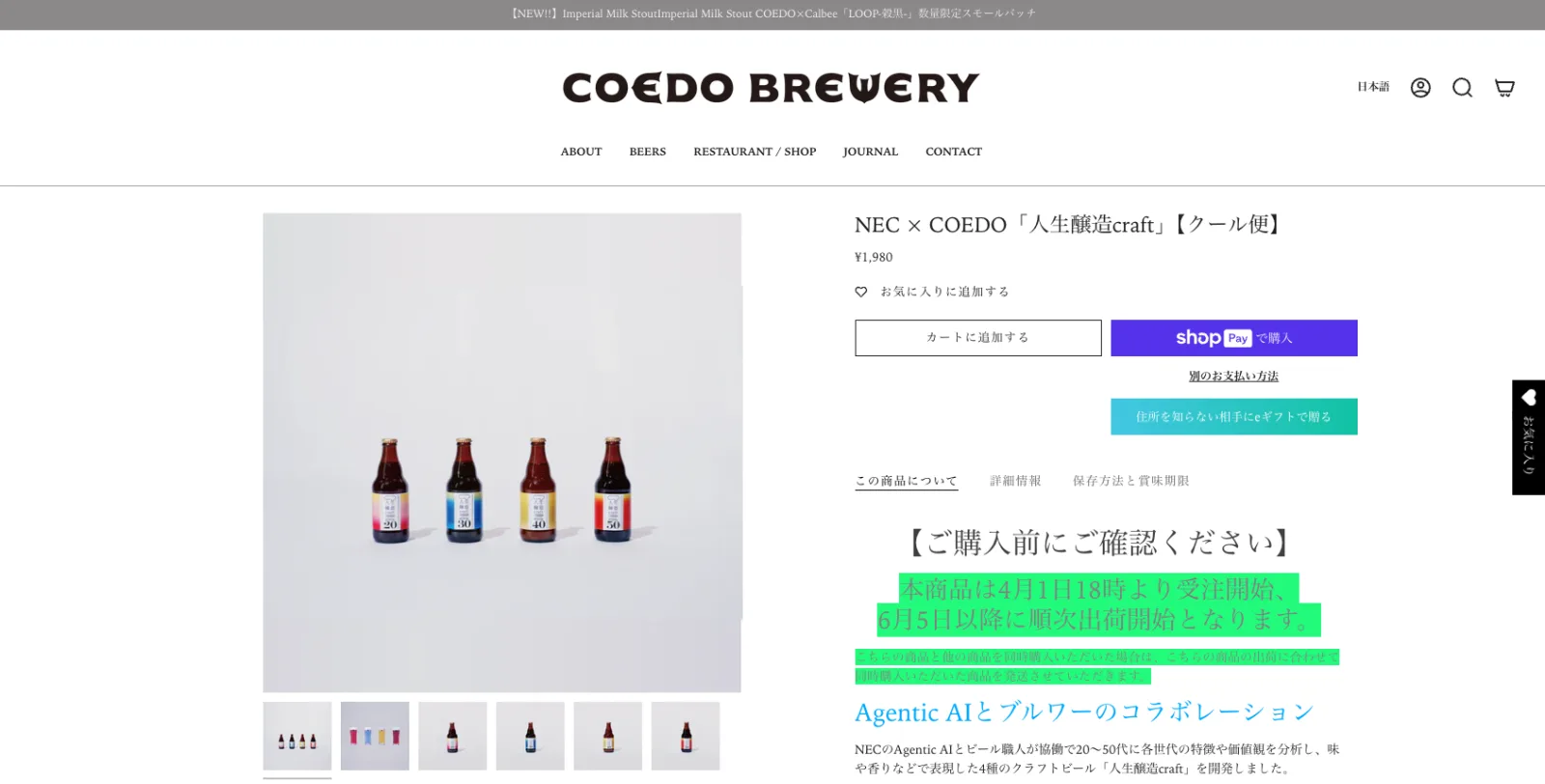
What stands out most in NEC’s agentic AI efforts is its stance on collaboration. Remarkable examples are emerging in which people and AI join hands to create new value together.
The second “Jinsei Jozo craft” AI craft beer: NEC developed the second edition of its AI craft beer “Jinsei Jozo craft,” created by agentic AI and brewers working together to express the traits of each generation through taste and aroma. This is not simply automatic generation by AI. In the development process, agentic AI using NEC’s generative AI “cotomi” first analyzed generations and created personas (profiles) of the target consumers. Next, it autonomously searched for recipe information matching those personas and proposed several optimal recipe ideas. Then, starting from these AI-proposed ideas, the final recipe was completed through dialogue with skilled brewers. AI suggesting beer recipes shows the surprising potential of AI in creative fields. This case clearly shows that AI can be a partner that dramatically enhances human creativity rather than taking it away.
By using cutting-edge technologies including agentic AI in this way, NEC aims to move beyond the role of a traditional system integrator (SIer) and evolve into a “Value Driver” that brings direct value to its customers’ businesses.
ValueLabs: Reinventing the Business Model Around “Outcomes” with Agentic AI Services
ValueLabs sets itself apart from earlier AI companies and is showing global leadership in agentic AI services. By making full use of AI, it is overturning traditional business models and focusing on delivering “guaranteed outcomes” to its customers. Its innovative approach could greatly change how business is done.
ValueLabs’ Strategy: Transforming Business into an “Outcome-Driven” Model with AI
What stands out about ValueLabs in agentic AI is its bold business model shift.
A shift from “Time & Materials” to “outcome-based”: Many IT service companies have used “Time & Materials” contracts, in which they are paid according to the time and resources they put in. ValueLabs announced a strategic shift to offering “only outcome-based contracts globally.” This move to an outcome-driven delivery model is nothing less than a sign of confidence that agentic AI produces concrete business results. Outcome-based AI services make the return on investment clear, which is a very welcome change for companies.
The Core of the Transformation: The In-House “AiDE®” Accelerates Work Like an “Iron Man Suit”
What supports ValueLabs’ innovative business model is its in-house Enterprise Operating System “AiDE®.” It is truly the heart of a system built for the “Agentic Era,” in which agentic AI is deeply integrated into every aspect of business.
Autonomous workflows enabled by AiDE®: AiDE® seamlessly integrates its own autonomous AI agents into workflows across the whole enterprise, from software engineering and business operations to data analysis and even strategic decision-making. It greatly raises productivity in each area, and by having AI autonomously handle much of the work people used to do by hand, it transforms the efficiency of the entire company.
Industry-Specific Solutions and an Impressive Record of Awards
Beyond its general-purpose agentic AI platform, ValueLabs also offers solutions tailored to the specific challenges of each industry.
Combining deep domain expertise with agentic AI: It offers “vertical AI solutions” that combine agentic AI capabilities with deep knowledge of specific industries. These turn complex, industry-specific processes into intelligent, autonomous workflows and drive remarkable gains in productivity for each business.
World-recognized leadership in AI agents: Its technology and innovation are already recognized around the world. At the 2025 Globee® Awards, it won eight gold awards and one bronze award in the AI categories, establishing a firm position as an agentic AI services company. In particular, its core system AiDE® won gold for “Best AI Platform,” proof of its technical edge.
ValueLabs’ efforts show that agentic AI is not just a tool for efficiency but can transform a company’s business model itself and create new value.
UiPath: Automating Business with “Agentic Automation,” the Next Generation of RPA
UiPath, which has led the world in RPA (robotic process automation), is also riding the agentic AI wave and blending the technology into its own strengths. It advocates “agentic automation,” a concept that goes beyond automation by robots alone: AI agents, robots and people work together to automate more complex and sophisticated business processes.
UiPath’s Vision: The Best Collaboration Between AI Agents, Robots and People
UiPath plans to start selling its latest “agentic automation” solution in Japan in the second quarter of 2025 (May to July). Its aim is a powerful system that plays to the strengths of each to supercharge business processes.
Strong collaboration between AI agents, robots and people: UiPath’s “agentic automation” combines the intelligence of AI agents, the precise execution of RPA robots, and human judgment and creativity, aiming to automate complex end-to-end business processes that used to be hard to automate. It is a groundbreaking advance, like a perfect team getting the work done. RPA and AI agents working together to automate complex work feels like exactly what we have been waiting for, and expectations are very high.
The UiPath Platform for Automating Complex Work
This groundbreaking solution runs on UiPath’s unified platform, designed for building agentic solutions. Its main components work together seamlessly on this single platform, so companies can adopt agentic AI with relative ease.
Agentic Orchestration: This feature coordinates AI agents, third-party agents (external AI services), RPA robots and even tasks done by people, like the conductor of an orchestra, and links them at the right time. This keeps complex workflows running smoothly from start to finish and greatly improves operational efficiency.
Building “your own agent” with Agent Builder: “Agent Builder” is a powerful tool that guides you through building, testing and launching data-driven AI agents. It lets companies easily create AI agents for their specific business needs, even without specialized knowledge. With Agent Builder, companies can hand complex workflow processing and autonomous decision-making to AI agents, and integrate them with a wide range of enterprise tools.
UiPath has also published a Japanese edition of “The Definitive Guide to Agentic Automation” to help companies adopt agentic automation smoothly, giving them thorough support so they do not miss this new wave of automation.
OPPO: An “Autonomous AI Experience” Spreading from Smartphones, with Privacy Protection

OPPO, which keeps bringing innovative technology to the smartphone industry, is also making notable moves in agentic AI. It is not just offering high-performance devices; it is envisioning how to improve the “autonomous AI experience” through the smartphones people use every day.
OPPO’s “Agentic AI Initiative”: Leading Innovation in the AI Experience
At the major stage of Google Cloud Next 2026, OPPO announced its “Agentic (autonomous) AI Initiative,” making a strong statement that it will lead innovation in the AI experience. This points to a groundbreaking evolution in which AI understands users’ behavior and situations more deeply and offers the best support before they even ask.
Delivering agentic AI features through a strategic collaboration with Google: To realize this initiative, OPPO is strengthening its strategic collaboration with Google. By making full use of Google’s powerful AI technology and cloud infrastructure, it aims to give smartphone users more advanced and autonomous AI features than ever. This collaboration will “super-accelerate” a future in which AI blends seamlessly into our daily lives.
Efforts to Protect User Privacy
Protecting user privacy is one of the most important challenges in AI’s evolution. OPPO pays close attention to this as well, building an environment where users can enjoy the benefits of AI with peace of mind.
Private Computing Cloud (PCC) using Google Cloud’s “Confidential Computing”: OPPO announced “Private Computing Cloud (PCC),” which uses Google Cloud’s advanced “Confidential Computing” technology. In this groundbreaking system, data stays encrypted while AI processes it, which reduces the risk of data leaks to an absolute minimum. It is a striking advance in that users can enjoy the convenience of AI while their privacy remains firmly protected. Smartphone privacy is a real concern for most of us, so being able to use these features with peace of mind is a welcome point.
“100 Million” Users to Experience the Potential of OPPO AI by the End of 2025
OPPO has set a clear user growth target in its AI strategy.
About 100 million users worldwide by the end of 2025: The company aims to make the potential of OPPO AI available to about 100 million users worldwide by the end of 2025. This shows that OPPO intends to bring agentic AI not just to a few early adopters but to many more people, so they can feel its benefits every day.
OPPO’s strategy of balancing privacy protection and convenience will surely be an important step that shows the direction for the smartphone industry and, by extension, the AI industry as a whole.
AironWorks: Opening Up the “Next Generation” of Cybersecurity with Agentic AI
In today’s business, cybersecurity is a top-priority issue that no one can avoid. Against sophisticated cyberattacks that evolve every day, conventional defenses alone are becoming insufficient. AironWorks is supercharging the concept of cybersecurity with the power of agentic AI. It uses AI that functions autonomously to achieve a groundbreaking evolution in protecting companies from threats.
AironWorks’ Agentic AI: Staying “One Step Ahead” of Advanced Threats with Autonomous AI
AironWorks offers a next-generation cybersecurity platform built around agentic AI. The platform’s greatest strength is its autonomy.
Rapid threat response with autonomous AI: Conventional security systems were passive, reacting to “defined threats.” AironWorks’ agentic AI, by contrast, assesses the situation on its own and responds quickly and proactively to increasingly sophisticated cyber threats. It is like having an incredibly smart security expert who works 24 hours a day, 365 days a year, always on watch. With cyberattacks becoming more sophisticated, nothing could be more reassuring than AI that defends you by thinking ahead from a hacker’s perspective.
Focused on attacks that target “human vulnerabilities”: Attacks that target employees’ human vulnerabilities, such as spear phishing and business email compromise (BEC), are on the rise and keep getting more sophisticated. AironWorks offers specialized countermeasures against exactly these threats that exploit human weaknesses. AI developed with a hacker’s perspective predicts and defends against these attacks, which is expected to raise companies’ security levels.
An Integrated Platform That Is Exceptionally Easy to Use
By integrating multiple security measures into a single system, the AironWorks platform greatly reduces the effort companies spend managing cybersecurity.
Practical training and simulation features: It includes training and simulation features to raise employees’ cyber literacy. Through drills that mimic real attacks, each employee becomes more aware of cyber risks, minimizing the risk of human error.
Strong defenses powered by an AI Agent: An AI Agent built into the system provides a variety of functions, such as email protection and threat intelligence (gathering and analyzing information about threats). This lets companies always base their defenses on the latest threat information and build a rock-solid security posture.
AironWorks’ agentic AI cybersecurity platform will be an indispensable “cornerstone of defense” for today’s businesses.
Nayutam: Revolutionizing “Biometric Authentication” with Agentic AI, Balancing Ultimate Security and Convenience
As digital society accelerates, security is always a key element that underpins our lives and businesses. In a future where AI agents act on our behalf, authentication technology that prevents “impersonation” becomes more important than ever. Nayutam, a Japanese startup, is supercharging the concept of biometric authentication with the power of agentic AI. The autonomous biometric authentication it announced is a groundbreaking evolution and a remarkable attempt to achieve both security and convenience.
The Impact of Nayutam’s “Autonomous Biometric Authentication”: A Future Where AI Identifies You
Nayutam’s “Agentic Biometric Authentication-as-a-Service” overturns conventional thinking about biometric authentication. As the name suggests, it is a groundbreaking system in which AI agents perform biometric authentication autonomously.
AI agents generate unique identifiers and authenticate autonomously: At the core of this technology, an AI agent generates a unique “identifier” for each person from their biometric data (for example, palm vein patterns and, in the future, DNA data). Even more remarkable, this AI agent can perform biometric authentication autonomously even when the user is not present. It aims to fundamentally solve the security problems that AI agents face.
Higher security through “palm authentication” and “DNA-based identifier generation”: For now, it achieves extremely secure authentication by combining palm authentication technology with DNA-based identifier generation technology that looks further ahead. Identifiers generated from biometric information are very hard to copy or steal, so the security is expected to go beyond conventional passwords and multi-factor authentication.
Ease of Use and a Wide Range of Uses for Personal AI Agents
Nayutam’s autonomous biometric authentication is not just about raising security; it also aims to make personal AI agents more convenient.
Autonomous authentication tailored to each situation: Authentication can adapt to the situation, for example an AI agent authenticating you from a voice command alone and then accessing specific data. This enables seamless operation without extra effort.
Fine-grained permission management: You can strictly manage which information an AI agent can access and which operations it is allowed to perform. This keeps things secure while letting AI agents use their full capabilities.
Situational awareness, predictive judgment and flexible integration by AI: The AI agent can recognize how it is being used and predict and decide on the next action needed. And because it can connect flexibly with many systems and devices, it will be a partner that supercharges your entire digital life. A future where AI identifies you and authenticates you automatically, combining security and convenience, is very appealing.
Nayutam’s “Agentic Biometric Authentication-as-a-Service” is a breakthrough technology that solves two major challenges, security and convenience, for the coming era of personal AI agents.
Flytxt: A Pioneer Taking Subscription Businesses to a New Stage with Agentic AI
Subscription businesses hold a very important place in today’s economy, but preventing customer churn and building long-term relationships is not easy. Flytxt is using the power of agentic AI to bring innovative change to this field. As a pioneer of agentic AI solutions for subscription businesses, it is breaking new ground at the forefront.
Flytxt’s agentic AI solution deeply analyzes customer behavior patterns and autonomously offers each customer the best information and services at the best time, greatly increasing customer engagement. For example, AI can proactively offer personalized retention measures to customers showing signs of churn, or encourage upselling and cross-selling to new services. This not only raises customer satisfaction but can also greatly improve a company’s profitability, thanks to its intuitive operation. AI that prevents customer churn must be an irresistible feature for anyone running a subscription business.
Infobip: Breathing Agentic AI into Global Communication
Infobip, which provides a cloud communications platform used around the world, is also paying close attention to the potential of agentic AI. By deeply integrating the power of AI agents into customer communication, it aims to bring a striking evolution to the conventional messaging experience.
Redefining the “fan experience” in the world of F1: One concrete example is its partnership with the MoneyGram Haas F1 Team. By combining agentic AI capabilities with messaging platforms such as RCS and WhatsApp, Infobip is dramatically transforming the digital experience of F1 fans. For example, fans can receive the latest race news, behind-the-scenes stories about drivers and exclusive content in real time through AI agents, which greatly boosts fan engagement with unprecedented immersion and excellent usability.
AI use expanding from automotive to many industries: Infobip also uses AI in the automotive field to dramatically evolve the customer experience. From buying a car to maintenance and even support while driving, AI provides personalized communication tailored to each customer. It has also announced strategic go-to-market partnerships to expand the use of agentic AI across a wide range of industries, including telecommunications, banking, financial services and insurance (BFSI), retail, government, hospitality and healthcare. This is expected to let its agentic AI technology open groundbreaking paths in many business settings.
Reliability backed by more than 10 years of R&D and a proprietary learning engine: Infobip’s agentic AI is built on more than 10 years of research and development (R&D). It maintains stable performance in diverse environments and is trained at scale on real-world data. Particularly notable is that its core is a proprietary “Federated Learning Engine.” This lets the AI keep learning and developing its capabilities while firmly protecting user privacy and corporate compliance. It is truly an innovative development that balances security and convenience.
Infobip’s work shows how agentic AI can transform customer communication and become a force that quickly accelerates business growth.
Cognizant: “Modernizing” Every Company’s Business with Agentic AI
Cognizant, a major global IT services and consulting company, also aims to use agentic AI to fundamentally transform how companies do business. It is making a scalable agentic AI network available to every company, unlocking the full capabilities of AI agents to help with “modernizing technology,” “reengineering processes” and “transforming experiences.”
Solving business problems with a “scalable agent network”: Cognizant offers a “scalable agent network” that flexibly combines the best AI agents for the many business problems companies face. Rather than a single AI, multiple smart AI agents work together to process complex corporate workflows autonomously, streamlining many tasks people used to do and greatly raising productivity.
Support from technology modernization to experience transformation: Its agentic AI solutions go beyond simple efficiency gains. For example, it helps with “technology modernization,” replacing outdated IT systems with the latest technology, and uses AI to “reengineer” inefficient business processes, raising the competitiveness of the whole company. It also focuses on “transforming” the experience of customers and employees itself. AI agents provide personalized services for each customer and reduce employees’ workloads so they can focus on more creative work, which leads to a marked rise in satisfaction across the company.
Cognizant’s agentic AI efforts will be a powerful weapon for companies to win in the digital age.
SS&C: Strengthening “Regulatory Compliance” and “Data Protection” in Finance and Healthcare with Agentic AI
How can agentic AI show its strength in industries such as financial services and healthcare, which demand especially strict regulation and high security? SS&C, which has a distinctive presence in this field, is using advanced agentic AI technology to solve the complex problems these industries face. Its goal is to streamline compliance (adherence to laws and regulations) and governance (corporate oversight) and to dramatically improve data security. This is truly an innovative step in how companies are run.
Key Points of Agentic AI Implementation According to SS&C
SS&C does not just provide AI; based on a global survey, it recommends the key elements needed to make AI adoption succeed.
Three pillars for successful AI implementation:
-
Strategic planning: Clarify the purpose and draw a roadmap with a long-term view.
-
Governance: Establish clear rules and lines of responsibility for using AI.
-
Process orchestration: Make sure AI fits smoothly into existing business processes and works in harmony as a whole.
SS&C believes that when these elements are in place, AI becomes not just a tool but a powerful engine that drives business transformation.
Based on this thinking, SS&C’s enterprise AI solutions aim to streamline compliance and governance across all communication channels. In particular, differentiated supervision features powered by generative AI and agentic AI help companies achieve two goals that are often hard to reconcile: stronger regulatory compliance and sustained cost efficiency. AI that delivers both data protection and efficiency under the strict regulations of finance and healthcare is a real lifesaver.
Next-Generation Data Security Powered by Agentic AI: Freedom from Manual Work
Today, data is a company’s most important asset, and protecting it is a matter of survival. SS&C has started offering an integrated data security solution that uses agentic AI, taking a groundbreaking approach that eliminates manual work and delivers scalable data security.
AI agents as a “force multiplier” for data protection: The AI agents SS&C provides work like a “force multiplier” for companies.
-
Automatic data classification: They automatically classify large amounts of data, judge how sensitive and important it is, and apply the right protection.
-
Learning how the organization protects data: The AI agents learn from the company’s own data protection policies and past threat cases, and always propose and apply the best defenses. This continuously strengthens the security posture.
With these features, much of the work security staff used to do by hand is automated, and efficiency rises greatly.
Proactive defense with real-time AI: The solution includes AI that works in real time.
-
Real-time data classification with pretrained LLM classifiers: Using the advanced classification ability of large language models (LLMs), it identifies the content of data the moment it is created or moved and applies the right security policy.
-
Autonomous AI self-learning: The AI agents adapt autonomously to new threat patterns and changes in the environment and keep learning, always maintaining an up-to-date security posture. In an age of increasingly sophisticated cyberattacks, this is a very reassuring feature.
-
Automatically adaptive DSPM controls (one-click remediation): In data security posture management (DSPM), when AI detects a risk, it provides automatically adaptive controls that let you fix it with one click. This dramatically speeds up the response to security incidents and keeps damage to the company to a minimum.
SS&C’s efforts show how agentic AI can raise security and compliance to new heights in fields such as finance and healthcare, which demand deep expertise and strict regulation, and make business safer and more efficient.
HONOR: Smartphones Evolve into “Smart Partners,” Enriching Life with Agentic AI

Smartphones are essential tools in our lives, and HONOR, a global AI device ecosystem company, aims to take them to the next stage with the power of agentic AI. Its focus is closely connecting the AI ecosystem with users through devices and fundamentally reinventing the interaction between people and devices. This is a striking advance that shows how much AI can enrich everyday life.
HONOR’s Vision for Agentic AI: Combining AI Cameras and Smart Features
HONOR is redefining what devices should be in the agentic AI era and bringing one product after another to market that dramatically improves the user experience.
The amazing evolution of the AI camera: the HONOR 400 series The “HONOR 400 series,” equipped with AI camera features, may overturn conventional thinking about taking and editing photos on a smartphone.
-
AI editing: AI automatically analyzes photos and videos after you shoot them and suggests the best corrections and edits. It is like having a professional editor right next to you, letting you create high-quality content with no effort.
-
AI-enhanced portraits: AI recognizes the subject and the background and makes portrait photos more attractive. It brings out facial expressions and skin texture in fine detail, helping create striking shots.
-
AI Super Zoom using AIGC: AI-based generative technology (AIGC) greatly reduces the loss of image quality during digital zoom, making it possible to capture distant subjects clearly. This significantly improves smartphone camera performance.
These AI features let users easily create excellent photos and videos without special knowledge, and their convenience is eye-opening. A smartphone AI that helps this smartly with photos and writing could speed up our everyday creativity.
Smart experiences delivered by MagicOS 9.0 HONOR’s own operating system, “MagicOS 9.0,” deeply integrates AI to offer a range of smart features that make daily tasks more efficient and comfortable.
-
AI Translation: It supports real-time voice and text translation, lowering language barriers.
-
AI Recorder: It not only records the audio of meetings and lectures but also has AI automatically create summaries and transcribe them with speaker identification.
-
AI Summary: AI automatically summarizes long texts and web pages so you can grasp the key information quickly.
-
AI Writing Tools: AI supports a wide range of writing tasks, such as drafting emails and polishing text, so you can write better text more efficiently.
These features will fundamentally change how we process information and communicate and will dramatically boost our daily productivity. Many people will likely want to try their excellent ease of use for themselves. HONOR’s agentic AI efforts suggest a future in which the smartphone evolves from a mere communication device into a personal AI partner that stays close to us and supports us intelligently.
Kirin Holdings: Making Internal Work “Autonomous” with Agentic AI and Creating the Future of Work
Did you know that Kirin Holdings, famous for beer and beverages, is putting serious effort into transforming its internal operations with cutting-edge agentic AI technology? It is not just introducing AI tools; it aims to fundamentally change how each employee works and build the business model of the future. Let’s take a closer look at how a major Japanese company is using agentic AI and expanding its possibilities.
Evolving into Employees’ “Smart Partner”: The Large-Scale Rollout of the Generative AI Tool “BuddyAI”
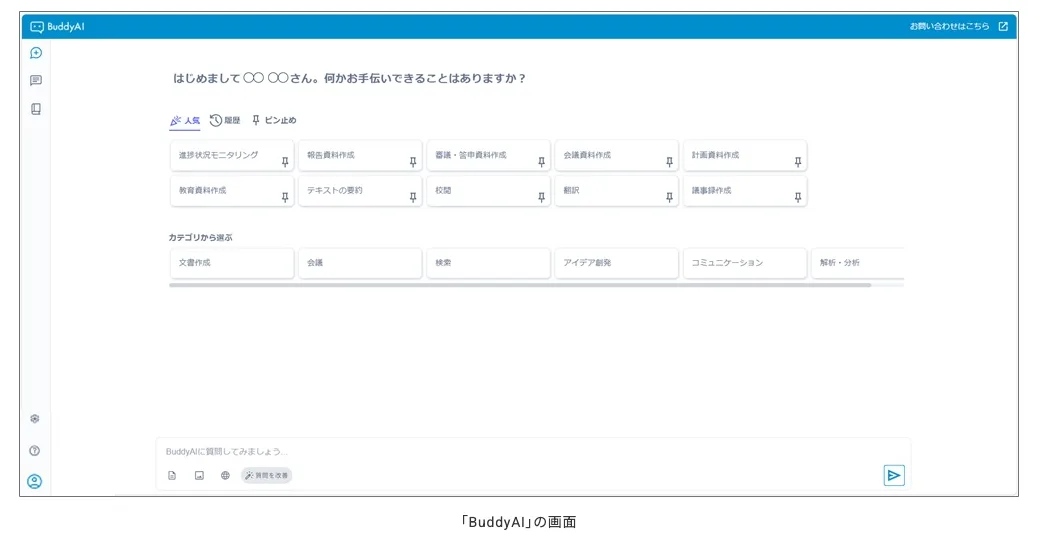
Kirin Holdings has already expanded its generative AI tool “BuddyAI” to about 15,000 employees in Japan. This is an important step toward employees using AI as a matter of course in their daily work and raising productivity.
“BuddyAI” supports daily work: “BuddyAI” acts as employees’ “smart partner” in a wide range of tasks, such as helping create documents, making information searches more efficient and generating ideas. This lightens the burden of routine work and creates an environment where employees can focus on more creative, high-value work.
Kirin Looks Ahead: Making Business Processes “Autonomous” with Agentic AI
Kirin Holdings aims to go beyond using generative AI toward agentic AI. It envisions a system in which AI autonomously breaks down tasks, carries them out and even writes the final report.
Autonomous task execution and reporting: For example, AI would not only write meeting minutes but also automatically draft the next action plan from the discussion, then autonomously collect and analyze the related data and even report the results. Conventional AI acts on a single instruction; here, AI understands the goal like a human and thinks through and carries out a whole series of steps by itself. This is a truly innovative advance.
Tailored to Each Department: The “BuddyAI for X” Concept Accelerates “Individual Optimization” of the Business
Another important pillar of Kirin Holdings’ agentic AI strategy is specialization for each department, based on its “Select & Fit” concept. The plan is to customize AI features for the needs of specific departments and roll them out as “BuddyAI for X.”
Optimizing AI for each department’s needs:
-
For marketing: AI strongly supports everything from planning to executing marketing strategy, including market trend analysis, identifying consumer insights and automatically generating ad content.
-
For sales: It improves the efficiency and quality of sales activities through personalized proposals based on customer data analysis, automated preparation for sales meetings and help with writing sales reports.
-
For R&D: It raises the speed and accuracy of R&D by making literature research more efficient, analyzing experimental data and helping generate new product ideas.
By deeply embedding AI into each department’s specialized work in this way, each department’s productivity is expected to rise significantly and deliver better results than ever. These efforts by Kirin Holdings show that agentic AI is not just a technology trend but a powerful driving force that transforms corporate culture and ways of working and enables sustainable growth.
Proofpoint: Strengthening the “Security” of Digital Communication with Agentic AI
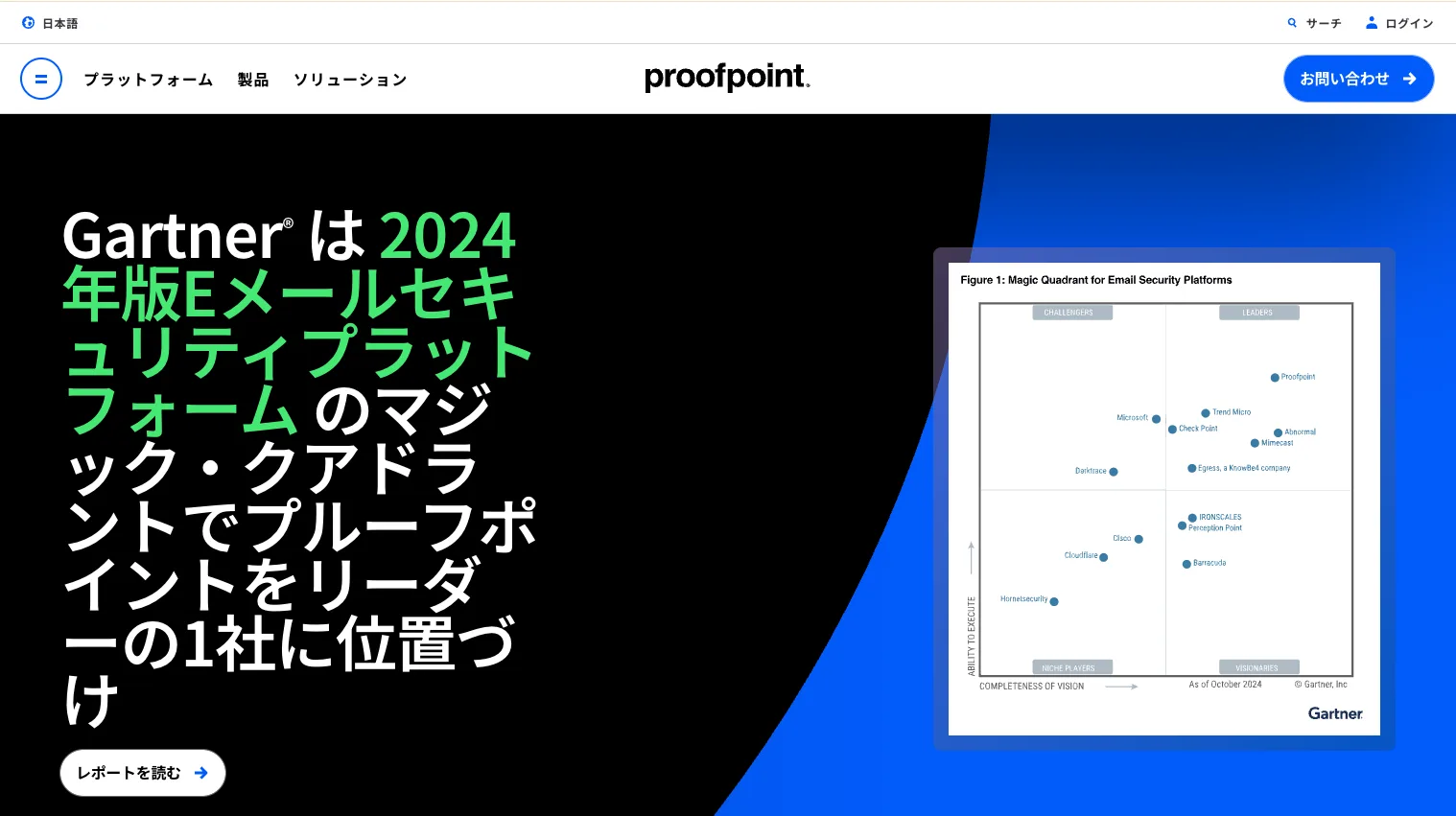
In today’s business, digital communication such as email and chat is essential, but it also carries risks of data leaks and compliance violations. Proofpoint, a leading cybersecurity company, is offering new solutions to this complex problem with the power of agentic AI. It is using AI to raise the “security” of digital communication to the next level.
As its name suggests, Proofpoint’s “AI-enhanced next-generation Digital Communications Governance (DCG) solution” has AI deeply understand the content of communications and autonomously detect and manage risks, significantly improving companies’ compliance. Rather than simple keyword detection, AI judges context and identifies potential risks and inappropriate content, so companies can build a more robust security environment. This solution streamlines the response to complex regulatory requirements and is a notable evolution that greatly advances companies’ digital risk management.
o9 Solutions: A “Decision-Making Revolution” for the Supply Chain with Agentic AI
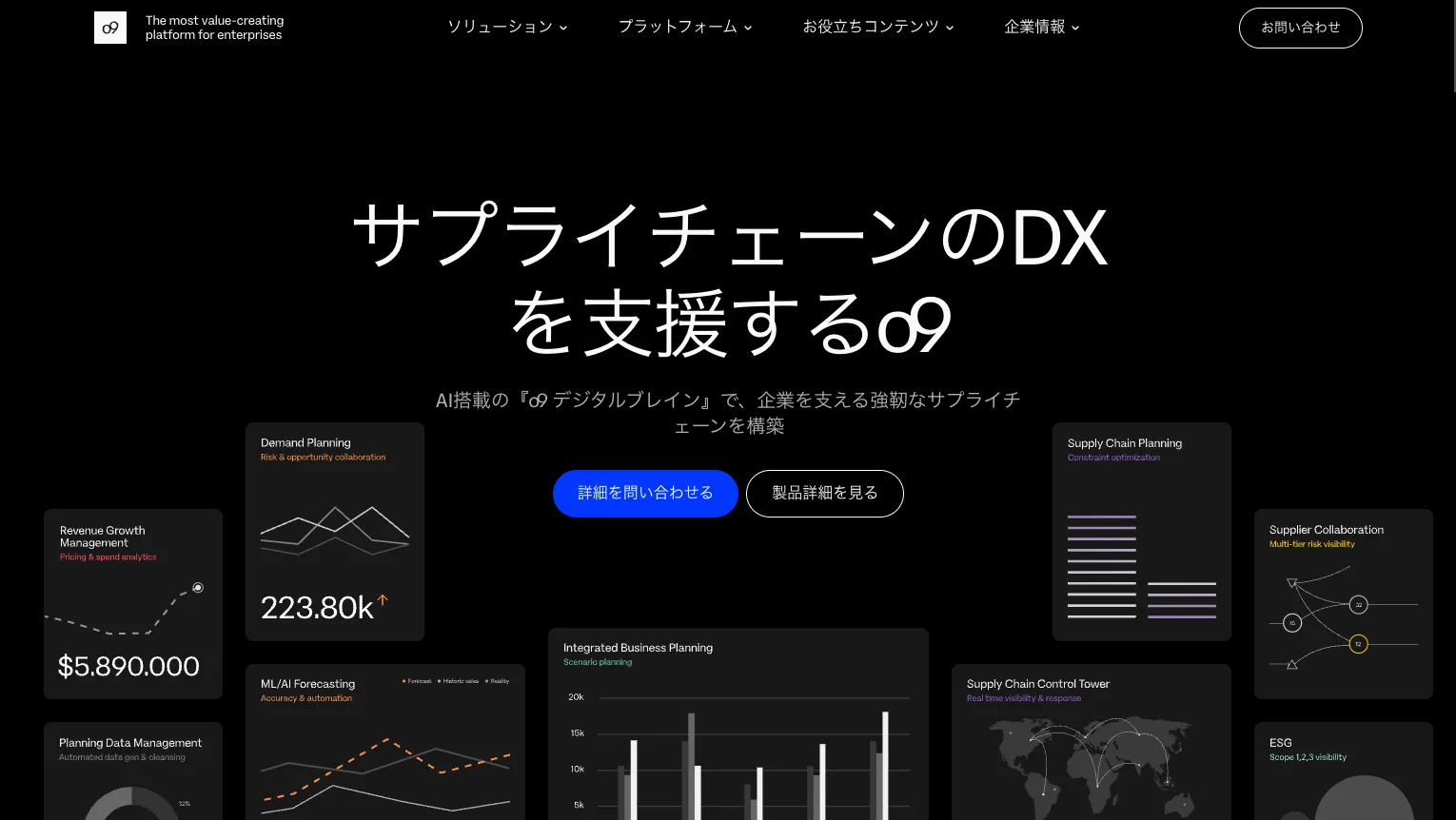
In corporate management, optimizing the supply chain is a key factor that determines productivity and profit. o9 Solutions aims to fundamentally transform this extremely complex planning and decision-making process with the power of agentic AI. Its AI-powered supply chain planning platform, the “o9 Digital Brain,” is a groundbreaking solution that offers a glimpse of the future of supply chain management.
The Power of Agentic AI Delivered by the “o9 Digital Brain”
By integrating generative AI and agentic AI capabilities into its powerful platform, o9 Solutions is bringing innovation to company-wide planning and decision-making.
Transforming company-wide planning and decision-making: The platform works like the company’s “smart brain,” integrating and analyzing all supply chain data. Information from departments that used to be siloed becomes connected, enabling consistent planning and decision-making from management to the front line. This efficiency will greatly raise the productivity of the whole company.
An LLM-based knowledge assistant supports “knowledge exploration”: The “o9 Digital Brain” includes a knowledge assistant built on a large language model (LLM). Users simply ask questions in natural language to quickly retrieve the information they need from huge amounts of data or get complex analysis results explained clearly. It is an easy-to-use feature that significantly raises the speed and quality of data use.
Composite AI agents carry out cross-department tasks autonomously: Even more notable is its use of “composite AI agents” that can carry out complex cross-department tasks autonomously. For example, when a demand forecast changes, AI agents can automatically work with the production planning, inventory management and logistics departments to make the best adjustments. This dramatically streamlines the coordination and information sharing between departments that used to take people a lot of effort, enabling fast decisions and action. For business leaders, AI that makes complex supply chain decisions this smooth is a very intriguing point.
Already in pilot use at several companies: This agentic AI technology is already being piloted at several customer companies. This suggests that its effectiveness is being proven in real business settings, not just in theory, and that it is starting to produce solid results. Many companies that see these effects will likely want to consider adopting it.
o9 Solutions’ efforts show how agentic AI can transform supply chain management, one of a company’s most complex operations, and bring new efficiency and competitive advantage. Its platform will be an excellent solution that takes business planning and decision-making to the next level.
PROMISE Technology: High-Performance Storage Solutions That Support the “Foundation” of Agentic AI

For AI, and especially autonomous agentic AI, to show its true value, it needs “powerful infrastructure” that can process huge amounts of data at high speed. PROMISE Technology, with a long track record in data storage, offers innovative storage solutions to meet the needs of the AI era. It is building the “groundwork” that maximizes the performance of AI workloads and lets agentic AI run smoothly.
The Innovation of the “BoosTrak AI Storage and Servers” Unveiled at COMPUTEX 2025
At COMPUTEX 2025, a global technology trade show, PROMISE Technology unveiled “BoosTrak AI storage and servers,” focused on data storage for the AI era. They aim to remove data processing bottlenecks and unlock the full capabilities of AI in the coming agentic AI era.
Optimizing AI workflows with its own “AIBoost technology”: At the core of the BoosTrak product family is PROMISE Technology’s own “AIBoost technology.” It uses machine learning and predictive intelligence (technology that anticipates and optimizes) to significantly improve the performance of entire AI workflows. When AI can read and write data efficiently, training and inference for complex AI models become much faster, greatly increasing their practical value.
The “BoosTrak” Product Line That Brings Out the Performance of Agentic AI
PROMISE Technology offers a specific product lineup optimized for the characteristics of agentic AI.
BoosTrak HBA: maximizing the performance of NVMe drives The “BoosTrak HBA (Host Bus Adapter)” is designed to get the most out of ultra-fast NVMe (Non-Volatile Memory Express) drives for AI workloads. This keeps latency extremely low when AI accesses large amounts of data and dramatically increases AI processing speed.
BoosTrak Tower: an ideal storage appliance for agentic AI The “BoosTrak Tower” is an AI storage appliance described as ideal for running agentic AI. Because agentic AI makes decisions autonomously and carries out tasks continuously, it needs low-latency, high-throughput (able to process large amounts of data at once) access to data. By meeting these requirements, BoosTrak Tower lets AI agents run smoothly without interruption. With this high-performance storage solution, agentic AI can think and act almost without limits, and its practical value will be remarkable.
PROMISE Technology’s efforts once again show the importance of the “data foundation” that is essential for AI to evolve.
Neuchips: An AI Chip Company Opening New Horizons for Agentic AI Through Power Efficiency
For AI, and especially autonomous agentic AI, to take root deeply in society, “efficiency” matters as much as “intelligence.” The lower the power consumption, the more AI can run sustainably in more places. Neuchips, an AI chip developer, is at the forefront of these power-efficient AI solutions. On the big stage of COMPUTEX 2025, it stepped up these efforts and showcased technology that accelerates the future of agentic AI.
The Wonder of the “Viper Series AI Accelerator Cards” Unveiled at COMPUTEX 2025
Neuchips unveiled its “Viper series AI accelerator cards,” which dramatically raise the efficiency of AI processing, and their performance drew a lot of attention.
Running a 14-billion-parameter model on just 45W: The most remarkable thing about this card is that it can run a large AI model with 14 billion parameters on very low power consumption of just 45W. This is far less than the power that typical high-performance graphics cards consume, and it dramatically improves power efficiency in AI processing. Being able to run such complex AI on so little power is a truly innovative breakthrough for the spread and practical use of AI.
Neuchips’ Demonstrations That Shape the Future of Autonomous AI
Building on its high-performance, power-efficient AI accelerators, Neuchips demonstrated a variety of agentic AI applications. These give a concrete picture of how autonomous AI will change our lives and businesses.
NL2SQL Agentic AI: making data analysis “autonomous” with natural language “NL2SQL Agentic AI” is agentic AI that autonomously extracts the needed information from a database and generates analysis results when people simply ask questions in natural language (such as Japanese). This lets businesspeople without programming knowledge easily perform complex data analysis. It is a very easy-to-use feature that significantly lowers the barrier to using data and raises the speed and quality of decision-making.
Meeting analysis and customer service systems using multi-agent technology: AI that works smartly as a team There were also demos of meeting analysis and customer service systems using “multi-agent technology,” in which multiple AI agents work together.
-
Meeting analysis: AI agents recognize the audio of a meeting and autonomously extract key points, assign tasks and create minutes, dramatically streamlining follow-up after meetings.
-
Customer service: Multiple AI agents work together to deeply understand customer inquiries, propose the best solutions and hand off seamlessly to a person when needed, greatly improving customer satisfaction. These systems show striking progress, with AI working together autonomously to solve complex tasks.
A GenAI application platform for autonomous LLMs: anyone can develop AI apps A GenAI application platform that supports autonomous LLMs (large language models) was also demonstrated. It provides an environment where companies and developers can easily build and deploy complex agentic AI applications. Because even non-AI specialists can build the potential of agentic AI into their business, its practical use will speed up greatly. Many developers are expected to use this platform to create innovative applications. Such smart AI running on so little power makes a future where AI blends into every part of our lives feel real, and that is exciting.
Neuchips’ efforts point to a future in which AI becomes more accessible and more efficient. Its power-efficient AI chips and agentic AI applications will undoubtedly play a central role in the coming era of autonomous AI.
LambdaTest: Making Software Testing “Autonomous” with Agentic AI and Speeding Up Development
In software development, the testing needed to ensure quality often becomes a bottleneck. LambdaTest, which provides a cloud-based testing platform, aims to fundamentally transform this complex, time-consuming process with the power of agentic AI. It offers a truly innovative solution in which AI runs and manages tests autonomously, delivering both development speed and quality.
The Power of LambdaTest’s “Unified Agentic AI and Cloud Engineering Platform”
LambdaTest is opening up the future of test automation through a platform that unifies agentic AI and cloud engineering.
Automating test orchestration with “HyperExecute MCP Server”: LambdaTest’s “HyperExecute MCP Server” is an AI-native test orchestration platform that automates setting up and running test environments and significantly shortens testing time. Development teams can get feedback faster without being bogged down in preparing and running tests, and focus on improving their products. This is a striking advance that dramatically speeds up the development cycle.
A World First: The Impact of “KaneAI,” a GenAI-Native Testing Agent
At the core of LambdaTest’s agentic AI strategy is “KaneAI,” which it calls “the world’s first GenAI-native testing agent.”
LLM-powered test creation and autonomous execution: KaneAI uses the advanced understanding and generation capabilities of large language models (LLMs) to test in ways that overturn conventional thinking.
-
Autonomous test case generation: Even if developers do not write detailed test scenarios, AI understands the application’s behavior and requirements and autonomously creates the right test cases. This greatly reduces the time and effort spent on test design.
-
Autonomous test execution and result analysis: KaneAI autonomously runs the test cases it created and analyzes the results. Because AI handles everything up to identifying bugs and finding the root cause of problems, it minimizes human intervention and makes the entire quality assurance process more efficient and reliable. It is as if AI were acting as a testing expert, thinking and acting on its own. AI that handles everything from creating test cases to running them is very appealing for developers and QA engineers.
LambdaTest’s efforts show that agentic AI is a powerful tool that improves two key aspects of software development at once: quality and speed. Its solutions will be indispensable for agile development and DevOps.
Side Note: What Is COMPUTEX 2025? What Happens at This Festival of Agentic AI?
So far, we have looked at how major companies are approaching agentic AI. Many of these innovative technologies and products were in fact announced and exhibited at an international event called “COMPUTEX 2025.” What kind of event is COMPUTEX, and why is it so important for agentic AI?
“COMPUTEX 2025”: The Frontline of AI Technology That the World Is Watching
COMPUTEX is one of the world’s leading IT and technology trade shows, held every year in Taipei, Taiwan. In 2025, it was held from May 20 to 23 in Hall 1 of the Taipei Nangang Exhibition Center.
What this year’s theme, “AI Next,” means: This year’s COMPUTEX theme was, simply, “AI Next.” As the theme suggests, the event focused strongly on the “next stage” of AI technology. In particular, there were many exhibits of the hardware, software and wide-ranging solutions that support “autonomous agentic AI,” a further evolution of generative AI. This shows that a future in which AI does not just generate content on instruction but thinks and acts on its own to handle more complex tasks is no longer science fiction but is becoming reality. It is fair to say that companies competed here on technology to pursue the potential of agentic AI and speed up its practical use.
COMPUTEX 2025 was truly the best stage to experience the evolution of agentic AI firsthand and to predict its future. We need to keep watching how the announcements made here will affect the AI industry and our businesses and lives.
Side Note: Japan’s Large-Scale Investment in AI Foundation Technology to Lead Future AI Development
So far, we have looked at how the world’s major companies are approaching agentic AI development. But to unlock AI’s true power and expand its potential to the fullest, investment in the foundation technology that serves as its “groundwork” is essential. Japan, too, is keenly aware of the importance of this AI foundation and has launched a national effort to strengthen it.
The Next-Generation Supercomputer “FugakuNEXT”: Accelerating “Leaps Forward” in AI Research
One of the most notable efforts to strengthen Japan’s AI foundation is RIKEN’s project for the next-generation supercomputer “FugakuNEXT.” Targeted to start operating around 2030, the system could take Japanese AI research to the next level.
Opening a new era of science with “AI for Science”: “FugakuNEXT” is built around the concept of “AI for Science” and has been designed from the start with AI use in scientific research in mind. This merges conventional simulation technology with AI and can dramatically speed up processing for many scientific applications. For example, it will contribute greatly to solving complex challenges facing humanity, such as shortening new drug development and improving the accuracy of climate change predictions. This is truly a remarkable development in science.
Enabling pretraining of large language models with trillions of parameters: “FugakuNEXT” is also expected to make it possible to pretrain large language models (LLMs) on an enormous scale of trillions of parameters. This means Japan will have an environment to develop and research large AI models like ChatGPT independently and efficiently within the country. With such a high-performance computing foundation, Japan can further accelerate the evolution of next-generation AI, including agentic AI, and Japanese AI research has the potential to lead the world. Hearing that Japan’s supercomputers will drive AI research raises high hopes for the future of homegrown AI.
A National Strategy to Ensure the Safety and Reliability of AI
Japan’s investment in AI foundation technology is driven not only by the goal of raising technical capability but also by a clear vision for AI to be accepted by society and used sustainably.
Aiming for AI use that follows international standards: Japan’s goal is for the AI products and services it develops to have a way to objectively demonstrate their safety and reliability. It aims to build a society that can use AI in line with international standards. This is a strategic national effort to create an environment where AI can be used with confidence, taking into account the ethical aspects of AI and its impact on society.
Contributing to solving social problems and developing industry: Strengthening this foundation aims to use AI technology to help solve social problems such as the declining birthrate, the aging population and environmental issues, and to encourage the creation of new industries and the growth of existing ones. By building a solid foundation so that AI can play a role in every part of society, Japan aims to strongly support its own future.
There is no doubt that Japan’s large-scale investment in AI foundation technology is an important strategic approach to raising the nation’s competitiveness in the agentic AI era and making our lives and businesses richer and safer.
Key Points of Agentic AI Trends
- AI evolves to the next stage, “AI that thinks and acts on its own”: Going beyond generation, autonomous AI that understands goals on its own and plans, acts and learns is becoming mainstream.
- Big companies lead the development race and drive broad adoption: Microsoft, Google, OpenAI and others are integrating agentic AI into existing services and platforms and transforming how business is done.
- The rise of startups solving problems in specific industries and niches: Innovative agentic AI solutions keep emerging in highly specialized fields such as healthcare, cybersecurity, biometric authentication and drug discovery, creating breakthroughs.
- Foundation technology (infrastructure, AI chips) strongly supports progress: Development of the hardware and software foundation agentic AI needs to show its true value, such as high-volume data processing and power-efficient AI chips, is accelerating.
- Safety, security and ethics are the key to deployment in society: Building frameworks so that AI can be used widely and with confidence, including privacy protection, management of sensitive data and compliance with international guidelines, is seen as essential.
A Deep Dive into AI Agent Use Cases and the Latest Trends by Industry
So far, we have seen how hard the world’s major companies are working on agentic AI development and how its foundation technology is evolving. So how is the power of this groundbreaking autonomous AI being used in the real world, especially in various industries, and what changes is it bringing? From here, let’s take a detailed look at specific industries that AI agents are already affecting, or will greatly affect, and the latest trends in each.
Healthcare: Toward a Future Where AI Agents Support “Life”
Healthcare, which deals with human life and health, is one of the fields where AI is most anticipated. Using their ability to plan and act autonomously, AI agents are starting to bring striking progress to medical settings.
A Wide Range of Roles
Diagnostic support: Analyzing complex image data and patient information to assist doctors’ diagnoses.
Treatment planning: Proposing the best treatment for each patient.
Streamlining daily work: Automating medical staff’s administrative work and reducing their burden.
Better patient communication: Providing information and support tailored to each patient’s condition.
Accelerating drug discovery: Finding new drug candidates and shortening development time.
As this shows, AI agents are being used across a very wide range of medical settings. This is a truly innovative step with the potential to dramatically improve the quality of care and save more lives. Let’s look at the remarkable ways AI agents function as “smart partners” in medical settings and support our health.
Tsinghua University
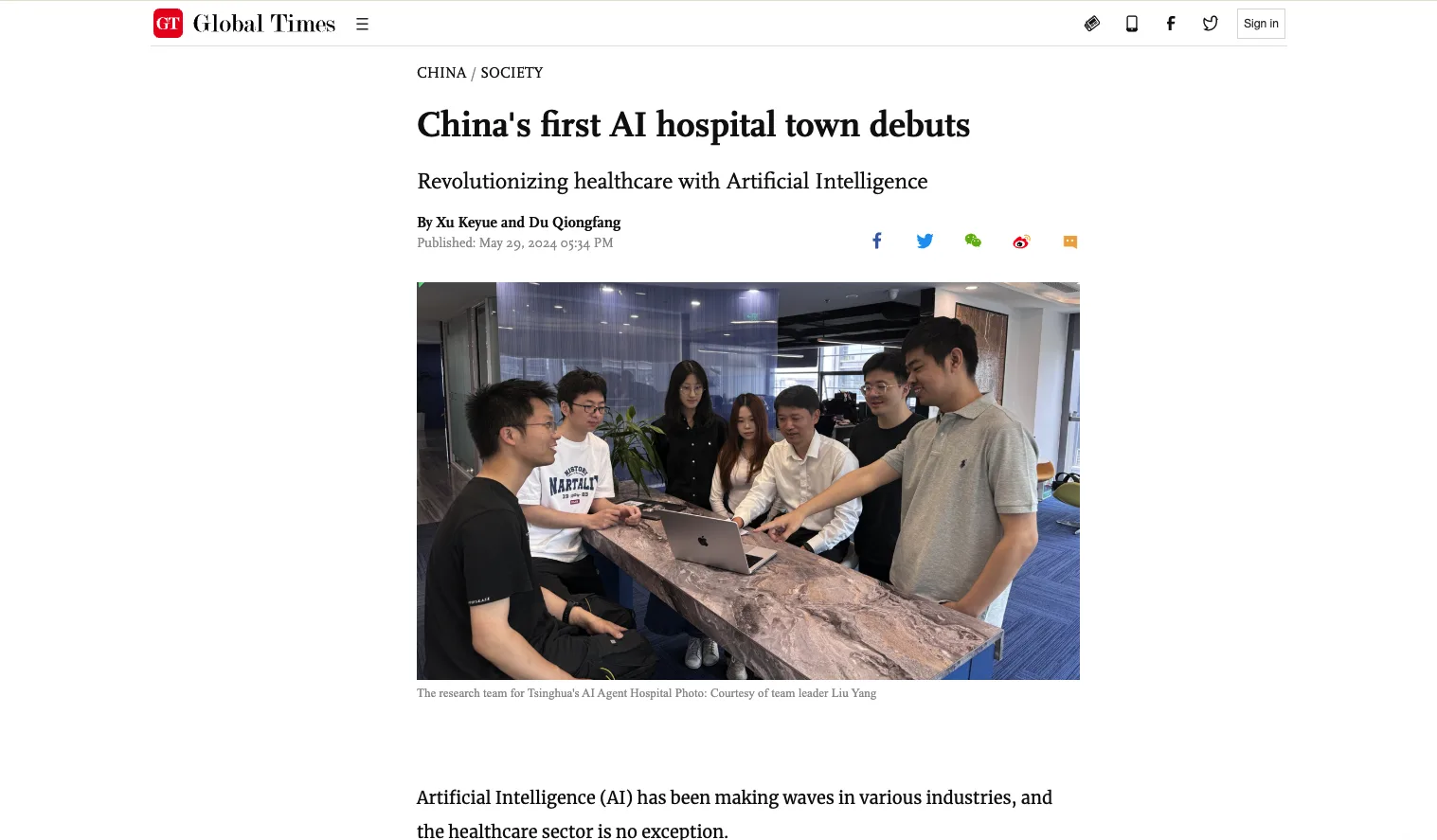
China’s Tsinghua University has developed an AI hospital, “Agent Hospital,” that offers a glimpse of the future of medicine. It is more than a demonstration: it is a remarkable experiment in which AI agents play the roles of doctors, nurses and even patients in a virtual environment and autonomously carry out the whole medical process, from diagnosis to treatment.
High diagnostic accuracy and enormous processing capacity: This AI hospital has achieved very high accuracy on “MedQA,” a medical question-answering dataset, and its diagnostic ability is impressive. It can also examine many virtual patients in a short time, giving it the potential to dramatically improve the efficiency of medical settings.
Innovation in medical education and applications in public health: Particularly notable is that because AI agents also play patients, medical students and healthcare workers can train their skills in handling a wide variety of cases in a safe environment. This will bring groundbreaking progress to medical education and contribute greatly to developing high-quality medical professionals. Its range of applications is also very broad, for example finding the best response to public health challenges such as large-scale epidemics through simulations in a virtual environment. This effort is an excellent example of AI’s potential to dramatically raise the quality of care.
Eucalia
Japanese healthcare IT company Eucalia offers solutions that benefit both patients and medical institutions through AI agents.
Early detection of brain health issues with Smart Scan’s “MVision health”: The “MVision health” service offered by its subsidiary Smart Scan uses AI to analyze brain checkup MRI images and provides detailed reports on brain health. It quantitatively evaluates the progression of brain atrophy and white matter lesions, enabling early intervention and contributing greatly to maintaining brain health. By expanding its cancer screening menu, it also supports early detection of various cancers, making it a very promising solution from the standpoint of preventive medicine.
Smoother communication between patients and healthcare workers with “Eucalia Merge”: In “Eucalia Merge,” an app that supports communication between hospitals and patients, AI explains tests and treatments in an easy-to-understand way and answers patients’ questions. This not only reduces the burden on healthcare workers but also helps patients understand their condition and treatment more deeply and receive care with peace of mind, and its convenience is impressive.
Co-developing a “conversational healthcare agent” with Hippocratic AI: Eucalia has also formed a capital and business alliance with Hippocratic AI (HAI) in the US and is co-developing a generative AI healthcare agent that can converse in Japanese. It focuses on patient-facing tasks that do not involve diagnosis, such as pre-consultation interviews, appointment booking and medication reminders. With AI agents taking on these tasks, healthcare workers can focus on more specialized work that only people can do, which will significantly improve both the efficiency of medical settings and the quality of patient care. The company aims to launch the service in Japan within the year, and hopes are high that many medical institutions will feel its benefits. AI support all the way from diagnosis to communication sounds like a big help for both patients and healthcare workers.
Google Cloud
Google Cloud is also actively advancing the use of AI agents in healthcare. Especially notable is an approach that dramatically changes how healthcare workers search for information.
Adding “Visual Q&A” to “Vertex AI Search” for healthcare: Google Cloud has added a new “Visual Q&A” feature to “Vertex AI Search,” its search service for medical institutions. With this feature, healthcare workers can directly input visual data such as X-ray images, MRIs, CT scans and pathology images, as well as graphs and charts in electronic medical records, and search and analyze the information they need. Extracting information from image data used to be laborious, but AI now makes it possible, helping shorten diagnosis time and create treatment plans based on more accurate information.
Woebot and Wysa
AI counseling has made especially rapid progress in practical use in chat form, and services such as Woebot and Wysa are already used on a large scale. These AI agents offer text-based conversations about the worries and stress users are dealing with.
Forming a “Therapeutic Alliance” on Par with Humans
Remarkably, research has shown that conversations with AI agents can form a “therapeutic alliance,” in other words a relationship of trust between counselor and client, comparable to the one formed in counseling between people. This suggests that AI is evolving from a mere information provider into something that can empathize with emotions and offer support. Many people may be impressed by how effective the quality of these conversations is.
Chatbots Based on Cognitive Behavioral Therapy, and Hybrid Models
Many of these AI counseling services are based on psychotherapy such as cognitive behavioral therapy (CBT), helping users look objectively at their own thought patterns and behavior and guiding them toward improvement. Hybrid apps in which AI and human professionals work together are also available: AI handles initial responses and day-to-day support, and when deeper professional intervention is needed, it hands off smoothly to a human counselor, combining the convenience of AI with human expertise.
Of course, AI counseling has its limits. It still falls short in empathy and deep understanding of human emotions, and for severe mental health problems, attentive support from human professionals remains essential. Still, research and development is moving forward on many fronts, including screening of mental states, everyday psychological support, support for diagnostic interview training, analysis of drawing tests and evaluation frameworks for psychiatric diagnosis agents, and the speed of progress is remarkable.
Limbic Access and EARKICK
AI agents are very useful not only for full-fledged counseling but also as support tools for everyday mental health care. Services such as Limbic Access and EARKICK are leading examples.
Available 24 Hours a Day, Anonymous and Non-Judgmental
A major benefit of these AI agents is that you can use them anytime, 24 hours a day, whenever you like. This means you can get emotional support right when you need it, regardless of time or place. Because anonymity is preserved, even people who are reluctant to talk to others can use them with peace of mind. And because AI does not “judge” the way people might, users can open up about any worry without fear, which is another big benefit. Being able to consult AI anonymously at any time looks like a real help for maintaining mental health.
The impact AI agents bring to mental health care is immeasurable. It is a very important step toward a society where anyone can easily access and continuously care for their mental health.
AI-DataScience Inc.
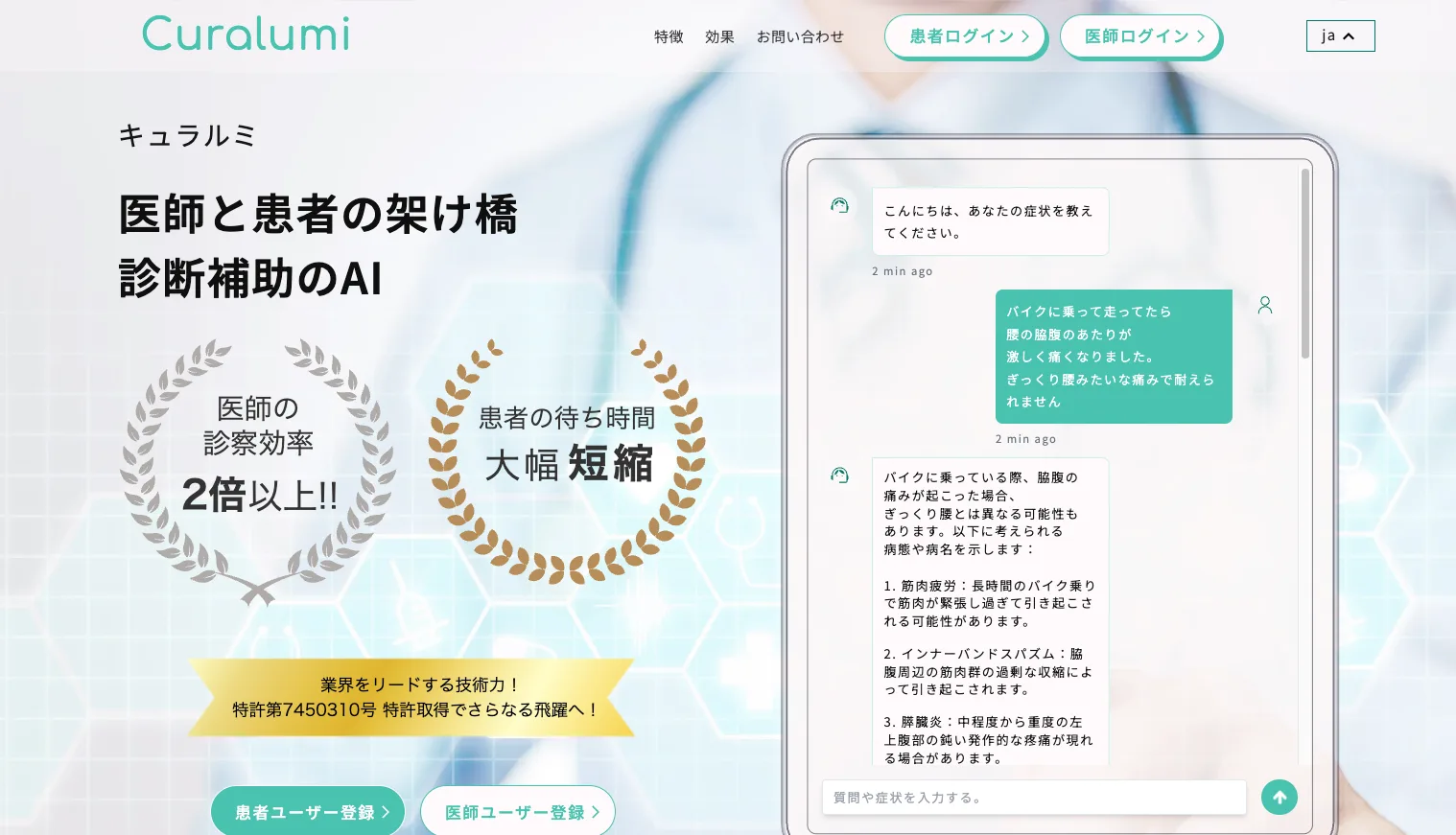
Japan’s AI-DataScience Inc. has developed “Curalumi®,” a groundbreaking clinical support AI in which an AI agent handles the pre-consultation interview. It is a very practical solution that makes doctors’ consultation time more efficient and reduces the burden on patients.
Greatly Improving Consultation Efficiency
Adopting Curalumi® has reportedly made it possible to more than double consultation efficiency. This is because AI interviews patients in detail beforehand about their symptoms and medical history, creating an environment where doctors can focus on the consultation. If AI handles the pre-consultation interview and waiting times get shorter, that would be wonderful.
Patients Can Consult AI “Without Hassle”
Curalumi® is also very easy for patients to use. There is no need to download a special app, and what patients discuss with the AI is sent directly to the doctor. This lets patients calmly organize their condition before the consultation and helps prevent them from forgetting to tell the doctor something.
This effort is an excellent example of AI autonomously handling part of the care process, dramatically raising productivity in medical settings and supporting higher-quality care.
UiPath, Inc.
UiPath, a leader in RPA (robotic process automation), also offers solutions in healthcare that use the power of agentic AI. Its “UiPath Medical Record Summarization agent” brings an innovative solution to the challenge of managing huge volumes of medical records at medical institutions and insurance companies.
Summarizing Huge Volumes of Medical Records Quickly and Accurately with Generative AI
This agent is powered by advanced generative AI capabilities and can summarize huge volumes of medical records, work people used to do by hand, remarkably quickly and accurately. It automatically creates summaries that capture the key points without missing important information, dramatically improving work efficiency.
Cutting Prior Authorization Time by Up to 50%
A particularly big benefit for medical institutions and insurers is shorter prior authorization time. Using UiPath’s agent reportedly cuts the time needed for this authorization process by as much as 50%. This not only speeds up services for patients but also greatly reduces the administrative burden on medical institutions and insurers and significantly raises operational efficiency.
This UiPath solution shows how agentic AI can streamline back-office work in medical settings and create an environment where healthcare workers can focus on patient care. These examples make it clear that AI agents are showing their true value both “on stage” and “behind the scenes” in healthcare.
MG-DX Co., Ltd.
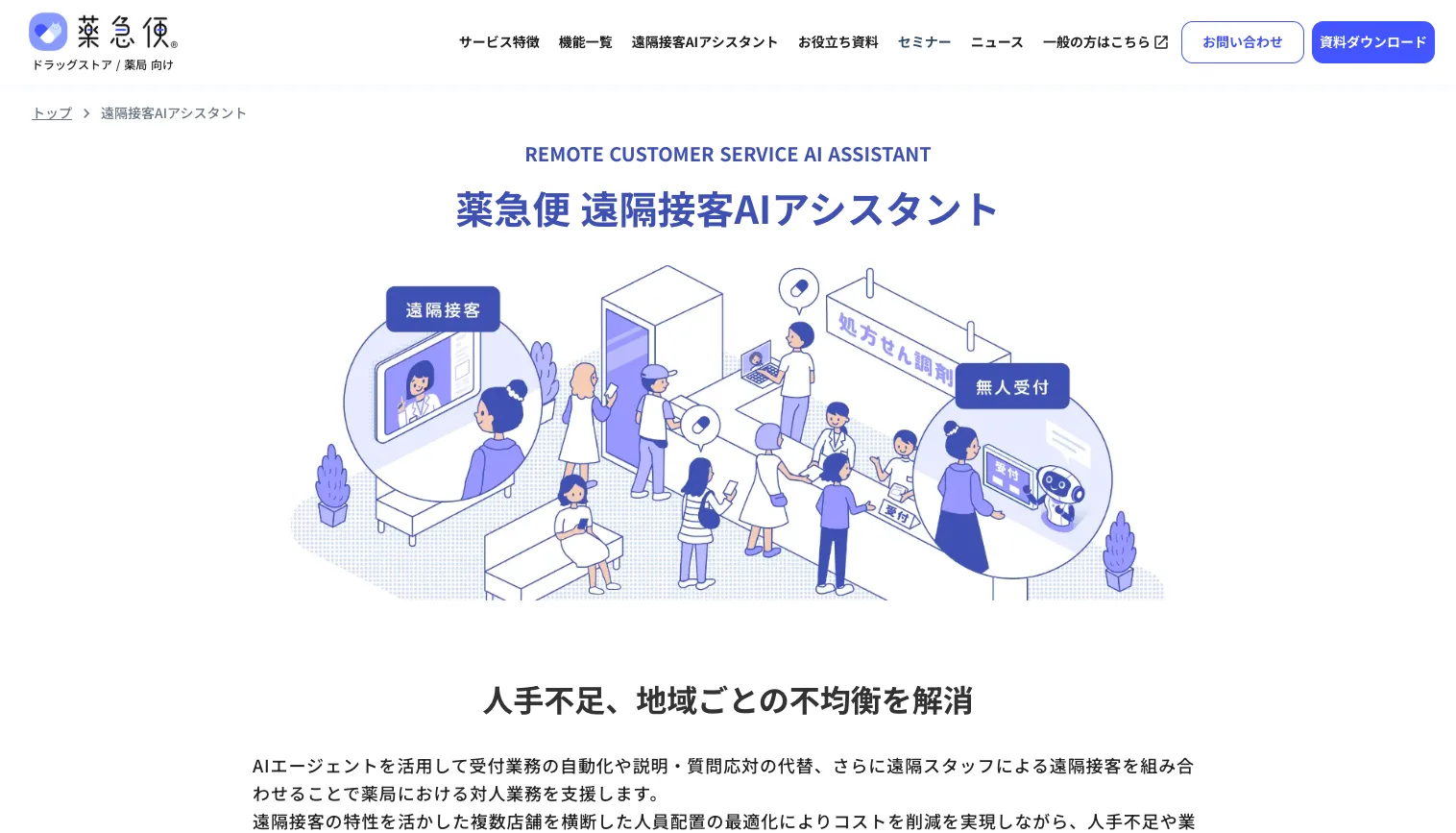
AI agents in healthcare are spreading beyond hospitals to the pharmacy, a place close to our daily lives. A pharmacy is not just where you pick up medicine; it is an important hub that supports patients’ health. But it involves a lot of work, such as reception and explaining things to patients. MG-DX Co., Ltd. offers a truly groundbreaking solution that streamlines this pharmacy work with the power of agentic AI and makes things more convenient for patients.
An “AI Agent” Handles Pharmacy Reception: The “Yakkyubin Remote Customer Service AI Assistant”
MG-DX offers the “Yakkyubin Remote Customer Service AI Assistant,” an AI agent specialized in pharmacy reception. It is like having a veteran assistant on duty at the pharmacy around the clock.
Streamlining reception work handled by AI:
-
Prescription intake: AI smoothly receives and processes the information on prescriptions patients bring in.
-
Insurance card checks: AI checks insurance card information and enters the necessary data into the system.
-
Answering basic questions: AI accurately answers common questions, such as the pharmacy’s opening hours, its location and general questions about medicines.
With an AI agent handling these tasks, pharmacists can focus on their core professional work: dispensing, medication guidance and attentive counseling for patients. This is a striking advance that significantly raises pharmacy efficiency and greatly reduces the burden on pharmacists.
More convenience for patients, too: The AI assistant also brings big benefits for patients. Beyond shorter waiting times, the anonymity of being able to ask questions without worrying about others, and the reassurance that AI always responds calmly and accurately, along with its excellent usability, should make many people feel it is convenient.
The Future the “Yakkyubin AI Assistant” Brings to Homes: Monitoring and Care Support for Older People
MG-DX’s vision goes beyond streamlining pharmacy work. In the future, it aims to place the “Yakkyubin AI Assistant” in many homes, where it would support older people’s daily lives, respond in emergencies, help manage their health and even provide medication guidance.
An AI partner that supports older people’s lives: AI agents provide support in every part of daily life, from managing older people’s daily health and reminding them when to take medicine to checking in on them with regular conversation. In an emergency, AI could assess the situation and automatically notify the right contacts. By supporting health management at home and accurately relaying doctors’ medication instructions, it will also contribute greatly to keeping older people healthy. This is a truly groundbreaking evolution in which AI stays close to the household and becomes a reassuring partner for older people and their families.
MG-DX’s efforts show the potential for AI agents to expand from the familiar setting of the pharmacy into the home and make our lives richer and safer.
Tifana.com “AI Sakura-san”
Tifana.com, which builds websites and develops AI solutions, has introduced “AI Sakura-san,” a reception AI agent that can talk, into clinics, bringing new value to reception work.
More Efficient Reception and a Better Patient Experience
With AI Sakura-san at the clinic reception desk, AI handles answers to routine questions and guidance around the clinic. This lets staff focus on more specialized work and attentive care for individual patients. For patients, too, AI’s smooth responses mean shorter waits and the ability to resolve questions on their own, making things significantly more convenient. Combined with its intuitive operation, it will help greatly streamline work, and many medical institutions may find it worth considering.
This solution is an excellent example of AI acting as the “face” of a medical institution, benefiting both sides by reducing staff workloads and raising patient satisfaction.
Kairo Health
In medical settings, nurses and medical office staff spend a lot of time on routine, repetitive tasks. Kairo Health addresses this challenge with a solution in which AI agents carry out these tasks, raising productivity in medical settings.
Much Higher Efficiency Through EHR Integration
Kairo Health’s AI agents integrate seamlessly with EHR (electronic health record) systems to automate many tasks people used to do. For example, by having AI handle time-consuming administrative work such as entering patient information, organizing data and writing reports, nurses can focus on patient care and medical office staff on more complex work. This solution has the potential to dramatically change productivity in medical settings, and the degree of efficiency it brings is impressive. It is fair to say that AI agents offer a very attractive solution to the staff shortages and heavy workloads medical settings face.
Smart Gate Co., Ltd.
Smart Gate Co., Ltd., which develops monitoring solutions, sells “WearSafe Ver.2.0,” a next-generation monitoring solution with an AI posture detection app. It is a truly groundbreaking product that uses AI to keep patients safe and drives the digital transformation (DX) of nursing work.
Preventing Accidents with “Bed-Exit Detection” by AI Cameras
“WearSafe Ver.2.0” uses AI cameras to detect patients’ posture and track events such as getting out of bed in real time. This makes it possible to spot risks such as falls early and prevent accidents before they happen. Because AI keeps watch even at times when nurses cannot, patient safety improves significantly and the mental burden on healthcare workers is reduced. This is a striking advance in monitoring care.
Future Development Toward “Early Warning Detection” and “Individual Care Plans”
Smart Gate is developing technology with an eye toward future early warning detection by AI agents and automatic creation of individual care plans tailored to each patient. With AI predicting signs of abnormalities from patients’ past data and behavior patterns and suggesting the best ways to provide care, more personalized, high-quality care will become possible.
“WearSafe” is a very attractive solution that brings new possibilities to monitoring work with AI, delivering both patient safety and more efficient work for healthcare workers.
SS&C Blue Prism
SS&C Blue Prism, which has a track record in RPA (robotic process automation), also uses agentic AI systems to help ease workforce challenges and improve operational efficiency. Adoption is moving forward especially in medical and pharmacy work.
Easing Workforce Challenges in Medical Settings
The healthcare industry constantly faces staff shortages. SS&C Blue Prism’s agentic AI systems automate routine work people used to do, creating an environment where healthcare workers can focus on more specialized, higher-value work. This makes it possible to provide the most medical services with limited resources and greatly raises productivity in medical settings.
SS&C Blue Prism’s efforts show that agentic AI can be a “smart helper” across a wide range of areas, from back-office work in medical settings to direct patient interactions, and contribute to optimizing the healthcare system as a whole.
Lumeris “Tom”
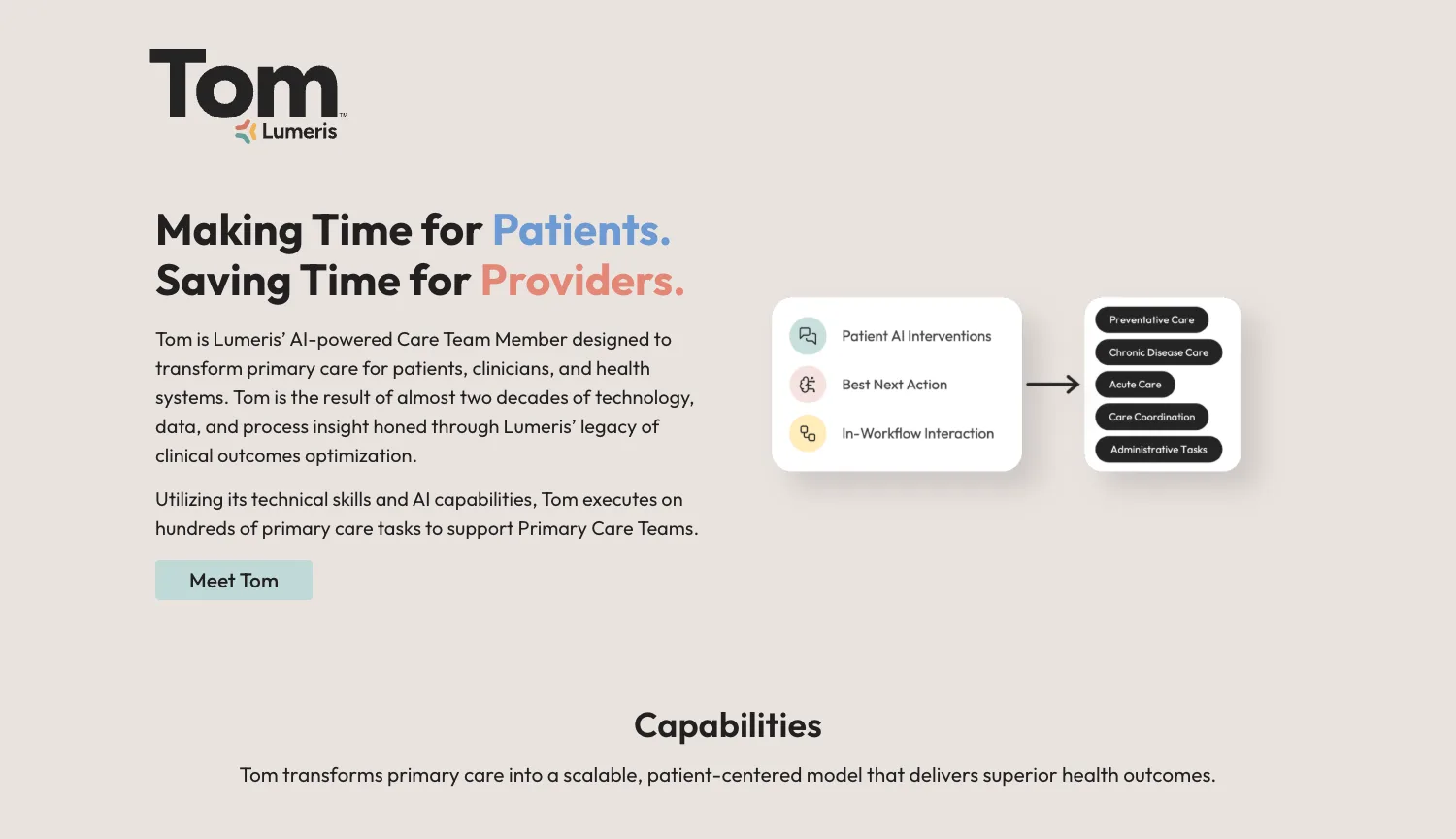
US healthcare IT company Lumeris has announced “Tom,” an AI agent specialized for primary care. It is an innovative effort to strongly support the work of doctors and nurses and make patient care smoother.
Acting Autonomously as a Member of the Care Team
The AI agent “Tom” goes beyond providing information: it aims to talk directly with patients and autonomously take actions such as booking appointments and arranging tests. It is like a member of the medical team who supports patients’ everyday care proactively. This lets healthcare workers focus on more specialized examinations and treatments that only people can do, and productivity in medical settings will rise greatly. Many people in healthcare will surely see the value of its excellent support capabilities.
The introduction of “Tom” shows a new role for AI agents in primary care and opens up a future in which patients receive more efficient, higher-quality care.
Apple “Apple Healthcare”
Apple, a leader in the smartphones and wearable devices we use every day, is also deeply committed to the potential of AI agents in health. Its goal is to further strengthen its health management offering, “Apple Healthcare,” so that AI provides personalized advice based on each user’s health insights.
Personalized Health Guidance with “Project Quartz”
In “Project Quartz,” scheduled to launch in 2026, AI will provide specific recommendations and guidance tailored to each person’s health and lifestyle, based on the vast user data Apple Healthcare collects. For example, it could analyze sleep patterns and suggest improvements, or autonomously give advice that encourages exercise habits. This is a truly striking advance that strongly helps users understand their own health more deeply and take charge of it.
Earlier Examples: Wearables Such as Whoop and Oura
Wearable devices such as Whoop and Oura already have AI agents providing individual recommendations and coaching based on users’ biometric data (heart rate, sleep patterns, activity levels and so on). Apple’s effort aims to go a step beyond these earlier examples and offer a more comprehensive, personal health management experience. With AI, users can understand their health in detail and choose the best actions, and many people will find its excellent usability convenient.
Apple’s “Project Quartz” points to a future that fundamentally changes how we manage our health, with AI acting as a “personal healthcare agent” that supports each person’s health.
Rozetta
Developing new drugs involves enormous time and cost, plus complex document work. Rozetta, known for its AI translation services in Japan, is putting the power of agentic AI to work in making the pharmaceutical business more efficient.
Streamlining Work with the Specialized Document AI Service “Rakuyaku AI”
Rozetta’s specialized document AI service, “Rakuyaku AI,” aims to streamline every part of the pharmaceutical business, including automatically generating clinical trial documents and promotional materials, checking documents and searching for drug information. AI understands complex technical terms and regulatory requirements, creates documents automatically and checks them for errors, greatly reducing people’s workload and dramatically improving work efficiency. This will be a very valuable solution in the pharmaceutical industry, where both time and accuracy matter.
“Rakuyaku AI” is a notable example of how agentic AI can improve efficiency and accuracy in fields that require advanced expertise.
Insilico Medicine
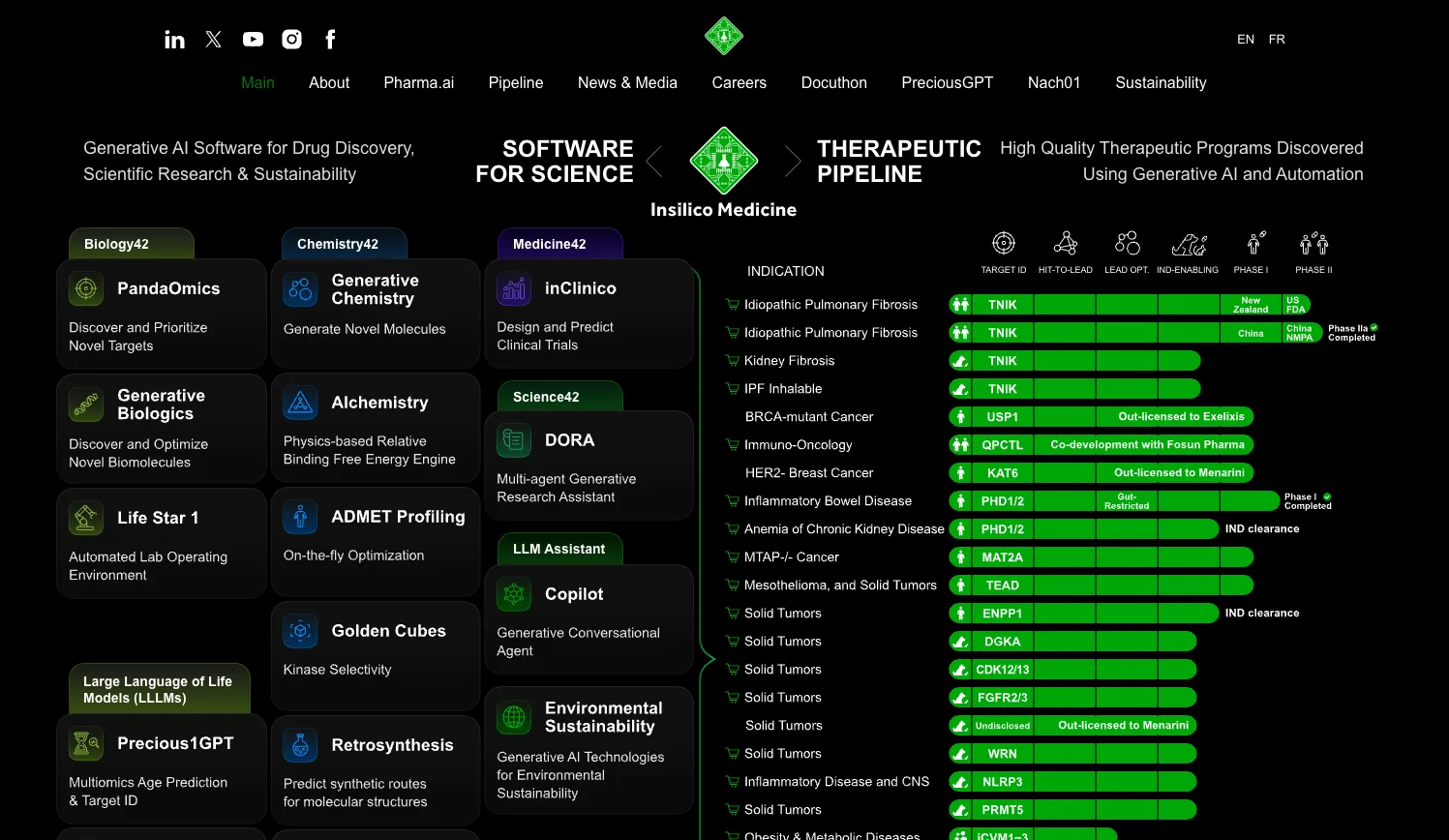
Discovering and developing new medicines is essential for human health, but the process is very long and has a low success rate. Insilico Medicine aims to speed up this drug discovery process remarkably and raise the success rate by combining AI and robotics.
Shortening the Time from Target Identification to Candidate Selection
In its approach, AI analyzes vast amounts of genetic information and chemical data to identify the target molecules that cause disease and to quickly pick out candidate substances that work against those targets. This could significantly shorten R&D periods that used to take many years and get new drugs to patients sooner.
Insilico Medicine’s efforts show that agentic AI can go beyond human limits and bring breakthroughs to drug discovery, a complex and important scientific field.
NVIDIA
Developing new drugs is an extremely complex process that takes enormous time and cost. But NVIDIA aims to dramatically speed up this drug discovery process with the power of AI agents.
Shortening the Research Process Through Collaborating AI Agents
NVIDIA advocates an approach in which multiple AI agents work together to move the drug discovery process forward.
Scientific paper summarization agent: AI quickly summarizes huge numbers of scientific papers so researchers can efficiently keep up with the latest findings.
Target discovery agent: AI autonomously searches for the “target molecules” that are the root cause of disease, expanding the possibilities for new treatments.
Research report writing agent: AI organizes complex research results and makes writing reports more efficient.
When these AI agents work together, they can significantly shorten drug discovery processes that used to take years and greatly raise the speed and accuracy of decision-making. As NVIDIA stresses, the pharmaceutical industry should embrace this as a “paradigm shift” (a fundamental change), and the technology is a truly innovative step toward getting new drugs to patients sooner. Multiple AI agents cooperating on drug discovery feels like science fiction coming true.
Modastera “MAEA”
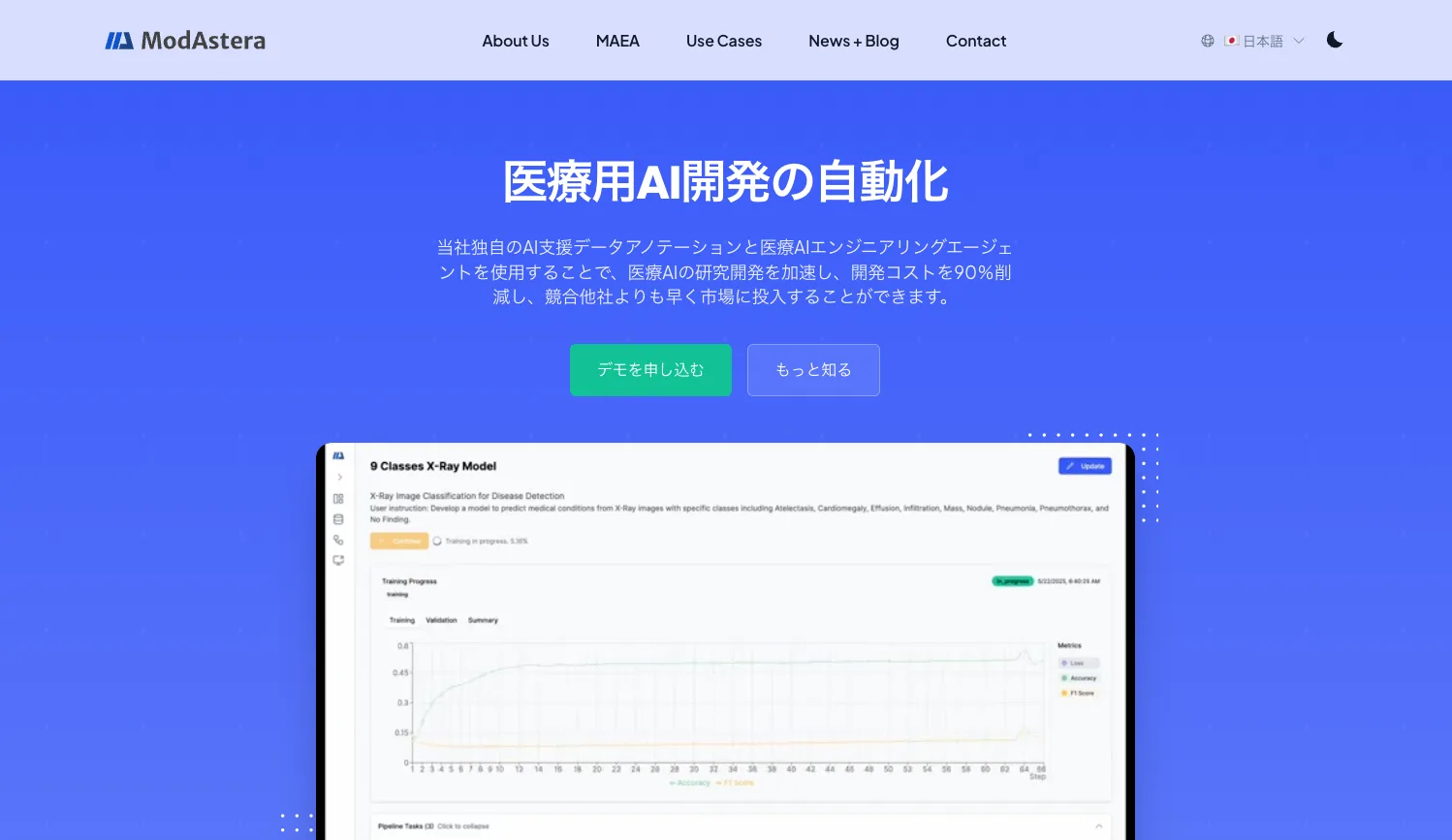
Modastera has announced the “Medical AI Engineering Agent (MAEA),” its own agent that automates and speeds up medical AI development. It is like having a “smart engineer” take on complex medical AI development for you.
Give Development Instructions in Natural Language, and AI Carries Them Out Automatically
MAEA’s most groundbreaking feature is that healthcare workers and researchers simply give development instructions in natural language (everyday words), and the AI agent understands them and autonomously carries out the whole development process. Specifically, it automates building AI models, evaluating their performance, creating the complex documentation needed for regulatory compliance and, finally, deployment (putting the system into use). With AI handling work that experts used to put a lot of effort into, development speed and accuracy rise greatly.
Shortening Development to “Days” and Greatly Reducing Costs
Using MAEA has reportedly made it possible to dramatically shorten the medical AI development process from the usual several months to “just a few days.” Many people in healthcare and development will be impressed by this gain in efficiency. Shorter development directly leads to much lower development costs, which will make it easier for more medical and research institutions to adopt AI solutions. Developing medical AI in just a few days is a truly groundbreaking service.
A Trial at Tohoku University Hospital: Building a “Practical-Level” AI Model in Very Little Time
MAEA’s effectiveness has already been proven in a specific use case.
Use in developing a brain age prediction model: Tohoku University Hospital used MAEA to develop a brain age prediction model. In this project, MAEA achieved an excellent result, building a model of practical quality in a short time. This clearly shows that MAEA is not just a development support tool but can quickly create “practical AI models” that can be used in real medical settings. Many researchers and medical institutions will likely want to try this solution for themselves.
Modastera’s MAEA will be a powerful force that removes the “development” bottleneck in medical AI with the power of agentic AI and gets AI into medical settings faster and more efficiently.
Kurashiteku “HOUKAN Agent”

“HOUKAN Agent,” offered by Kurashiteku Inc., is a truly innovative solution in which agentic AI autonomously handles the whole chain of administrative work in the medical and nursing care industries.
End-to-End Automation of Work
This AI agent automates almost all of the administrative work medical and care providers deal with, end to end: from “planning” such as creating care plans, to organizing daily “records,” preparing complex “claims (receipts),” “information sharing” between different systems and even “accounting.” With AI taking over the time-consuming work people used to do by hand, work efficiency improves dramatically.
Reducing the Burden on Frontline Staff and Improving Profitability
With HOUKAN Agent, staff in medical and care settings can greatly cut the time spent on paperwork and focus on direct care for clients and patients and on more specialized work. This also helps ease the industry’s labor shortage and raises the quality of services. More efficient paperwork with fewer errors also lowers providers’ operating costs, which in turn improves profit margins. This is a very attractive effect that also leads to healthier management.
Also Contributing to Better Governance Across the Industry
Accurate data processing and record-keeping by AI also strengthens compliance (adherence to laws and regulations). HOUKAN Agent automatically processes work correctly based on complex medical and care regulations and guidelines, significantly raising governance across the industry and supporting the delivery of reliable services.
Kurashiteku’s “HOUKAN Agent” offers a comprehensive solution to the paperwork challenges the medical and care industries have faced for years, through the “autonomy” and “integration” that agentic AI provides.
zapath Inc.
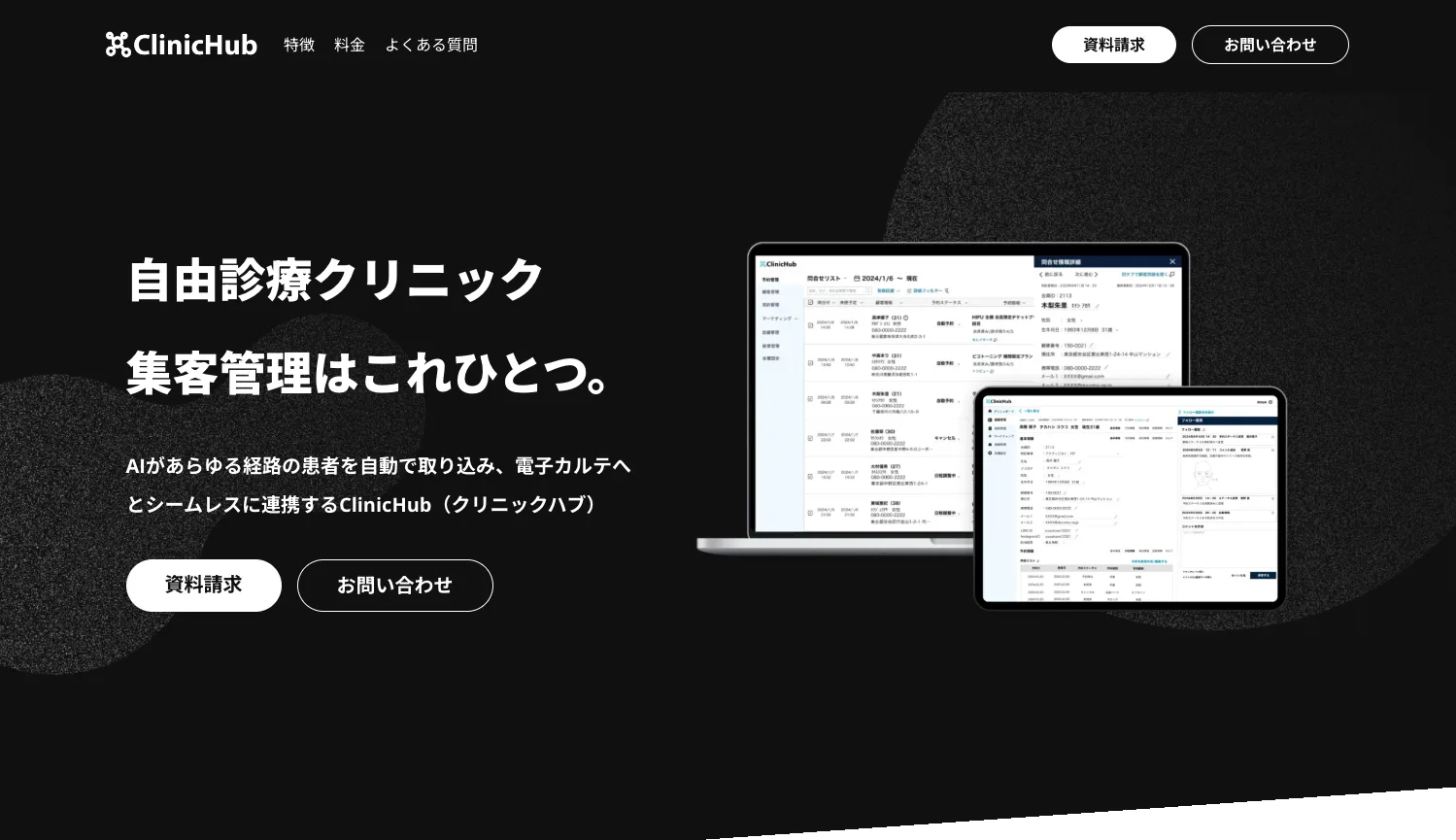
“ClinicHub,” an AI agent for aesthetic medicine offered by zapath Inc., uses AI to solve the challenge of creating advertising content that clinics face.
Automatic Creation of Advertising Content by AI
“ClinicHub” uses AI to autonomously create advertising content for aesthetic medicine clinics. This lets clinic staff greatly reduce the effort spent writing ad copy and choosing images, and attract patients more efficiently.
Strong Support for Complying with Medical Advertising Guidelines
Medical advertising, including for aesthetic medicine, is subject to strict guidelines. The AI agent understands these complex guidelines and automatically generates content that complies with them, reducing the risk of unintended violations. Creating medical ads involves many points to watch out for, so AI that follows the guidelines while creating them is a real help.
Attracting Patients More Efficiently
Optimized, guideline-compliant advertising content created by AI reaches potential patients more effectively and significantly improves patient acquisition. Many clinics will likely find its excellent convenience and effectiveness worth considering.
“Kirei Search,” a Search Engine for Aesthetic Medicine: Building Anticipation with Future “Treatment Simulations”
In addition to “ClinicHub,” zapath also runs “Kirei Search,” a search engine specialized in self-pay medical services such as aesthetic medicine. It is designed to help users efficiently find the aesthetic medicine information they are looking for, and further AI-powered features are planned.
Nihin Media Inc. (MedGen Japan)
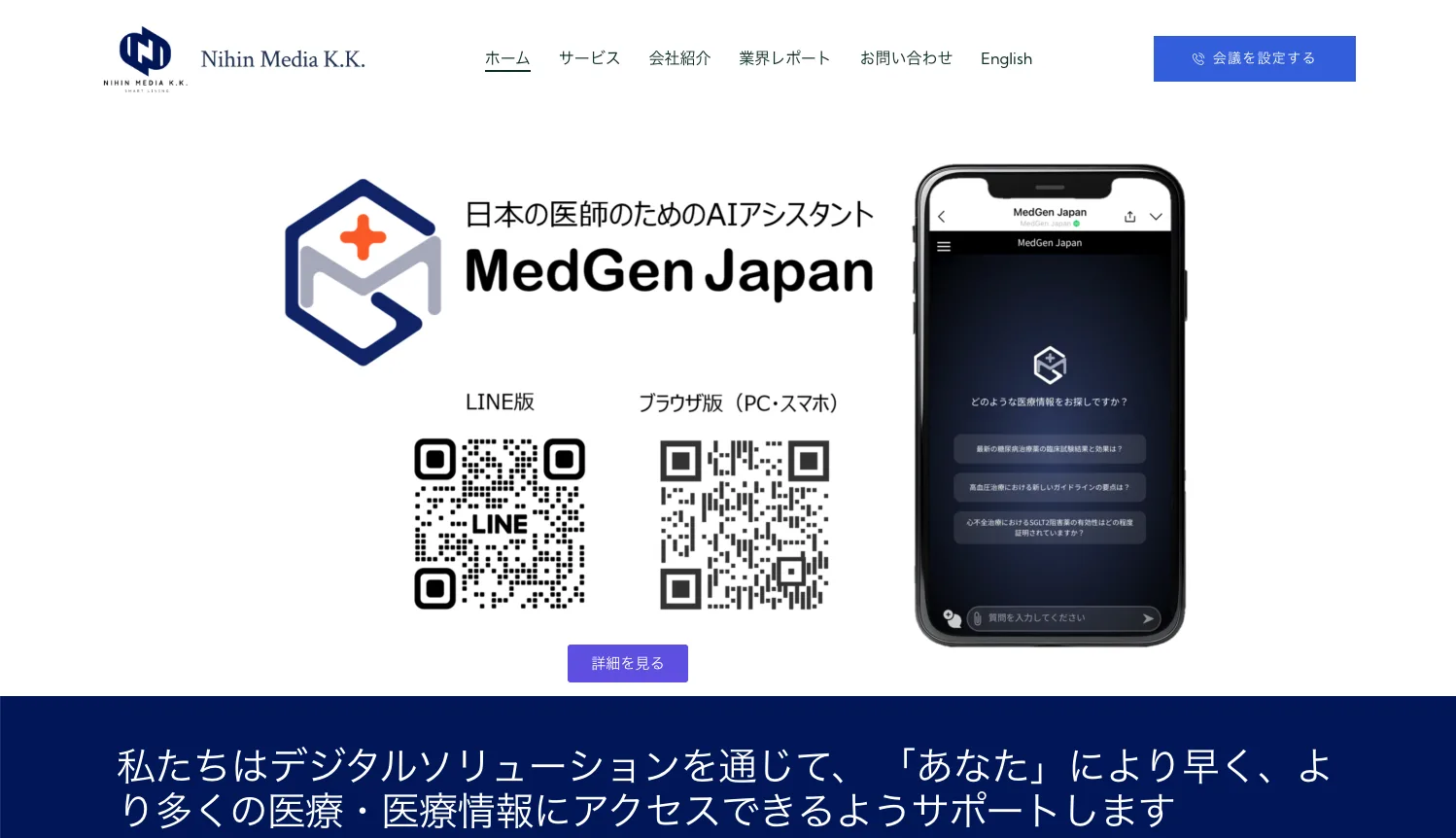
Nihin Media Inc. offers “MedGen Japan,” a medical literature search AI agent that lets busy doctors quickly check reliable evidence (scientific grounds) even in limited time, such as between outpatient appointments. It dramatically streamlines doctors’ search for knowledge and supports higher-quality medical decisions.
Supporting Care Through Fast Access to Information
AI quickly finds and presents the information doctors need from a vast body of medical literature. This greatly streamlines information gathering that used to take time and also helps improve the accuracy of diagnoses and treatment plans.
Evolving Further Through Feature Upgrades
“MedGen Japan” has also been upgraded with better detection of drug names, display of medical images and support for searching global guidelines. With AI supporting everything from complex medical terms and image data to the latest treatment guidelines from around the world, it helps doctors make decisions from many angles. This functionality significantly improves the usability of accessing medical information and will bring striking progress to medical settings.
Chugai Pharmaceutical (Chugai AI Assistant)
Chugai Pharmaceutical, a leader in pharmaceutical R&D, is also actively using the power of agentic AI to make internal work more efficient. It is especially focused on streamlining document work in the complex drug development process, with AI agents playing the central role.
Introducing Generative AI (RAG) into the SOP Search System
Chugai Pharmaceutical uses generative AI (RAG: retrieval-augmented generation) in its search system for SOPs (standard operating procedures). RAG is a technology that has generative AI refer to an external knowledge source (in this case, a huge number of SOPs) to generate more accurate and reliable information. This lets employees instantly find the information they need among vast procedure documents, greatly improving the accuracy and speed of their work and supporting compliance.
Building a Medical Writing Support Environment
The company is also building an environment to support medical writing (creating medical documents). AI agents streamline gathering the necessary materials and drafting documents. Because researchers and healthcare professionals can efficiently collect what they need from vast literature and create accurate drafts in a short time, this also speeds up R&D and has the potential to accelerate the birth of new drugs.
JSOL Corporation
JSOL Corporation, a system integrator, offers solutions for pharmaceutical and medical device makers that use Salesforce Life Sciences Cloud, a global CRM (customer relationship management) platform. It is focusing on the power of “Agentforce, the autonomous AI agent built into Salesforce.”
“Agentforce” Improves Data Access and Streamlines Indirect Work
With the help of Agentforce, JSOL’s solution centrally manages customer data and medical information that tended to be scattered, significantly improving access to the information people need. By also streamlining indirect work such as writing sales reports and sharing information, it creates an environment where pharmaceutical company representatives can focus on what really matters: building relationships with customers and contributing to medical settings. Many companies will feel the convenience of this level of efficiency.
This effort is an excellent example of AI agents being deeply embedded in a company’s CRM strategy, raising both work productivity and the quality of data use at the same time.
EQUES
Drug development requires highly specialized knowledge and the huge amount of document work that comes with it. EQUES develops large language models (LLMs) specialized in pharmacy and pharmaceutical work and offers services that streamline the creation of quality assurance documents.
Higher Information Accuracy with Specialized LLMs
Unlike general-purpose AI, the LLMs EQUES develops have been trained deeply on the terminology, regulations and practices of pharmacy and pharmaceuticals. This improves search accuracy for related information and lets users get more reliable information quickly.
Reducing Workload by Automating Quality Assurance Documents
Approval of a new drug requires complex, rigorous quality assurance documents. EQUES’s service uses AI to streamline this document creation process. AI drafts documents and organizes the necessary information, greatly reducing the workload on people, and the efficiency gains are remarkable. This will be a very valuable solution in the pharmaceutical industry, where both time and accuracy matter.
EQUES’s efforts are a notable example of how agentic AI can improve efficiency and accuracy in niche fields that require advanced expertise.
SyntheticGestalt

Drug discovery, the challenge of finding treatments that do not yet exist, is one of the most important scientific fields for humanity. SyntheticGestalt aims to fundamentally change the possibilities of drug discovery with the power of AI. By developing one of the world’s largest molecular foundation models, it aims to discover new compounds with AI.
Accelerating Drug Discovery with One of the World’s Largest Molecular Foundation Models
This molecular foundation model has been trained on vast data about chemical structures and molecular behavior. Using this model, AI can efficiently explore compounds with new functions that humans could never have imagined. This is a truly innovative technology that could dramatically speed up the discovery of new drugs. With AI autonomously designing the best candidate compounds for target molecules and predicting their effects, it could remove bottlenecks in conventional drug discovery and get new treatments to patients sooner.
Humanome Lab
Like SyntheticGestalt, Japan’s Humanome Lab aims to speed up drug discovery and basic research by deeply integrating AI into life science research. It is developing a foundation model based on gene expression levels.
Advancing Drug Discovery and Life Science Research with Gene Expression Data
By analyzing this model, AI can efficiently help uncover disease mechanisms, discover new biomarkers and search for drug candidates for specific diseases. This significantly speeds up life science research that used to take enormous time and effort and increases the chances of new discoveries and innovation.
Trends in Drug Discovery and R&D: AI Agents Open Up the Future of Research
Research and development (R&D) at pharmaceutical companies has always been a process that takes huge amounts of time and effort. But AI agents are expected to make this process dramatically more efficient and produce new discoveries with greater speed and accuracy than ever.
Expected Uses in R&D and Medical Affairs
In pharmaceutical R&D departments, AI agents are expected to be used to create the “Target Product Profile (TPP),” which sets the direction for new drug development. AI analyzes market data and existing research and proposes the best product profile, streamlining decisions in the early stages of development and significantly improving their accuracy. In MA (medical affairs) departments, AI agents support answers in “medical information (MI)” work, which handles medical inquiries from doctors and patients, helping deliver information faster.
AI Agents That Drive the Research Process “Autonomously”
Research is under way on AI agents that drive research autonomously, including analyzing pharmaceutical patents, navigating (tracking the progress of) the entire drug discovery pipeline and exploring new uses for existing drugs (drug repositioning). This could uncover new possibilities that human researchers have missed and greatly speed up R&D.
The Arrival of AI Co-Researchers: Deepening Research Through Intelligent Dialogue
Even more notable is the development of “AI co-researchers,” in which AI agents carry out research together or people and AI collaborate.
-
Automatic generation of survey papers: AI extracts key papers from vast literature and automatically writes survey papers (papers summarizing research trends in a specific field), streamlining the early stages of research.
-
Generating research ideas by structuring literature: AI structures literature data and discovers relationships and patterns that had been overlooked, helping generate new research ideas.
-
Data science workflow management: AI manages the whole data science workflow, from data collection to analysis and model building, automating and streamlining the research process.
-
Automatic generation and refinement of research hypotheses: AI automatically generates new research hypotheses from existing data and refines them, making it possible to find research directions more efficiently.
These AI co-researchers will provide an environment where human researchers can focus on more advanced thinking and creative work, significantly raising the quality of research.
Trends in Finance (Healthcare-Related): AI Agents Advance Market Analysis and Risk Management
AI agents are also spreading in the financial industry, which is closely tied to healthcare. In areas such as complex market analysis and risk management in particular, research is under way on AI agents that complement human abilities and support faster, more accurate decisions.
Speeding Up M&A by Automating Due Diligence
In finance, when a large company acquires another, or when several companies work together on complex financing (known as “structured finance”), it is essential to investigate thoroughly in advance whether the deal is really safe and will be as profitable as expected. This detailed investigation is called “due diligence,” and because it requires scrutinizing huge volumes of documents and data, it is hard work that consumes a lot of time and people. AI agents, however, will automate this process and gather and analyze the necessary information efficiently, greatly speeding up decision-making.
Simulating Healthcare-Related Financial Markets and Supporting Investment Decisions
Healthcare-related financial markets fluctuate widely due to their own particular factors, which makes them hard to predict. AI agents simulate these markets and support continuous investment decisions in changing markets, helping create more accurate investment strategies.
Automating Equity Analysis, Financial Modeling and Risk Management Processes
Research is also exploring the use of AI agents to automate equity analysis, complex financial modeling and risk management processes. With AI analyzing huge amounts of market data and news in real time, identifying risks and proposing the best portfolios, financial professionals can work more efficiently and safely.
These trends show that AI agents are indirectly contributing to the development of healthcare as a whole by speeding up R&D and supporting complex decisions in financial markets.
Side Note: The Future of AI Agents Shown at HIMSS25: “Creating” and “Transforming” Healthcare
So far, we have seen how companies are bringing agentic AI into healthcare. So what is happening at the cutting edge of healthcare technology? The big picture comes from the HIMSS Global Health Conference and Exhibition, known as “HIMSS25”, one of the world’s largest healthcare industry events. Held in Las Vegas in March 2025 under the theme “CREATING TOMORROW’S HEALTH,” the event showed how AI agents will shape the future of healthcare.

Highlights of HIMSS25: Multimodal AI and Agentic AI Take Center Stage
More than 700 companies exhibited at HIMSS25, and the latest versions of healthcare-specific “multimodal AI” (AI that handles multiple formats of information) and “agentic AI” drew particular interest. The opening keynote suggested a shift to an era in which AI is not just a tool but the right hand of healthcare workers, a “member of the care team” that takes on part of the care process. It stressed that three elements, people, process and technology, are essential for using AI, once again underscoring the importance of balancing them.
The Many-Sided Evolution of AI Use in Medical Settings
What stood out most at HIMSS25 was that AI agents offered concrete solutions to a wide range of challenges in medical settings.
The Future of Healthcare Opened Up by AI Agents: Evolving Roles and Patient Engagement
AI agents, as software that works autonomously, are rapidly being adopted in medical settings. Their role is evolving beyond supporting healthcare workers’ tasks to talking directly with patients and taking part in more autonomous decision-making. HIMSS25 showcased many examples of using AI agents to improve patient engagement (interaction with patients), and many people will feel the convenience of their effects.
Operational Efficiency: “Smart Assistants” That Reduce the Burden on Healthcare Workers
AI agents were presented as reliable assistants that reduce much of the hassle healthcare workers face in their daily work.
Automating paperwork and administrative tasks: With AI automating the creation of complex medical documents and time-consuming administrative work, healthcare workers can focus on their core duties.
Digital integration of consent forms and invoices: Integrating the consent forms needed to inform patients and the processing of complex invoices digitally, with AI support, makes these procedures much smoother.
AI medical scribe: AI records and summarizes conversations between doctors and patients in real time and automates entries into medical records. This lets doctors focus on talking with patients and significantly raises the quality of care.
Automatic scheduling of nurse shifts: AI automatically creates the best shifts, taking into account nurses’ skills and preferences and patients’ situations, streamlining understaffed workplaces.
Generating and managing educational content: AI supports the creation and management of educational content for healthcare workers, making it more efficient to learn the latest knowledge.
Advanced Care and Clinical Decision Support: AI Supports “Smart Judgments”
Several clinical decision support (CDS) services for doctors using AI and LLMs (large language models) were also exhibited. These are powerful tools that help doctors make more accurate and faster judgments.
Searching and summarizing papers and guidelines: In response to doctors’ questions, AI searches vast medical papers and the latest guidelines for relevant information and generates answers that summarize the key points. This enables care based on the latest findings, and the access to information it provides is remarkable.
Suggesting diseases and treatments: Based on a patient’s symptoms and test results, AI suggests possible diseases and the best treatments, supporting doctors’ diagnoses.
Information for patients and help choosing a hospital: Tools also appeared that answer patients’ questions about diseases and treatments and help them choose a hospital that fits their symptoms.
Monitoring with small, lightweight devices: Small, lightweight devices also appeared that detect patients’ location in the hospital, walking level and sleeping posture, keeping patients safe and reducing the monitoring burden on healthcare workers.
Drug Discovery: AI Agents “Dramatically Accelerate” R&D
AI agents are also being used deeply in the new drug development process, significantly improving its efficiency and accuracy.
Automating scientific paper summaries, target discovery and research report writing: AI agents automate summarizing huge numbers of scientific papers, searching for the “targets” that cause disease and writing complex research reports. This lets researchers focus on more creative work and greatly raises the speed and accuracy of decisions.
NVIDIA’s support for developing drug discovery applications: NVIDIA provides tools such as BioNeMo, NIM microservices and Blueprints to speed up the development of drug discovery applications. This high-performance AI foundation is driving groundbreaking discoveries in pharmaceutical research.
Agentic AI Announcements from Major Companies: The Giants Shaping the Future of Healthcare
At HIMSS25, major technology companies also announced their latest agentic AI solutions for healthcare and drew a lot of attention.
Microsoft: AI Becomes Doctors’ “Powerful Partner”
Microsoft announced “Microsoft Dragon Copilot,” a unified voice AI assistant. It is a solution in which AI strongly supports doctors’ daily work.
From recording conversations during visits to automatically writing referral letters: By combining DMO (Dictation, Mobile, Office) voice input, DAX Copilot ambient voice recognition and generative AI, it automatically records and summarizes conversations between doctors and patients during visits. It also supports doctors’ work in many ways, such as automatically writing referral letters and presenting the latest guidelines and patient histories. Doctors can greatly cut the time spent on paperwork and focus on patient care, and its convenience is striking.
A secure data foundation and healthcare-specific protections: Microsoft builds healthcare-specific protections on a secure data foundation, ensuring high security even when handling highly sensitive medical data.
Google Cloud: Strengthening Medical Information Search and Analysis “Visually”
Google Cloud added the “Visual Q&A” feature to “Vertex AI Search” for medical institutions. It reinvents how medical information is searched and analyzed.
Searching and analyzing by directly inputting charts and images: With this new feature, healthcare workers can directly input charts and tables in electronic medical records, and even medical image data such as X-rays and MRIs, to search and analyze the information they need. Because AI extracts and understands information not only from text but also from visual data, healthcare workers can get a more comprehensive picture of a patient’s health. It also supports the latest Gemini 2.0 models, so fast and accurate performance is expected.
Salesforce: Automating and Optimizing “Patient Care” with Agentic AI
Salesforce, a leading CRM company, announced “Agentforce for Health,” a new library for the healthcare industry that uses agentic AI.
Automating work with minimal human intervention: The library comes with prebuilt agent skills and actions specialized for healthcare and uses autonomous AI (agentic AI) to automate many tasks with minimal human intervention.
-
AI chat that matches patients with doctors and helps book appointments: When a patient describes their symptoms in a chat, the AI agent helps match them with the right doctor and supports them all the way to booking an appointment.
-
Information for care coordinators and insurance coverage checks: AI also supports care coordinators with the patient information they need and with complex checks on insurance coverage, dramatically improving work efficiency.
This solution not only makes things more convenient for patients but also greatly reduces the workload on medical institutions, and the degree of efficiency it brings is impressive.
The Importance of the Underlying “Data Environment and Security”
As the use of AI and data expands, HIMSS25 strongly emphasized the importance of the underlying data environment and security. In the US, electronic health records (EHRs) are widely used and medical data sharing is being promoted, but the risk of cyberattacks is growing along with it. At HIMSS25, about 60 companies exhibited in an area dedicated to security, showing how important countermeasures are.
Attackers are also using AI to evolve their methods, so integrated platforms and app integration solutions are needed. Awareness is growing across the healthcare industry that, to make the most of AI while protecting patient privacy and the safety of medical data, it is essential to always take the latest security measures and build a solid data foundation.
Key Points of Healthcare Trends
- More efficient medical work and a better patient experience: AI agents are reducing the burden on healthcare workers in tasks such as pre-consultation interviews, record-keeping and reception, and making waiting times and procedures smoother for patients.
- Dramatic acceleration of drug discovery and R&D: AI is acting as a powerful partner in the research process, from discovering new drugs and shortening development time to analyzing huge numbers of research papers.
- The spread of personal health management and mental health care: From personalized advice in health apps to AI counseling available 24 hours a day, AI is supporting our health close at hand.
- Advanced search and analysis of medical information, and stronger data security: AI is contributing to extracting information from medical images and records, searching medical literature and protecting highly sensitive medical data.
- AI assistants in pharmacies and nursing care: AI is spreading into community healthcare and home care, from automating pharmacy reception and monitoring older people to streamlining nursing care paperwork.
Finance, Securities and Insurance: Redefining “How Finance Works”
Finance, securities and insurance rely heavily on processing language and analyzing huge amounts of data, so they are considered an excellent match for AI. Much of the work involves making data-based judgments and reading customer needs, so there are many places where AI can play a role.
At the same time, these industries face challenges of their own: staff shortages, the need for greater efficiency and the need to beat the competition. Against this backdrop, AI agents are expected to go beyond being simple automation tools and become “systems that think for themselves and make the best decisions.”
The specific benefits AI agents bring to finance, securities and insurance, and the problems they can solve, include the following.
More advanced risk analysis and more accurate forecasts of market movements: By instantly analyzing huge amounts of market data and news and predicting risk factors and market movements, they support more accurate decisions.
Support for fast, accurate decisions: Because AI proposes risk-based decisions, teams can respond quickly. This matters especially in financial markets, where conditions change moment by moment.
Higher productivity by automating repetitive work: AI agents automatically handle repetitive, routine work such as data entry, compliance checks and transaction processing, so employees can focus on more creative and strategic work. This looks like a real boost to efficiency.
Faster, personalized customer experiences: With AI automatically handling inquiries and providing information, customers receive information that suits them more quickly.
Handling strict regulations and legacy systems: AI can also help comply with complex financial regulations and act as a data bridge between old and new systems.
Adopting AI agents has the potential to solve the challenges the financial industry faces and overturn long-held assumptions about how the work is done. Beyond efficiency gains, freeing up time to focus on more strategic work is a big benefit.
Automation Anywhere
Automation Anywhere, which specializes in business process automation, offers the “Agentic Process Automation System.” It is a system that supports truly autonomous operations, in which a bank thinks and acts on its own almost like a living organism.
Using a technology called intelligent document processing, the system can read the necessary information from documents and connect in real time with a bank’s core systems. This smoothly links information that used to be separated by department and by data type, so work across the whole bank can move forward efficiently. It looks like it will make cooperation across operations much smoother.
The KeyBank case: At KeyBank, a major US bank, this AI agent was used to complete data extraction equal to nine years of work in just 14 days, an astonishing result. It is a wonderful example of the processing power of AI.
SBI Sumishin Net Bank
SBI Sumishin Net Bank, a well-known Japanese online bank, is also actively developing AI agents. The company is working with Hitachi to expand the possibilities of AI agents.
SBI Sumishin Net Bank aims to launch services during fiscal 2025 and appears to have several specific use cases in mind. For example, AI could manage system security, and AI agents could handle legal risks in Japan and abroad. It is also considering a use in which multiple AI agents debate with each other and exchange ideas when developing new financial products and services. It is almost like AI joining a meeting, and the future looks exciting.
Mitsubishi UFJ Financial Group (MUFG)
Mitsubishi UFJ Financial Group (MUFG), one of Japan’s megabanks, has decided to set up a new internet-only bank and plans to make active use of AI agents in it.
A New Bank Where AI Proposes the Best Financial Products
At the core of the new bank MUFG is planning, AI will deeply understand each customer’s needs and situation and propose the best financial products. The aim is a personal financial experience, as if you had your own financial advisor by your side at all times. This is very appealing for us as users.
Adopting “Databricks” as its next AI common platform: MUFG has adopted “Databricks” as its common AI platform. This platform will let it use AI agent systems across many different operations.
-
Fraud detection: AI automatically detects suspicious transactions and activities and helps prevent them.
-
Risk management: It analyzes financial market movements and economic conditions and properly assesses and manages risks.
-
Operational efficiency and automation: AI automates routine daily work, creating an environment where employees can focus on more important work.
-
Marketing: It analyzes customers’ behavior patterns and preferences to plan more effective marketing strategies.
-
New business creation: AI analyzes market trends and customers’ latent needs and helps generate ideas for new financial services and businesses.
In this way, MUFG is putting AI agents at the heart of its business and aims to use them in a wide range of areas, from security to creating new businesses. This may well be what the bank of the future looks like.
Accenture
Accenture, the world-renowned consulting firm, also points to the great potential of AI agents in the financial industry. It advocates the concept of an “AI bank” and shows concretely how AI can help both individuals and businesses.
The Value of an AI Bank in Banking
The “AI bank” Accenture proposes is one where AI provides attentive support for people’s financial lives, such as life planning, money planning and reviewing everyday household spending. AI that analyzes spending like a household budgeting app, points out waste and proposes savings plans to reach future goals sounds very reliable.
The “AI CFO” for Businesses
For businesses, Accenture also presents an intriguing concept: the “AI CFO (chief financial officer).” The idea is to dispatch AI to a company and support everything from planning its financial strategy to carrying out that strategy autonomously.
Financial strategy planning: AI analyzes the company’s financial data and proposes the best financial strategy, taking market trends and competitor information into account.
Support for autonomous execution: Based on the proposed strategy, AI supports execution, such as raising funds, investing and cutting costs. It may feel like having one more excellent finance professional on the team.
Accenture envisions a future in which AI agents create value in every aspect of finance, from household budgets to corporate finance.
nCino
nCino, which provides cloud banking solutions for financial institutions, unveiled its next-generation AI banking solutions at “nSight 2025.” By building AI capabilities into its entire platform, it aims to make banking smarter.
Features of the Next-Generation AI Banking Solutions Unveiled at “nSight 2025”
nCino’s AI solutions are packed with features that automate many banking processes and raise efficiency.
Credit monitoring: AI continuously monitors credit information and quickly spots changes in risk.
Instant quotes: AI instantly presents the best quote in response to customer inquiries. This looks like it will directly raise customer satisfaction.
Enhanced onboarding: AI smoothly supports procedures such as opening accounts for new customers, greatly reducing the time they take.
Document verification: AI automatically checks the content of submitted documents and confirms their accuracy.
Mortgage advisor: AI provides personal advice in response to mortgage inquiries.
With these features, nCino’s platform has a track record of shortening review times for commercial loans and mortgages.
KPMG Japan
KPMG Japan, part of the global professional services firm, has launched an advisory service for AI agents that uses task-specific generative AI. It is a service that supports financial institutions with specialized expertise when they adopt AI agents.
An Advisory Service for AI Agents Using Task-Specific Generative AI
KPMG Japan helps financial institutions solve problems and improve efficiency by applying AI agents to a wide range of their operations.
Automating and streamlining lending procedures: AI supports the complex lending process from application to review and execution, keeping it running smoothly.
Fighting financial crime: AI detects suspicious transaction patterns and reduces the risk of financial crimes such as money laundering. This is very reassuring from a security standpoint.
Support for customer proposals: AI analyzes customer data and organizes and provides the information needed to propose the best financial products to each customer.
More efficient insurance underwriting and payments: AI supports the procedures from underwriting insurance contracts to paying claims, making them faster and more accurate.
With thorough support from experts like KPMG Japan, financial institutions should be able to move forward with adopting AI agents with confidence.
Financial Brain Systems (FBS)
Financial Brain Systems (FBS), which develops systems and provides consulting for financial institutions, actively supports financial institutions in adopting AI agents. Based on a deep understanding of the nature of financial work, it proposes the best ways to use AI agents.
Support for Financial Institutions Adopting AI Agents
FBS promotes specific use cases in which AI agents help in many areas of financial work.
Account balance inquiries: AI instantly checks account information and answers customer inquiries.
Loan applications: In the loan application process, AI helps enter customer information and checks the required documents.
Opening securities accounts: AI supports the procedures for opening a securities account, reducing the burden on customers.
Automating internal document checks, formatting and data entry: AI checks large volumes of internal documents, extracts the necessary information and automates formatting and entering it as data. This looks like it will greatly cut daily paperwork.
FBS is driving AI agent adoption in a way that stays close to the realities of financial institutions, and it will help existing operations evolve to be smarter.
Microsoft
Microsoft, a giant of the technology industry, has high hopes for the potential of AI agents in the financial industry. It believes that AI “reasoning models” are a very good match for the logical thinking and data analysis the financial industry requires. This suggests that AI can not only process data but also understand complex situations and make rational judgments. That is very reassuring.
How AI Agents Can Be Used in the Financial Industry
Microsoft presents specific scenarios in which AI agents solve various challenges in the financial industry and raise the sophistication of its work.
Anti-money laundering (AML): AI detects suspicious flows of funds and helps prevent financial crime.
Loan application process: AI streamlines the procedures from loan application to approval, making things more convenient for customers.
Credit scoring: AI accurately assesses customers’ creditworthiness and supports fair lending decisions.
M&A support: In mergers and acquisitions, AI analyzes vast amounts of information and supports planning the best strategy.
Insurance underwriting: In reviewing insurance applications, AI assesses risks and helps set appropriate premiums.
AI Tools Microsoft Provides
To support these uses, Microsoft provides a range of AI tools, including “Microsoft Copilot Chat.” These tools make it easier for companies to build AI agents into their operations and also help raise employee productivity.
Adoption in Japan
Microsoft’s AI technology is already being used at financial institutions in Japan.
Dai-ichi Life Insurance: Dai-ichi Life has introduced an AI avatar called “Digital Buddy” and uses it to support the work of its sales staff. It is like having an excellent assistant by your side at all times, and it looks like it will make sales activities much smoother.
SoftBank: SoftBank is developing an AI agent that understands and processes specification documents that differ for each customer. It looks very useful for handling complex customer needs.
PKSHA Technology
PKSHA Technology, a company that aims to bring AI technology into society, offers “PKSHA AI Powered Data Entry,” an AI solution specialized for the insurance industry.
An AI Solution That Streamlines Data Entry for Insurance Reviews
By combining image-reading AI (OCR) with large language models (LLMs), this solution greatly streamlines the entry of data needed for insurance reviews. For example, AI accurately reads information from handwritten documents and image data and enters it into the system on people’s behalf.
Proven high accuracy: In a trial at a major life insurance company, data entry was reportedly possible with an accuracy of 93%. That is an astonishing number.
Faster claims and payments: More efficient data entry leads directly to faster insurance claim procedures and payments.
Less human workload: With AI taking on laborious data entry that people used to do, employees can focus on higher-value work.
Metareal
Metareal, a company that applies AI technology in many fields, offers “Metareal Fraud (Metareal FR),” an AI agent specialized in detecting insurance fraud, for the insurance industry.
The Insurance Fraud Detection AI Agent “Metareal Fraud (Metareal FR)”
Insurance fraud is one of the most serious problems for the insurance industry, and AI agents are proving very powerful in solving it.
Quickly detecting signs of fraud: Based on past cases and huge amounts of data, “Metareal Fraud” instantly finds signs of fraud hidden in insurance claims.
Quantitative risk analysis and automatic reports: For claims judged suspicious, it can show the risk concretely as a number and automatically create detailed reports. What’s more, all of this reportedly takes just a few minutes.
A Series of AI Agents Rolled Out Across Finance
Metareal is rolling out several series of AI agents not only for insurance but for the financial sector as a whole. These make it possible to automate and streamline work such as the following.
Economic indicator analysis: AI analyzes complex economic data and predicts market movements.
Market forecasting: AI predicts future trends in financial markets and provides material for investment decisions.
Currency market trend analysis: It analyzes what drives exchange rate movements and supports the best trading strategies.
Funding plan development: AI helps companies plan how to raise funds.
Macroeconomic scenario assessment: AI assesses various macroeconomic scenarios and helps shape management strategy.
Payment trend analysis: It analyzes the latest payment methods and customers’ payment habits and turns them into new service development.
Metareal’s AI agents show how AI can take on the many “expert eye” roles in the financial industry and support smarter decisions.
Lifenet Insurance
Lifenet Insurance, known as an internet-only life insurer, is actively working on using AI agents to further improve customer service. Together with partner companies such as Spark+ and Dyna.Ai, it aims to apply the voice agent “VoiceGPT” to insurance sales.
Using the Voice Agent “VoiceGPT” in Insurance Sales
“VoiceGPT,” which Lifenet Insurance aims to introduce, is a voice agent specialized for call center work. AI automatically handles customers’ phone inquiries or supports human operators.
More efficient and automated phone handling: AI automatically answers customers’ calls, responds to common questions and provides the necessary information, streamlining call center work. This lets operators focus on more complex inquiries and on work that needs a careful human touch.
Highly accurate speech recognition and analysis: AI recognizes customers’ voices with very high accuracy and analyzes what they say precisely. This makes it possible to understand customers’ intent quickly and provide the right information.
Fast, consistent responses: With an AI agent handling calls, customers can get information smoothly without waiting, and the same accurate, consistent information is provided no matter who responds.
In this way, Lifenet Insurance aims to make things more convenient for customers and raise call center productivity by using voice AI agents. A future in which an AI assistant tailored to each customer answers the phone seems to be drawing closer.
GMO Internet Group
GMO Internet Group, which runs a wide range of internet businesses, is experimenting in its AI R&D lab with automating financial trading strategies using AI agents.
Trying to Automate Financial Trading Strategies with AI Agents
GMO Internet Group is focusing on “multi-agent systems,” in which multiple AI agents cooperate to achieve a single goal. It assigns AI agents separate roles, “code development” and “review,” and is taking on the challenge of automating financial trading strategies.
Building a multi-agent system: For example, one AI agent develops the code for a new trading strategy, and another AI agent checks (reviews) that code for accuracy and efficiency. The aim is to produce more polished strategies efficiently.
Capabilities confirmed in Japanese stock trading predictions: When the system was applied to predicting trades in Japanese stocks, a certain level of capability was reportedly confirmed. AI that comes up with and executes trading strategies on its own sounds like the investor of the future.
GMO Internet Group’s efforts suggest that AI could autonomously handle everything from analyzing complex financial markets to executing trading strategies, greatly changing how investing works.
Personetics
Personetics is a global company that provides an AI-driven engagement platform for financial institutions. Its research also shows that demand for AI banking services is rising rapidly around the world.
Raising Customer Engagement with an AI-Driven Platform
Personetics believes AI agents will dramatically improve customers’ financial experience by deeply understanding each customer’s financial situation and goals and offering personalized advice.
Help reaching financial goals: AI analyzes customers’ income, spending and saving patterns and provides specific advice and nudges toward personal financial goals such as “save this much by this date.”
Support for autonomous spending and saving: AI points out waste in customers’ spending patterns and suggests amounts that can be moved into savings automatically, helping customers manage their money wisely on their own. It looks like a very reassuring ally for solving our money worries.
Greater customer loyalty: Personetics points out that this kind of personal support raises customers’ trust in and satisfaction with their financial institution, which in turn increases loyalty.
Digital adoption and revenue growth: Personalized services powered by AI encourage customers to use digital channels actively, which also helps financial institutions raise digital adoption rates and revenue.
Personetics’ platform aims to deepen the bond between financial institutions and customers by turning everyday banking from a mere procedure into a “data-driven experience” tailored to each customer.
Cinnamon AI
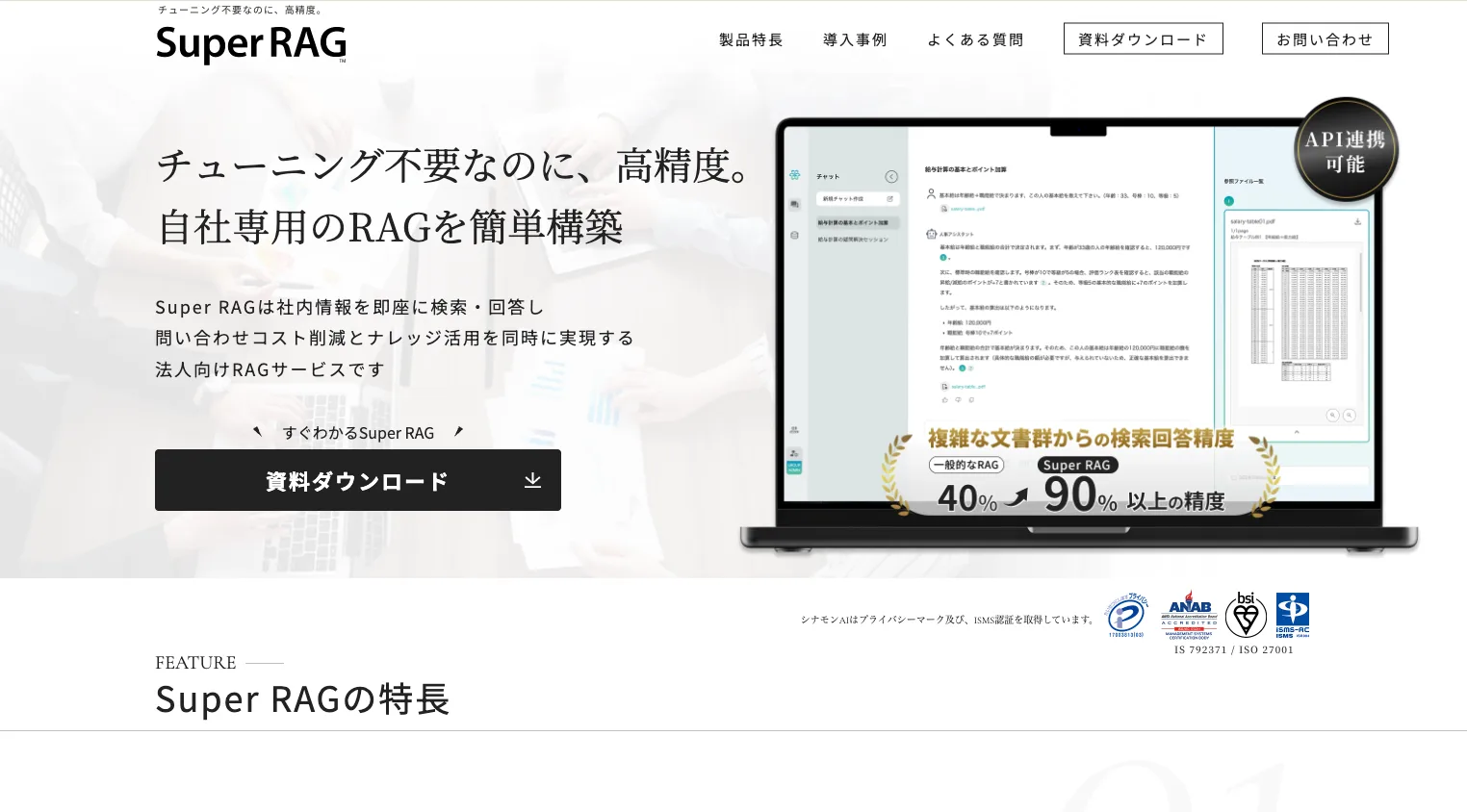
Cinnamon AI, an AI solutions provider, has developed its own RAG system, “Super RAG,” and provides it to Norinchukin Bank. RAG (retrieval-augmented generation) is a technology in which AI generates answers while referring to accurate information, and it is especially promising in highly specialized fields.
Streamlining Work with the Proprietary RAG System “Super RAG”
A key feature of Cinnamon AI’s “Super RAG” is that it can read information with high accuracy even from complex unstructured documents (documents without a fixed format) that include figures and tables. It can generate highly accurate answers without tuning, so it is also easy to deploy.
Using data for company assessments: It extracts the necessary information from huge amounts of unstructured data about companies and helps improve the accuracy of company assessments.
Using data for sales planning: It analyzes diverse internal and external data and helps plan more effective sales strategies.
More efficient internal Q&A: In response to staff inquiries, AI finds accurate information in internal documents and answers quickly, helping streamline Q&A work. This looks very convenient for smoothly resolving everyday questions.
Cinnamon AI reportedly plans to keep advancing process automation through agent workflows that use the “Super RAG” API, as well as trials of AI agent adoption.
Daiwa Securities
Daiwa Securities, a major securities company, has introduced “KARAKURI assist,” an AI agent for customer support, to improve the quality of customer service while making contact center work more efficient and standardized.
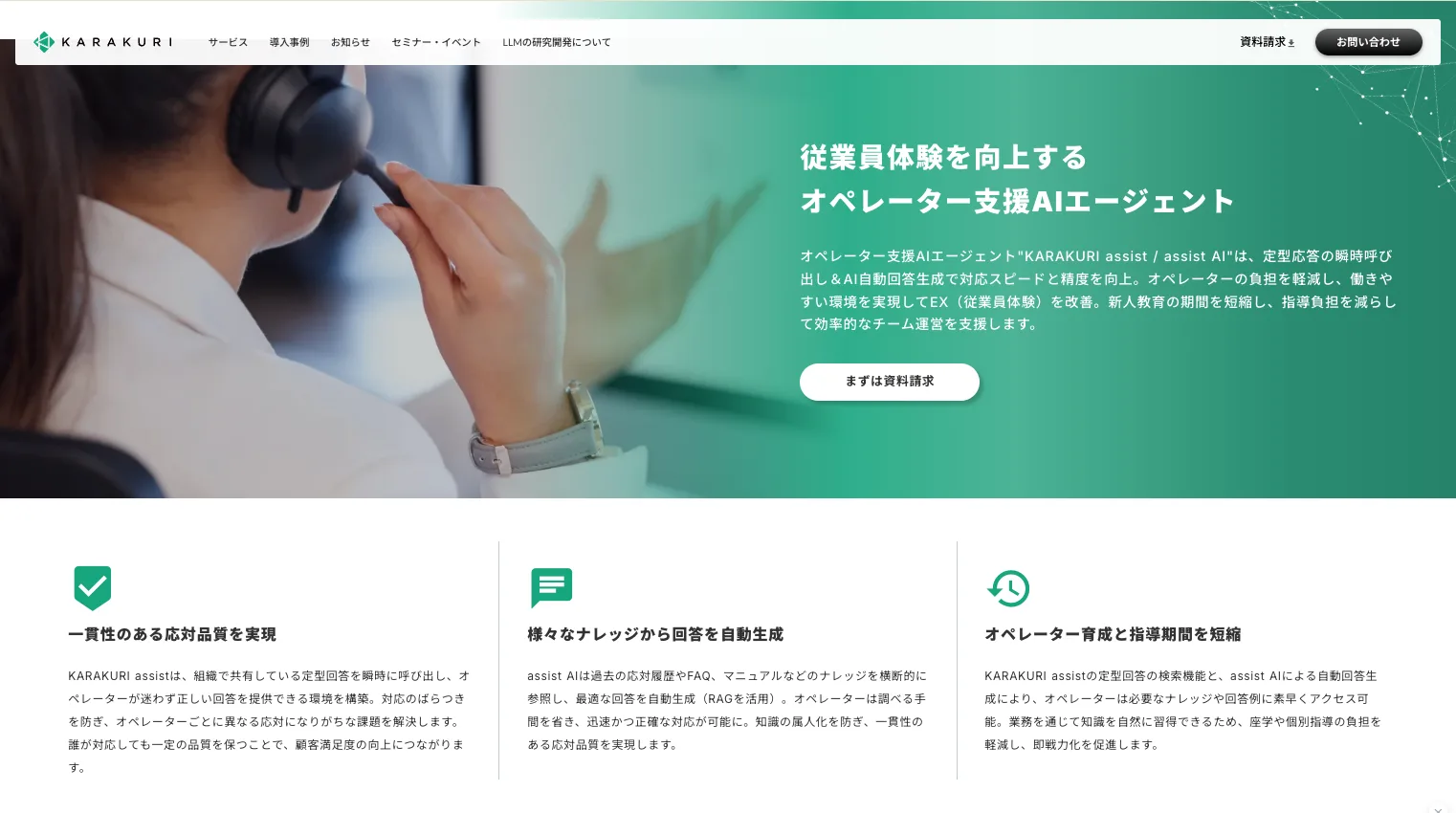
“KARAKURI assist,” an AI Agent for Customer Support
At Daiwa Securities’ contact center, work had been growing more complex because of procedures unique to the securities business and a rise in inquiries about NISA. Especially in email handling, using template responses depended on individual skill, and it took a long time for new staff to work independently, among other problems.
Shorter email handling time: Introducing “KARAKURI assist” cut email handling time by an average of 6 minutes 50 seconds per message and reduced workload by 52 hours per month. That is a remarkable effect.
Standardizing contact center work: The AI agent manages knowledge centrally and creates a setup where anyone can respond consistently, eliminating variation in response quality.
Encouraging knowledge sharing and use: By opening up template registration to frontline operators, practical knowledge is shared more easily, building a more useful knowledge base.
Daiwa Securities’ effort is a good example of how AI can raise the quality of customer service while reducing the burden on the people who do the work.
New Trends in Fintech
As a Forbes article points out, “investment research” using AI agents is drawing attention as a new trend in fintech.
Faster Investment Research with AI Agents
AI agents are dramatically speeding up research for investment banks and investors, work that used to take a lot of time and effort.
Examples from specific companies: The trading app Robinhood and the investment advisory startup Arta Finance have announced AI features for consumers. Companies such as AlphaSense, Hebbia, RavenPack and Rogo have released AI tools that streamline research for professionals.
Hebbia’s Contribution
Hebbia in particular specializes in streamlining research at financial institutions and law firms and provides support such as the following.
Private market data analysis: AI also analyzes market data that is not public and identifies investment opportunities.
Identifying risk factors: It quickly finds potential risk factors in complex documents and data.
Report writing: AI helps write reports summarizing research results, saving time and effort.
AI agents that instantly find and analyze the data you need from vast amounts of information are truly a powerful ally in the information society.
Industry-Wide Trends and the Outlook of Major Financial Groups: FIN/SUM 2025
FIN/SUM is one of Japan’s largest fintech events, where cutting-edge technology and innovation in the financial industry are discussed. At FIN/SUM 2025, Japan’s major financial groups held lively discussions about using AI agents. Let’s look at some of the challenges each group recognizes and the futures they envision.
SMFG (Sumitomo Mitsui Financial Group)
SMFG strongly emphasized the need for “agentification” and “personalization” in financial services. This means it is important for AI agents to propose the best services for each customer’s needs and respond attentively, almost like a dedicated representative. The customer experience looks set to improve greatly, and expectations are rising.
Mizuho FG (Mizuho Financial Group)
Mizuho FG stressed the need for AI agents against the backdrop of “a shrinking workforce,” one of Japan’s major challenges. As staff shortages become more serious, it appears to see AI agents automating and streamlining work as the way to keep providing high-quality services with limited personnel.
MUFG (Mitsubishi UFJ Financial Group)
MUFG spoke about the potential of “agent-to-agent collaboration,” in which AI agents work with each other, to overcome the limits of what people alone can do in some areas of work. The idea is that when multiple AIs cooperate, each handling what it does best, they can take on more complex and advanced work.
SMBC (Sumitomo Mitsui Banking Corporation)
SMBC shared PoC (proof of concept: testing whether a new idea or technology is feasible) cases of using generative AI to draft and analyze contracts. With AI drafting complex contracts and analyzing their content, major efficiency gains and fewer errors can be expected.
As this shows, Japan’s major financial groups each recognize the importance of AI agents from different perspectives and are actively moving to use them. From many angles, including the shrinking workforce, a better customer experience and more sophisticated work, AI agents look certain to shape the future of the financial industry.
GenerativeX
GenerativeX offers solutions that can handle very complex tasks by combining generative AI and AI agents. Its technology goes beyond generating information: agents judge and act autonomously, aiming to reinvent a wide range of business processes.
AI Agents That Handle Complex Tasks
GenerativeX’s solutions are used in a wide range of complex work, such as the following.
Core system monitoring: AI constantly monitors the state of systems and automatically detects and reports any anomalies.
Financial analysis: AI analyzes huge amounts of financial data and helps develop a deep understanding of a company’s business condition.
Purchasing and procurement: AI selects the best suppliers and supports negotiations, streamlining the procurement process.
M&A due diligence: AI supports the detailed investigation (due diligence) needed for mergers and acquisitions.
AI getting involved even in advanced, strategic work like M&A is truly surprising.
cycaltrust Inc.

cycaltrust Inc. runs its business with a very unique approach that combines AI agents with “Web3,” a new internet technology. It aims to guarantee the “authenticity” (genuineness) of products and services and build a foundation of trust across society.
Building a Trust Foundation with “Web3 x AI Agent” Technology
Web3 is the concept of a next-generation internet that uses technologies such as blockchain to achieve transparency and decentralized management of information. By combining it with AI agents, the company is pursuing possibilities such as the following.
Guaranteeing the authenticity of products and services: For example, a product’s manufacturing history and distribution process are recorded on a blockchain, and AI agents check against that information to keep counterfeits and imitations from circulating. Being able to choose products with confidence is very good for consumers.
Building a “trust foundation”: AI agents verify the reliability of all kinds of information in digital spaces, aiming to build a safe, trustworthy digital environment for society as a whole.
The combination of AI agents and Web3 looks set to make the digital society of the future safer and more transparent.
Uhuru Corporation

Uhuru Corporation, which supports cloud service adoption and provides consulting, offers a contact center renewal solution for the financial industry that uses Salesforce’s AI agent “Agentforce.”
Renewing the Contact Center with Salesforce’s AI Agent “Agentforce”
Contact centers in the financial industry handle a wide variety of customer inquiries and require complex information sharing, so the burden on operators tends to be heavy. Uhuru aims to solve these problems with AI agents.
Lighter operator workloads and more efficient operations: AI handles routine inquiries and organizes information, reducing operators’ workloads and improving overall efficiency.
Automatic inquiry classification with AI voice guidance: AI voice guidance takes customers’ calls, automatically classifies the inquiry and connects them to the best department or operator.
CRM integration: AI connects with the customer relationship management (CRM) system and responds while instantly referring to the customer’s information.
Call summaries: AI automatically summarizes calls, saving the effort of writing records.
Handover information: Even when operators change, AI concisely presents the history of past interactions and the necessary information, supporting a smooth handover.
This lets operators focus on higher-value work. For customers, too, shorter waits and smoother problem resolution are welcome changes.
Workday, Inc.
Workday, Inc. is a company that provides a cloud platform for managing HR, finance and AI agents in one place. It strongly supports efficiency and data use across the whole company.
An AI Platform That Manages HR, Finance and Agents in One Place
Workday’s platform manages HR data, financial data and AI agent activities in an integrated way, much like a company’s “brain.”
Services using data centers in Japan: Workday has set up data centers in Japan and offers domestic AWS (Amazon Web Services) operation of Workday HCM (human capital management) and Workday Financial Management. This addresses Japanese companies’ concerns about security and compliance in data management.
Expectations from PayPay Corporation: PayPay Corporation, known for its cashless payment service, has also welcomed the opening of Workday’s data centers in Japan and expects to use the services safely and securely in line with domestic compliance requirements.
AI supporting core business functions such as HR and finance, combined with a secure data environment, is very reassuring for business management.
ExaWizards Inc.
ExaWizards Inc., which aims to solve social problems with AI, has formed a business alliance with Fukuoka Financial Group (FFG) and is driving digital transformation (DX) in the financial industry.
Using “exaBase Studio,” a Platform for Developing and Running AI Agents
ExaWizards is using “exaBase Studio,” its platform for developing and running AI agents, to transform FFG’s operations and raise productivity.
Transforming FFG’s operations and raising productivity: exaBase Studio provides a foundation for developing and running AI agents efficiently. This lets FFG raise overall productivity by handing time-consuming work to AI and having AI support more complex decisions.
Also looking at joint rollouts to regional companies: This effort could extend AI agent solutions beyond the FFG group to regional small and midsize companies that do business with FFG. An effort that also helps revitalize regional economies is truly wonderful.
ExaWizards’ technology is expected not only to make financial institutions’ work more efficient but also to benefit the regional companies and customers beyond them.
ZEALS
ZEALS offers AI agent solutions specialized in “conversation,” and in the financial industry in particular, it focuses on automating communication with customers and improving the customer experience (CX).
Customer Service AI Agents in the Financial Industry
ZEALS’s customer service AI agents guide customers through financial products and support procedures through natural conversation, as if a person were responding.
Product diagnosis and simulations: AI diagnoses the best financial products for each customer’s situation and proposes simulations of the future.
Automating document requests and inquiries: AI automatically handles document requests and answers common questions, so customers get the information they need without waiting.
Nurturing: AI provides information at the right time based on customers’ interests and behavior, contributing to “nurturing” that increases their willingness to buy.
LINE official account integration as a top priority: ZEALS places great importance on integration with LINE official accounts, which many people use every day, so customers can communicate smoothly with AI agents on a familiar platform. This feels very convenient for users.
Automating and reducing manual work while maintaining and improving CX: By having AI take over routine work, ZEALS aims to automate and reduce work that used to be done by hand while keeping, and even improving, the quality of conversations with customers.
GFA Co., Ltd. & OKWAVE Inc.
GFA Co., Ltd. and OKWAVE Inc. are pursuing a unique effort that combines the new technology of Web3 with AI agents to make information more reliable. The two companies are working together and using their respective AI agents in the “Web3.0 special community” on the Q&A site “OKWAVE Plus”.
Providing Information Through AI Agents Specialized in Web3
GFA has developed “GENAI,” an AI agent specialized in Web3 technology, which provides automatic first responses to specialized questions. OKWAVE Inc., which runs “OKWAVE,” one of Japan’s largest Q&A sites, has also introduced its own AI agent “Ai” into this community, where it automatically answers users’ questions.
In relatively new fields like Web3, there are still few people with specialized knowledge. By providing fast, accurate information based on existing Q&A data and expertise, AI agents let users resolve their questions quickly and help raise the knowledge level of the whole community. Having AI explain specialized topics in an easy-to-understand way is a big help.
Headwaters Co., Ltd.
Headwaters Co., Ltd., an AI solutions provider, has added the “Stripe agent toolkit” to its lineup as an AI agent solution specialized for payments.
Accelerating DX by Combining AI and Payments
Headwaters aims to accelerate digital transformation (DX) in business by combining AI with payment functions.
Stripe agent toolkit: This toolkit is an SDK (software development kit) that adds payment functions to AI agents. It lets developers build payment processing directly into AI agents.
Automating the payment process: AI agents understand payment instructions from customers and process payments automatically, greatly streamlining payment processes that used to involve people.
Stronger monetization of AI tools: Adding payment functions directly to the services AI provides lets companies strengthen AI tools themselves as a source of revenue. AI doing business on its own is an interesting idea.
AI Bank: A New Banking Model Enabled by AI Agents
As AI agents become smarter and able to think for themselves and handle entire processes, they are expected to eventually make possible an “AI bank,” a truly autonomous banking operation. The idea is that AI functions not just as a tool but as the bank’s brain. It is almost as if the whole bank became one giant AI agent.
The New Value an AI Bank Offers Customers
What good things would an AI bank bring to us as users?
AI supports life planning and money planning: Tell the AI your dreams and goals for the future, and it will understand your current relationship with money and work out a concrete action plan with you. It is as reassuring as having your own life planner available for advice anytime.
A smooth path from saving to investing: AI analyzes our spending, tells us how much we can comfortably put into investments and proposes investment strategies that suit us. It may even handle the procedures for us. This looks set to lower the barrier to investing dramatically.
AI helps review household spending: AI looks at your monthly household budget and makes it visible where money is being wasted. It sometimes even suggests specific ways to save, like “you’re spending too much on this item,” so managing money looks like it will become much easier.
Democratizing “individual” service: Until now, highly attentive financial services have been offered mainly to wealthy customers. But with AI understanding each person’s needs and providing personal service automatically, everyone may be able to receive services that “fit them.” This is a big step toward making financial services more accessible.
Closing gaps in financial literacy, cost and information: With AI explaining financial information clearly and presenting the best options, anyone can manage money wisely at no extra cost, even without financial knowledge. Information gaps may also disappear, so no one has to struggle with finance.
Attachment to and reliance on a personal AI: An AI that always supports us and understands our preferences may come to feel like a close friend, and attachment and trust may develop naturally. This is a new kind of relationship of trust.
Benefits for Financial Institutions
Of course, AI banks also bring big benefits for financial institutions. They can provide attentive service without meeting customers face to face, and AI can autonomously reach out to and win customer segments with low financial literacy. And with AI taking over routine work people used to do, employees can focus on more creative and strategic work, making it possible to redeploy human resources effectively.
Key Design Principles for Building an AI Bank
What matters for an AI bank is not adding AI to existing systems but designing a new architecture that assumes AI from the start. This requires new AI customer experiences, AI learning and feedback loops, AI specialization and system boundary design, responsible AI design that addresses regulation, security and risk, data collection and aggregation, flexible delivery of products and services, process design and APIs that need no human intervention, and integration with embedded finance, other companies’ services and other companies’ AI agents.
The Potential of the “AI CFO” for Businesses
For businesses, too, the AI bank concept brings major change. The idea is that AI deeply learns the financial and commercial transaction data of the bank’s corporate customers and is dispatched to companies as an “AI CFO (chief financial officer).”
Support for planning and autonomously executing financial strategy: An AI CFO will not only analyze a company’s financial position and propose the best financial strategy but also seamlessly provide automated financing (automatic fundraising) and automated asset management services.
Bank relationship managers can make more advanced proposals: Based on the data the AI CFO provides, banks’ corporate relationship managers will be able to make more advanced and strategic proposals to client companies than ever.
The AI bank has the potential to fundamentally transform the financial business, and in the future the bank itself may shift into an “unsung hero” that works behind the scenes of business.
The Relationship Between Cryptocurrency and AI Agents
AI agents are drawing a lot of attention, especially in finance and investment, as a technology that will lead the Web3 era, often described as the next form of the internet. AI agents eliminate the assumptions (biases) people may hold, such as “it must be this way,” and help make efficient decisions. And because they can provide personal services tailored to each customer, they have the potential to bring major change to the financial industry.
As AI technology and blockchain (the foundation technology of Web3) merge, AI agents are taking a central role in Web3 ecosystems such as DeFi (decentralized finance), NFTs (non-fungible tokens) and the metaverse, and their range of applications is expanding. AI agents are expected not only to automate repetitive work such as data entry, compliance checks and transaction processing, but also to serve as “thinking systems” that support risk analysis, forecasts of market movements and even fast, accurate risk-based decisions.
Expectations and Reality for AI Agents in Cryptocurrency
CZ, the founder of the cryptocurrency exchange Binance, has also said that cryptocurrency is a natural financial system for AI, and that blockchain will provide the data AI needs while protecting privacy. This is the view that cryptocurrency is important as the infrastructure for AI to operate in finance.
However, the market for cryptocurrency-related AI agents is still developing. Practical projects such as information analysis and investment funds have appeared, but many projects are highly speculative and cannot be called immediately useful. Sygnum, a Swiss crypto bank, also sees AI agents as one of the trends of 2025, while pointing out that they have a strong speculative side. Against this backdrop, AI infrastructure projects such as Bittensor (TAO) are working on more practical problems.
The number of cryptocurrency tokens related to AI agents is also growing, and they come in many types: platforms for building AI agents, AI-led decentralized autonomous organizations (DAOs), projects in which AI evolves autonomously, and projects that support Web3 content creators.
Main Uses of AI Agents in the Cryptocurrency Market
AI agents take advantage of the characteristics of the cryptocurrency market and play a role in many situations.
Automating high-frequency trading: AI analyzes huge amounts of market data in real time, judges the best timing to buy and sell, and executes trades automatically. This is a big advantage in the cryptocurrency market, where speed is everything.
Optimizing portfolio management: AI proposes the best mix of cryptocurrencies for each investor’s risk tolerance and goals and adjusts it automatically. It is like having an excellent asset management advisor.
Stronger risk management: AI assesses market fluctuations and the risks of specific cryptocurrencies and proposes strategies to avoid them.
More efficient information gathering and market analysis: By collecting data from every source, including news, social media and on-chain data, and analyzing it with AI, market trends and sentiment (investor psychology) can be captured quickly.
Automating DeFi protocols: AI automatically handles complex processes in decentralized finance (DeFi), such as managing liquidity pools and executing trading strategies, enabling efficient operation.
More efficient mining: In cryptocurrency mining, AI proposes the best allocation of resources and helps reduce operating costs.
Risks of AI Agent-Related Cryptocurrency Tokens
However, AI agent-related cryptocurrency tokens also carry several risks.
Technical challenges and ethical issues: Some parts of the technology are still immature, and ethical issues around the use of AI remain.
Market speculation and price volatility: The cryptocurrency market as a whole tends to be speculative, and AI agent-related tokens are also extremely volatile, so there is a risk of sharp drops if they fall short of expectations.
Competition and liquidity: With so many projects competing, competition is fierce, and competing with Chinese companies that have low-cost AI technology is a particular challenge. And because few of these tokens are handled by exchanges in Japan, there is also liquidity risk (how easily they can be bought and sold).
Information and regulatory risks: There are also risks of AI-generated misinformation spreading and of financial losses from inaccurate predictions or advice. When using overseas exchanges, you also need to understand differences in language and in each country’s laws and regulations.
AI-specific risks: Experts have also pointed to the possibility of an “echo chamber effect,” in which AIs with similar algorithms take the same actions and information becomes skewed, and of AI-driven trading causing artificial bubbles and crashes. Other challenges include the risk of investors relying too heavily on AI and weak security due to immature technology.
The combination of AI agents and cryptocurrency holds great potential, but there are also many points to be careful about. It will be worth watching how these risks are overcome as the technology evolves.
Key Points of Trends in Finance, Securities and Insurance
- Faster efficiency gains and automation: AI agents automate routine financial work (data entry, reviews, claims processing and more), achieving major time savings and cost reductions.
- Advanced analysis and decision support: AI agents support complex financial judgments, such as risk analysis, market forecasting, fraud detection and M&A support, quickly and accurately based on data.
- Personalized and innovative customer experiences: AI agents understand each person’s financial situation and offer personalized services, such as household budget support and investment proposals, to a broad range of customers.
- Strategic adoption and industry collaboration by major financial groups: Japan’s major financial institutions are pushing full-scale adoption of AI agents and collaboration to cope with labor shortages and increasingly diverse customer needs.
- Opening new fields by merging with Web3 and next-generation technology: Cryptocurrency, blockchain and AI agents are coming together, accelerating efforts to ensure the reliability of digital assets and create new financial services.
In this article, we showed how autonomous agentic AI is opening up new possibilities in fields closely tied to our lives, such as healthcare and finance. Next time, we will dig deeper into the trends and use cases of the “supercharging” AI agents bring to HR, marketing, customer service and manufacturing. Stay tuned!
Q&AQuestions and answers
- How is agentic AI different from conventional generative AI?
- Generative AI is a passive system that produces text, images and other content one request at a time, in response to instructions called prompts. Agentic AI understands the final goal, makes its own plan, carries it out, evaluates the results and improves, and keeps working until the goal is reached.
- What is the difference between an AI agent and agentic AI?
- The term AI agent often refers to a program that performs a specific task, such as a chatbot or a voice assistant. Agentic AI refers to the whole system in which autonomous AI agents work together and cooperate to achieve complex goals.
- How are AI agents used in healthcare?
- They are used for pre-consultation interviews, medical record summaries, reception at pharmacies and clinics, patient monitoring and drug discovery. For example, AI-DataScience's Curalumi® reportedly more than doubles consultation efficiency, and UiPath's agent can cut prior authorization time by up to 50%.
- Are there finance use cases that have already produced results?
- KeyBank in the US completed data extraction equal to nine years of work in just 14 days. Daiwa Securities cut email handling time by an average of 6 minutes 50 seconds per message with KARAKURI assist, and PKSHA Technology's solution entered data with 93% accuracy in a trial at a major life insurer.
- What is an "AI bank"?
- An AI bank is a truly autonomous banking operation in which AI agents think for themselves and handle entire processes. It supports each customer with life planning, household budget reviews and moving from savings to investment, and for businesses it includes the idea of dispatching AI to companies as an "AI CFO."