Tourism DX as the Key to Regional Revitalization: The Tourism Marketing Program That Unlocks Awara Onsen's Earning Power (Part 1)
- The Tourism Marketing Program we started with the Awara Onsen Ryokan Cooperative in June 2024 uses monthly online workshops and Slack to build members' digital marketing skills and cooperation across the area.
- In the first half, joint efforts such as Instagram collab posts and the "Awara Onsen Invitation Campaign" took off, and participants began to review and rethink their past initiatives.
- At the same time, the low priority of marketing work and resistance to local cooperation emerged as challenges, and we believe the tourism association taking the lead as a neutral coordinator is the key.
Since June 2024, we have been running the Tourism Marketing Program with the Awara Onsen Ryokan Cooperative. The program helps tourism businesses learn digital marketing and build practical skills. It also aims to deepen cooperation among local businesses and raise the appeal of the entire Awara Onsen area, unlocking its earning power.
This article describes the results that emerged in the first half of the program, the changes in participants’ mindsets and behavior, and the fundamental challenges the region faces. After the program ends, we will publish Part 2 on how the program evolved and the concrete results it achieved in supporting sustainable tourism in the region. Please stay tuned for the progress of the Tourism Marketing Program, a new initiative combining Awara Onsen and tourism DX.
The Awara Onsen Ryokan Cooperative, Leading Tourism in the Awara Onsen Area
The Role of the Awara Onsen Ryokan Cooperative
The Awara Onsen Ryokan Cooperative is an organization of lodging facilities in Awara Onsen, a hot spring resort in Awara City, Fukui Prefecture. Since its hot springs first opened in 1883 (Meiji 16), Awara Onsen has been loved as the “hidden retreat of the Kansai region.” The cooperative oversees its member facilities and has worked to improve the appeal and service quality of the hot spring town as a whole.
Awara Onsen Ryokan Cooperative official website (Japanese)
However, the tourism industry has entered a new phase marked by increasingly diverse traveler needs and advancing digitalization. In Fukui Prefecture and the Awara Onsen area, changes in visitor profiles due to the Hokuriku Shinkansen extension were also expected. Rather than leaving each lodging facility to deal with this on its own, people called for raising tourism value across the whole region. The cooperative set up a Marketing Strategy Committee and, in addition to its traditional operations, began strategic, data-driven marketing.
Turning Marketing Knowledge into the Strength of the Area
To run data-driven tourism initiatives effectively, it is essential to develop people with data analysis know-how and marketing expertise. Region-wide challenges such as raising awareness of the Awara Onsen area and attracting visitors must also be addressed by the area as a whole.
To break through this situation, the Awara Onsen Ryokan Cooperative planned and launched the Tourism Marketing Program, which shares marketing knowledge with member inns and aims to strengthen visitor acquisition through cooperation across the Awara Onsen area. The program aims for the whole region to work together to raise its earning power and tourism value. It goes beyond providing knowledge: it aims to build practical skills and a system of cooperation across the area.
Background and Goals of the Tourism Marketing Program
Fukui Tourism DX in the Awara Onsen Area
To strengthen its ability to attract visitors and revitalize the region, the Awara Onsen area took part in the 2023 tourism DX (digital transformation) demonstration project run by the Fukui Prefecture Tourism DX Marketing Data Consortium. The project focused on promoting data-driven tourism initiatives that generate revenue and tried to raise marketing skills across the area.
An AI-Powered Local Success Model Featured in a G7 Policy Document: Fukui Tourism DX
With the cooperation of its member facilities, the Awara Onsen Ryokan Cooperative made lodging reservation data available as open data. This was achieved through the Japan Tourism Agency’s FY2023 “Demonstration Project for Revitalizing Tourism and Regional Economies through Data Collaboration among Businesses and Regions,” with development by consortium members Code for FUKUI and B Inc. Making reservations across the area visible lets lodging facilities optimize food purchasing and resource allocation. Understanding and analyzing guest attributes such as place of residence is also expected to help optimize targeting and promotion for the whole area.
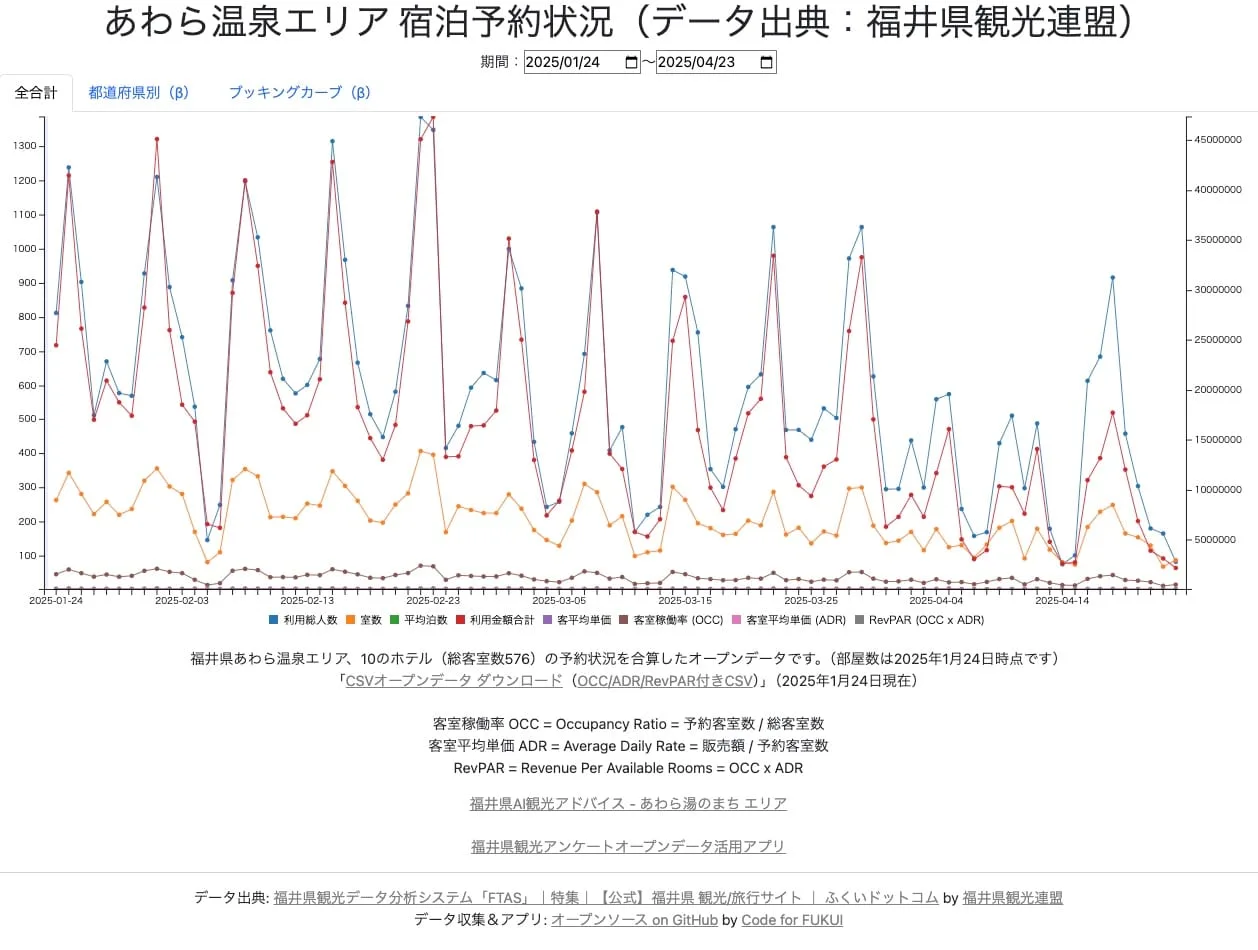
FTAS, the Fukui Tourism Data Analysis System: Awara Onsen area lodging reservations
In parallel, as part of a “model case creation project,” basicmath provided hands-on digital marketing support to Hotel Yagi, a cooperative member, and the Awara City Tourism Association. These businesses planned and placed their own online ads, analyzed performance data and devised improvements, running through the PDCA cycle and achieving solid results.
Model case creation (data utilization): Hotel Yagi (PDF, Japanese)
Model case creation (data utilization): Awara City Tourism Association (PDF, Japanese)
Why the Tourism Marketing Program Was Launched
When the Fukui tourism DX demonstration project ended, many lodging businesses and tourism association staff said that, because they lacked digital marketing knowledge and know-how, they had no capacity to continue or carry out initiatives on their own after the program.
On top of that, external factors such as labor shortages from population decline, a nationwide issue, and shifts in tourism demand from the opening of the Hokuriku Shinkansen made strategic marketing more necessary than ever. People began to recognize that raising tourism value across the region required not just individual businesses but the tourism association and other related organizations working together.
Against this background, the Tourism Marketing Program was planned with the Awara Onsen Ryokan Cooperative at its center. In the program, member businesses learn the basics of marketing while the whole region thinks through strategic, data-driven tourism initiatives. It started in June 2024 and is under way as an important program that strengthens regional cooperation and aims to raise the value of the destination as a whole.
Program Goals
① Building practical marketing skills that increase earning power
The first goal of the program is to give participants digital marketing skills they can put to use immediately, not just knowledge. Through monthly workshops and discussions on Slack, participants gain a deep understanding of data use and ad operations and build practical skills that help in their daily work.
Through the program, we aim for each participating lodging business to increase its earning power and achieve a direct rise in sales.
② Strengthening cooperation across the region and raising tourism value
By encouraging participants to share knowledge and information, the program aims to strengthen cooperation among lodging businesses in the area and across Fukui Prefecture. By working together across the region on attracting visitors and promotion, we help individual businesses solve their challenges and raise the tourism value of the whole region.
Ultimately, the goal is to build a foundation for the region to grow as a sustainable destination and contribute to the development of the entire Awara Onsen area.
What the Tourism Marketing Program Includes
① Workshops on Marketing Fundamentals
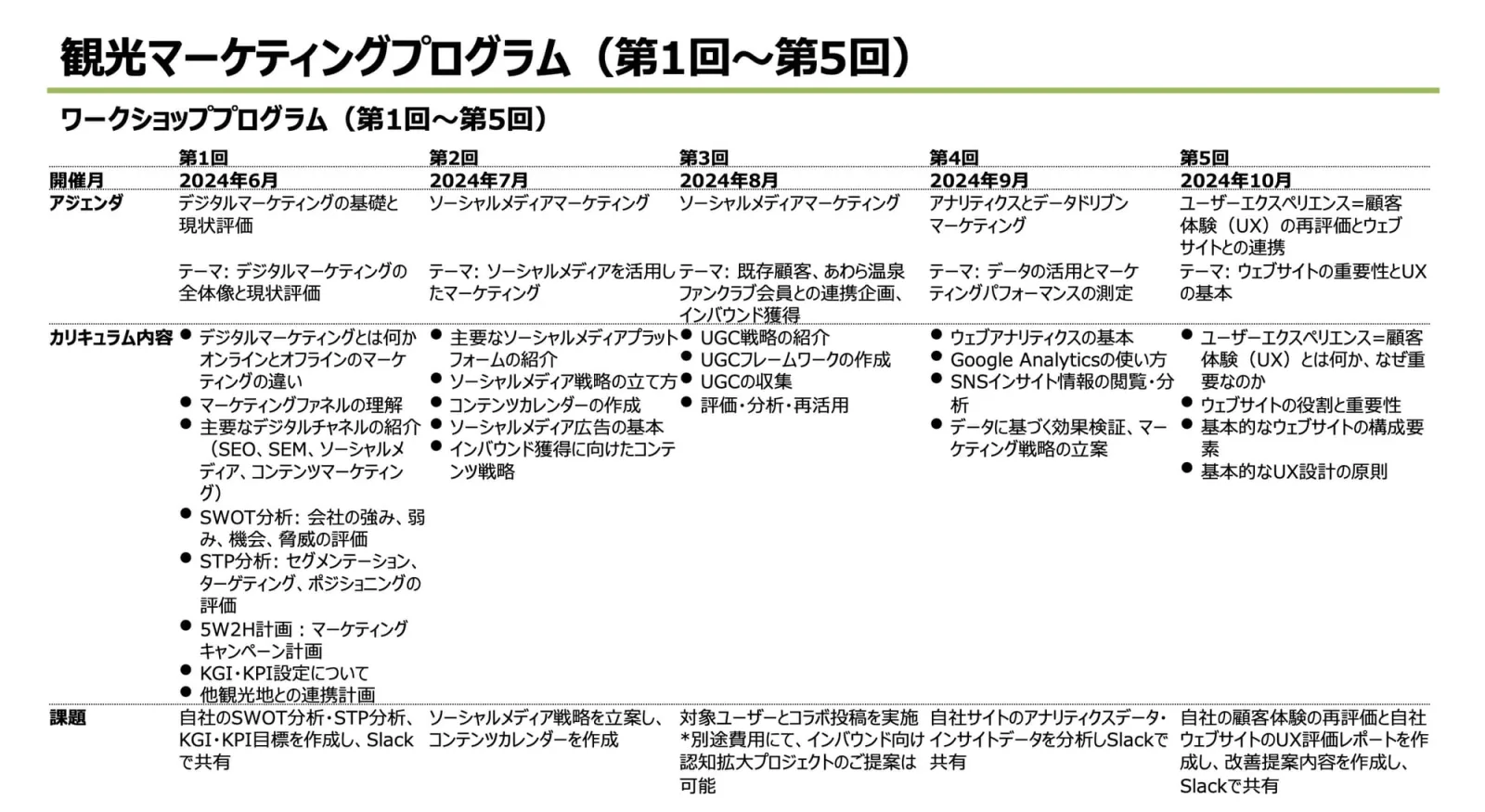
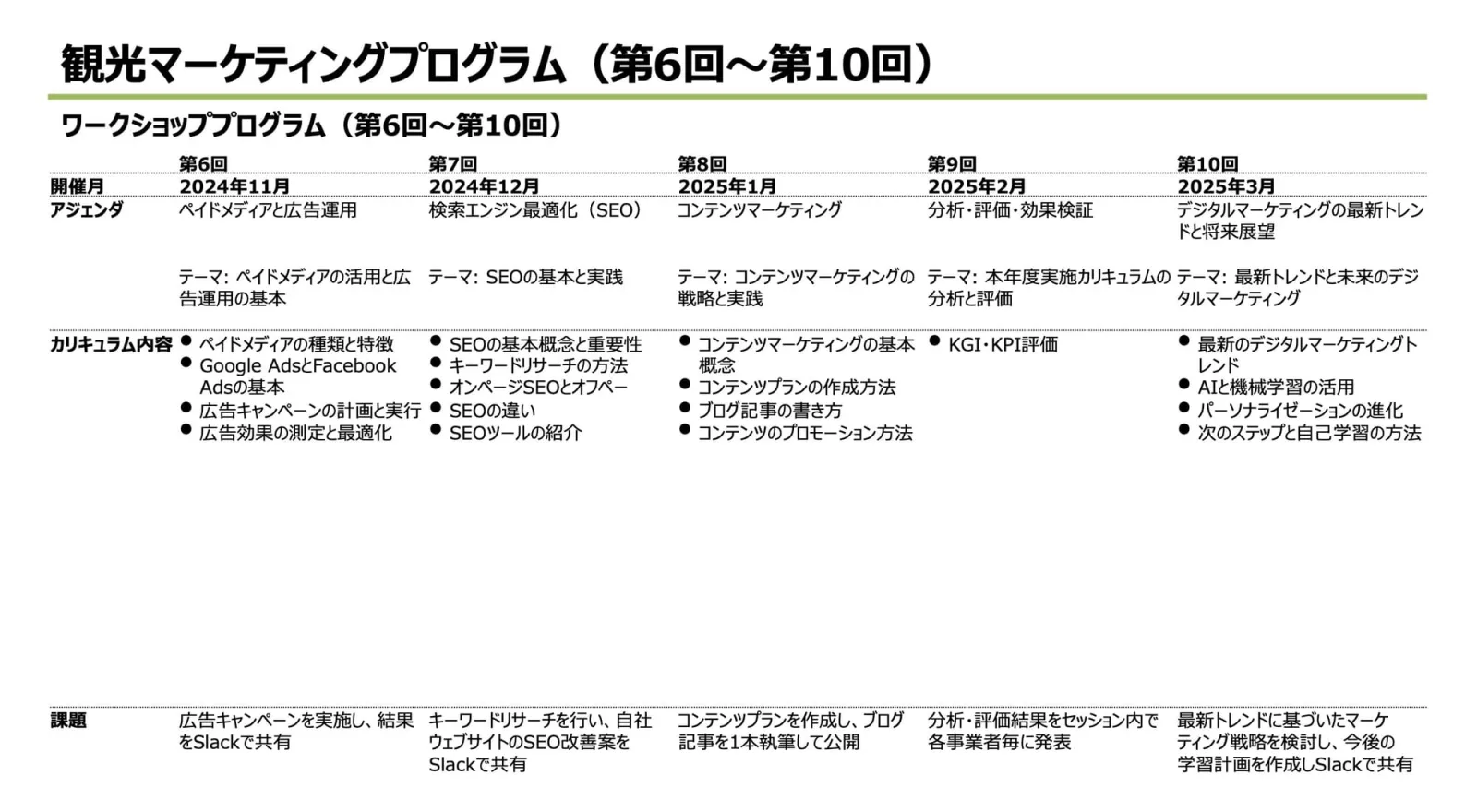
The monthly online workshops are for member businesses of the Awara Onsen Ryokan Cooperative and tourism association staff. Participants learn digital marketing basics in lecture format and build practical skills through Q&A and discussion, in an environment that makes it easy to take part actively. We also take questions and comments on Slack at any time and flexibly adjust the content and time allocation to participants’ needs and current challenges, keeping the program practical and grounded in the realities of the field.
Each session also includes time for participants to share past initiatives and experiences based on the session’s theme. Information sharing and discussion using Awara Onsen lodging reservation data play an especially important role in every workshop. Beyond sharing each facility’s reservations and promotion efforts, discussing how the numbers match the staff’s on-the-ground feel gives participants more practical and concrete insights.
The workshops do more than provide knowledge. They also serve as a place where tourism businesses share successes and challenges and deepen their mutual understanding.
② Stronger Cooperation between Lodging Businesses and the Tourism Association
In this program, we propose practical initiatives through which lodging businesses and the tourism association work closely together to promote tourism effectively, and we support their execution.
Encouraging Instagram Collab Posts
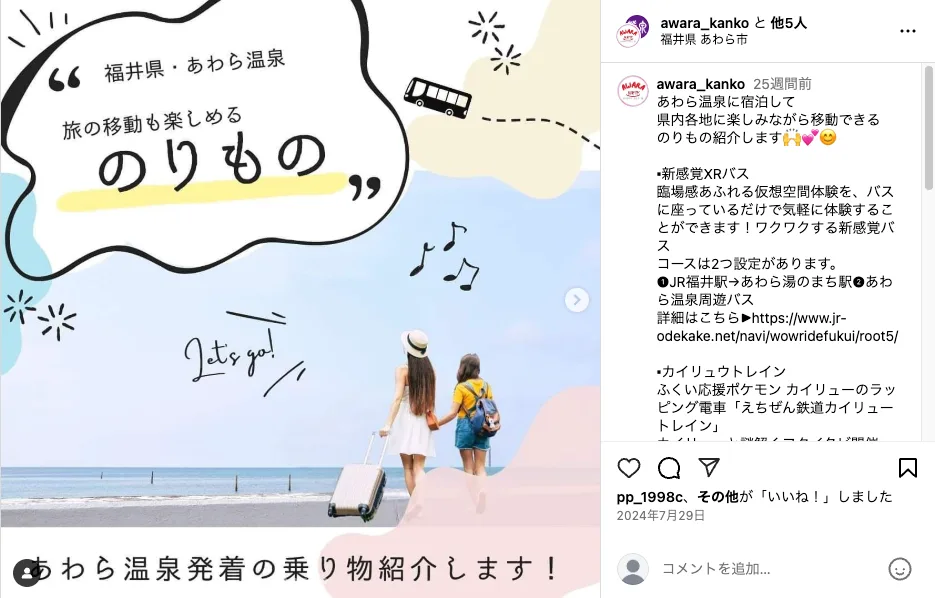
Lodging businesses and the tourism association use Instagram’s collab post feature to maximize their reach, including both sides’ followers. A common concern is that “if lodging facilities in the same area cooperate, won’t they compete for the same guests?” However, each facility has different target segments and its own appeal, so even when their posts overlap, the inn a user actually chooses differs by the user’s profile.
Instead, participants came to share the view that when lodging facilities collaborate to increase the reach of the whole area, they can expect a synergy effect in attracting visitors. This case shows that cooperation between local lodging businesses and the tourism association can help raise awareness and competitiveness for the destination as a whole.
A Jointly Planned Instagram Campaign
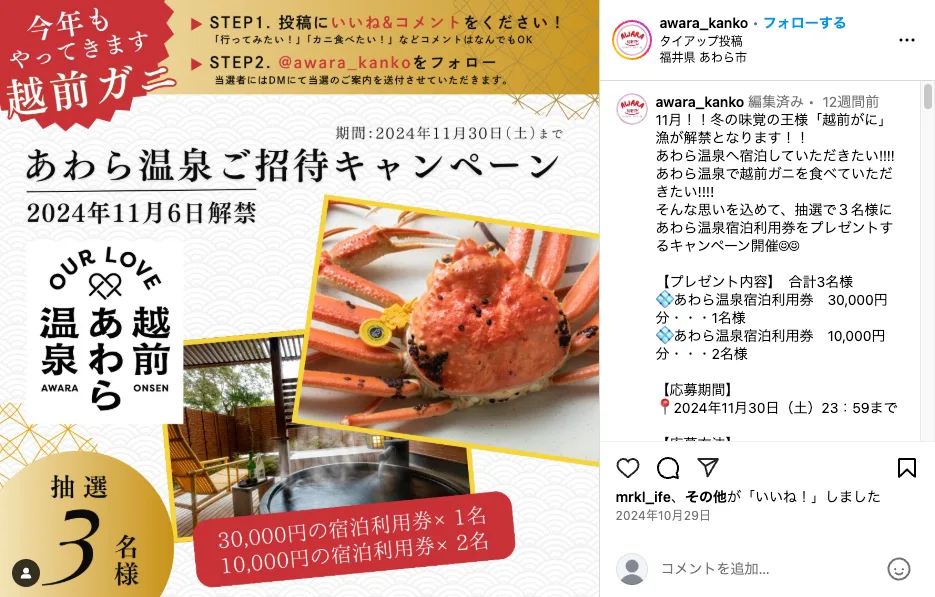
To gain followers for the Awara City Tourism Association’s official Instagram account, we ran the “Awara Onsen Invitation Campaign.” The Awara Onsen Ryokan Cooperative and the tourism association carried out the campaign together ahead of the opening day of the season for Echizen crab, a Fukui Prefecture specialty.
Collab posts between the area’s lodging accounts and the tourism association’s account were already under way, so the idea of sharing reach had taken root locally. However, even nationwide, there are almost no cases of businesses sharing campaign results and collected data with other businesses. In most cases, businesses run initiatives on their own and keep the data to themselves. Yet to raise earning power, the whole region needs to share data and knowledge actively and raise the experience level of all participating businesses.
In this campaign, all participants were actively involved from the planning stage. After the ads ran, the performance results and data, including comments collected from users as a condition of entry, were shared. Through this process, participating businesses gained a concrete understanding of the full flow from planning to evaluation. It was also a valuable opportunity to see firsthand that sharing and building up small initiatives directly raises the knowledge and skills of businesses across the region.
Building an Information-Sharing System on Slack
In this program, we set up a Slack environment where participants can share materials and archived workshop videos, check the progress of joint campaigns and consult on initiatives in real time. One of the main reasons cooperation between businesses and within an area does not go smoothly is the lack of tools for sharing information in real time. In rural areas, regular information sharing through meetings and email is the norm, and there is no way to make quick decisions or cooperate flexibly.
We believe it is important not only to provide knowledge and build skills but also to create a “place” where businesses can keep cooperating, share the information they need and exchange views. By providing that place through Slack, we hope to make campaign management and discussion more efficient and strengthen cooperation across the region.
③ Proposing Marketing Plans with the Future of Regional Tourism in Mind
We are also working to strengthen cooperation between regions and to raise the brand power of the entire area as a destination. Awara Onsen is one of the most popular tourist destinations in Fukui Prefecture. Strengthening marketing in this area and building up success stories is an important step toward revitalizing tourism across the prefecture.
This program does not end the learning after one year. We provide support so that the area can keep generating revenue in the following years and beyond. In particular, for the advertising of events held by the Awara Onsen Ryokan Cooperative, we not only advise on ad materials and creative but also propose effective promotion methods based on our own know-how.
By building up cases in the Awara Onsen area, we hope to show the importance and potential of data-driven tourism DX and contribute to the development of tourism initiatives across Fukui Prefecture.
Results of the Program: Changes among Participants
1. Greater Marketing Knowledge
The lodging businesses in the program are building their knowledge step by step, from digital marketing basics to practical application. Ad placement and promotion used to be done by feel. As participants come to understand the importance of data-driven initiatives, they have changed significantly: they are reviewing past efforts and considering marketing methods suited to their target segments.
The discussion on online advertising was especially memorable. Participants reflected that “we never had a chance to look back at whether our past ad campaigns worked” and “we ran campaigns without thinking deeply about targeting, and the results did not follow.” Others said, “we left it to an ad agency but could not fully pursue cost-effectiveness.” Participants coming to recognize the importance of having marketing knowledge themselves is a major result of the program.
Participants have also moved beyond a passive stance and are actively applying what they learn to their own businesses. For example, businesses that learned to run Google Ads and social media ads are devising and executing ad strategies that maximize results on limited budgets. As a practical test of the data analysis covered in the workshops, we also provide hands-on support, such as planning and running campaigns based on customer trends and needs within the program and reviewing the results with participants.
Through discussions on Slack and case sharing in the workshops, participants also learned from other lodging businesses’ successes and applied them to their own initiatives. As these connections within the area keep growing, we expect marketing skills across the region to improve and the area as a whole to become more competitive.
In this way, the program’s goal of “building practical marketing skills that lead to sales” is progressing well. A foundation is taking shape for marketing thinking to take root in the cooperative’s future efforts and to contribute to revitalizing tourism across the region.
2. A Culture of Reviewing Past Initiatives and Finding New Possibilities
Through the program, the mindset of “looking back at past initiatives and finding new possibilities” is gradually spreading among participants. Until now, many initiatives ended with only the outcome, such as “it did not attract visitors” or “it did not lead to bookings,” with little chance to dig into the causes. As a result, businesses often moved on to new initiatives without properly evaluating results.
However, through the workshops and discussions on Slack, participants have rediscovered the importance of reviewing past initiatives, and they are starting to evaluate them from new perspectives. One participant asked themselves, “Is this really the right approach?” about the targeting and creative of the online ads they work on, and showed a willingness to rebuild the initiative using past data and others’ input. This process of questioning again is an extremely important way of thinking in marketing.
In addition, as visualization of area PMS (property management system) data advanced, participants can now understand lodging reservations more concretely. Rather than simply taking the data at face value, participants are checking how it matches their on-the-ground sense while considering new initiatives.
This process of “review and improvement” is a basic principle of marketing and data use. We see participants beginning to adopt this perspective through the program as a sign of a major change in marketing across the region.
3. Cooperation among Businesses Spreading across the Region
Through the program, local businesses are beginning to work together on joint initiatives to promote tourism. It used to be common for lodging businesses and the tourism association to act separately. Through the workshops and discussions on Slack, participants are starting to feel the major benefits that become visible with cooperation across the area.
For example, in the Awara Onsen area, lodging businesses have started using Instagram’s collab feature to post jointly. Efforts led by the tourism association to plan and run events and promotions across the region are also becoming more active. In this way, cooperation among local businesses is creating effects that individual initiatives could not achieve and raising the tourism value of the whole area.
Participants’ Voices (Excerpts)
On the lectures
Our website does not express what we care about. After the lecture, I started paying attention to information from the customer’s point of view.
I was expecting quick results from ads, but after the lecture I realized I need a long-term outlook.
On past initiatives
When we build a website, we tend to focus on the design. It is hard for us as a business to notice issues like loading speed or the customer’s point of view.
We received reports on the ads we commissioned from an ad agency, but we did not know the evaluation criteria we learned in the program.
I feel we need to use customers’ voices in our ads rather than ads that just introduce our services.
On cooperation in the area
Each inn has a different image of the hot spring town it wants to be, but all of them share the desire to raise its profile.
I think tourism development should be positioned as a way to lift industry across Fukui Prefecture.
Challenges That Emerged: Barriers to Tourism DX
While the program has delivered steady results, a major challenge for tourism DX has surfaced: there are not enough opportunities or systems for putting what participants learn into practice. We see two main causes.
1. Marketing Has Low Priority
Through the program, participants have learned marketing and strongly feel its significance and the importance of using data. However, given each business’s internal circumstances, marketing does not get high priority in daily work.
Especially in workplaces facing severe labor shortages, staff are busy with daily operations and guest service, leaving little time or resources for marketing. As a result, it seems they cannot secure enough opportunities to put the knowledge and skills from the program into practice. And if marketing itself is not recognized as important work within the organization, a lack of understanding and resource allocation from management will also hinder execution.
Solving this requires not only upskilling frontline staff but also building a system in which management understands and supports the importance of marketing.
2. Resistance to Local Cooperation
Local businesses each have different challenges and directions, so setting common goals can be difficult. For example, even when inns consider jointly promoting the region’s appeal on social media and their websites, a lodging business may be reluctant to spend time and resources if it does not bring direct profit.
To move region-wide efforts forward in this situation, it is important for a neutral organization such as the tourism association to play a central role. In the Awara Onsen area, we believe that if the tourism association takes the lead in data analysis, information sharing and promotion, drives effective initiatives that involve the whole area and shows success stories, it can gradually change the mindset of local businesses, starting with lodging businesses, and spread the importance of cooperation.
We continue to work with the Awara City Tourism Association and hold ongoing discussions on questions such as “what kind of promotion increases visitor acquisition for the whole area?” and “how should the tourism association and the ryokan cooperative work together?” With the tourism association at the center, we expect to reduce the burden on individual businesses and lower the barriers to cooperation.
Looking Back on the First Half of the Tourism Marketing Program
Stronger Cooperation Is Needed to Raise the Regional Brand
To raise the brand power of the whole region, it is essential to deepen cooperation among businesses and foster a sense of unity across the area. To make the destination more competitive, the region needs unified efforts that make the whole area feel attractive.
First, it is important for local lodging businesses and the tourism association to share their goals and challenges and draw up a common vision to achieve together. For example, setting concrete goals such as “raising visitor satisfaction in the region above a certain level” or “promoting a specific seasonal event across the region” will further advance cooperation among businesses.
Data-driven information sharing and planning are also key to raising the regional brand. With the tourism association at the center, collecting and analyzing data on lodging reservations and visitor trends and running effective initiatives across the region based on that data is expected to strengthen the appeal of the whole area.
In addition, sharing the success stories born in the program with other businesses will help build and share know-how within the region and make it possible to extend the Awara Onsen area’s efforts across Fukui Prefecture. This kind of cooperation not only solves individual challenges but is also an important factor in lifting the competitiveness of the whole area.
Toward the Second Half of the Tourism Marketing Program
The Tourism Marketing Program started in June 2024 with the aim of promoting tourism across the region and developing the lodging industry. So far, participants have gained basic digital marketing knowledge, learned social media advertising and targeting skills, and achieved results such as revising their ad strategies and applying what they learned to their initiatives. Exchanges among businesses have also become more active through the workshops, and shared successes and challenges are being put to use in new initiatives.
On the other hand, it has also become clear that some businesses have not fully reflected what they learned in their initiatives, and that a lack of resources and low priority are challenges.
In the second half of the program, we plan to address these challenges and strengthen the system that helps participants turn learning into practice. In particular, we will set up an information-sharing system centered on the tourism association and provide more concrete support for data-driven initiatives. To further raise the tourism value of the whole area, we will also accelerate practical efforts based on success stories and lay the groundwork for revitalizing the entire region.
To contribute to tourism promotion in the Awara Onsen area and across Fukui Prefecture, we will continue to work with participants to maximize the program’s impact and move on to the next stage.
Q&AQuestions and answers
- What is the Awara Onsen Tourism Marketing Program?
- It is an initiative the Awara Onsen Ryokan Cooperative has run since June 2024 for its member inns and the Awara City Tourism Association. Through monthly online workshops and discussions on Slack, participants build practical digital marketing skills and work together across the area to increase their earning power.
- Why was the program started?
- When the 2023 Fukui tourism DX demonstration project ended, many people on the ground said they lacked digital marketing knowledge and know-how and had no capacity to continue initiatives on their own. Labor shortages caused by population decline and shifts in demand from the Hokuriku Shinkansen opening added to the need for strategic marketing across the whole area.
- What joint initiatives took place in the first half of the program?
- Inns and the tourism association made Instagram collab posts and ran the "Awara Onsen Invitation Campaign" ahead of the opening day of the Echizen crab season. All participants shared the campaign's performance results and data, including comments collected from users.
- What challenges for tourism DX did the program reveal?
- Two challenges stood out. Understaffed businesses are busy with daily operations, so marketing tends to get low priority, and businesses are reluctant to spend time and resources on local cooperation that does not bring them direct profit.
- What is needed to move local cooperation forward?
- We believe a neutral organization such as the tourism association should take the lead in data analysis, information sharing and promotion, and show success stories. This is expected to reduce the burden on individual businesses and lower the barriers to cooperation.