[June 2025 Update] How AI Agents Are Supercharging Business: A Deep Dive from Major Companies' Initiatives to Real-World Use Cases (2)
- In HR, Salesforce's Employee Portal resolves 96% of about 10 million searches a year without HR's help, and Maki automates up to 80% of screening and interviews.
- In marketing, an Improvado study found AI agents cut manual reporting by 99.5%, from about 250 hours a month to 1.4 hours, and AEO is becoming a new way to compete for AI's attention.
- Customer service and manufacturing show results too, with Retell AI users cutting abandoned calls by 80% and Hitachi and Daikin's failure diagnosis agent reaching 90% accuracy in under 10 seconds.
- 96%
- Inquiries resolved without HR on Salesforce's Employee Portal
- 99.5%
- Cut in manual reporting time with AI marketing agents (Improvado study)
- 90%
- Accuracy of Hitachi and Daikin's equipment failure diagnosis agent (responds in under 10 seconds)
- 52.1%
- Respondents who said they "don't know" about AI agents (Neo Marketing survey)
In our previous article, we took a deep look at agentic AI, from its basic concepts to concrete use cases in healthcare and finance. This time we widen the lens and explore how AI agents are evolving across a range of industries, including HR, marketing, customer service and manufacturing, and how they are changing the way work gets done. Through the advanced initiatives of many companies, we introduce the latest trends and concrete use cases.
HR and Recruiting: Efficiency Gains from AI Agents and the Future of Work
The progress of AI (artificial intelligence) in today’s business world is remarkable. One technology drawing particular attention recently is the “AI agent.” It is an AI that handles a wide range of tasks automatically, almost like a personal secretary.
The use of AI agents is spreading quickly in human resources (HR) and recruiting. HR work, which covers hiring, developing employees and creating a good working environment, plays a vital role in shaping a company’s future. That is exactly why companies expect AI agents to make operations more efficient and enable more strategic HR initiatives.
In fact, data shows that AI usage is higher among HR and labor management staff than in other job types. This suggests that the field stands to benefit greatly from AI-driven automation.
Why AI Agents Are Drawing Attention in HR and Recruiting
HR and recruiting work involves many routine tasks, and these have long consumed a great deal of staff time. Think of screening piles of résumés, scheduling interviews with applicants, or answering employee questions one by one. AI agents are attracting high expectations as a way to free employees and HR staff from these repetitive tasks. Because they automate time-consuming work such as sorting documents or switching between multiple apps to enter information, HR staff can focus on more strategic work.
Chief human resources officers (CHROs, the heads of HR) reportedly expect that a full rollout of AI agents would raise employee productivity by 30% on average and cut labor costs by 19%. That could dramatically change the future of HR work.
Key HR and Recruiting Use Cases Enabled by AI Agents
So where exactly are AI agents being put to work in HR and recruiting? Here are some of the main use cases.
Automating Employee Support
AI agents automatically handle a wide range of employee questions.
- Answering frequently asked questions (FAQs)
- Managing leave requests
- Handling payroll questions
- Explaining benefits (health insurance, retirement plans and more)
- Providing information on career development opportunities
With easier access to HR information and a smoothly running HR support system, managers and employees can focus on more important projects and tasks. It is an ideal setup in which both employees and managers can concentrate on the work that matters most.
Making Recruiting More Efficient
AI agents give recruiting teams powerful support.
- Helping create job postings
- Finding top talent in large volumes of candidate data
- Scheduling interviews and sending reminders
With AI supporting these tasks, HR staff can make better-informed hiring decisions and shorten time to hire. Candidates also benefit from smoother communication, which leaves them with a better impression of the company.
Supporting New-Hire Onboarding
Onboarding, the process of helping new hires settle into the company, is another area where AI agents excel.
- Answering common questions from new hires in real time
- Providing guidance tailored to each person’s experience and role
- Managing pre-start checklists
- Recommending the learning content they need
- Helping build onboarding profiles
- Helping submit initial IT setup requests
This helps new hires fit in quickly and get started on their work smoothly. A confident start for new employees is a big plus for the company as well.
Clear Results and High Expectations from Using AI Agents
Data shows that 85.7% of people who have used AI agents feel they have made their work more efficient. They appear to use them mainly for “getting-started tasks” at the starting point or preparation stage of work, such as “writing, editing and summarizing text” (55.4%) and “daily information gathering” (44.0%).
Top expectations for AI agents include “reducing human error” (32.8%) and “improving operational efficiency” (31.1%), which points to hopes of achieving both quality and efficiency. Many people also hope to hand routine work to AI, through “fully automating simple tasks” or “optimizing work management.” Seen through the data, the impact of AI agents really does look substantial. Below, we introduce the latest developments company by company.
Salesforce (Agentforce for HR Service)
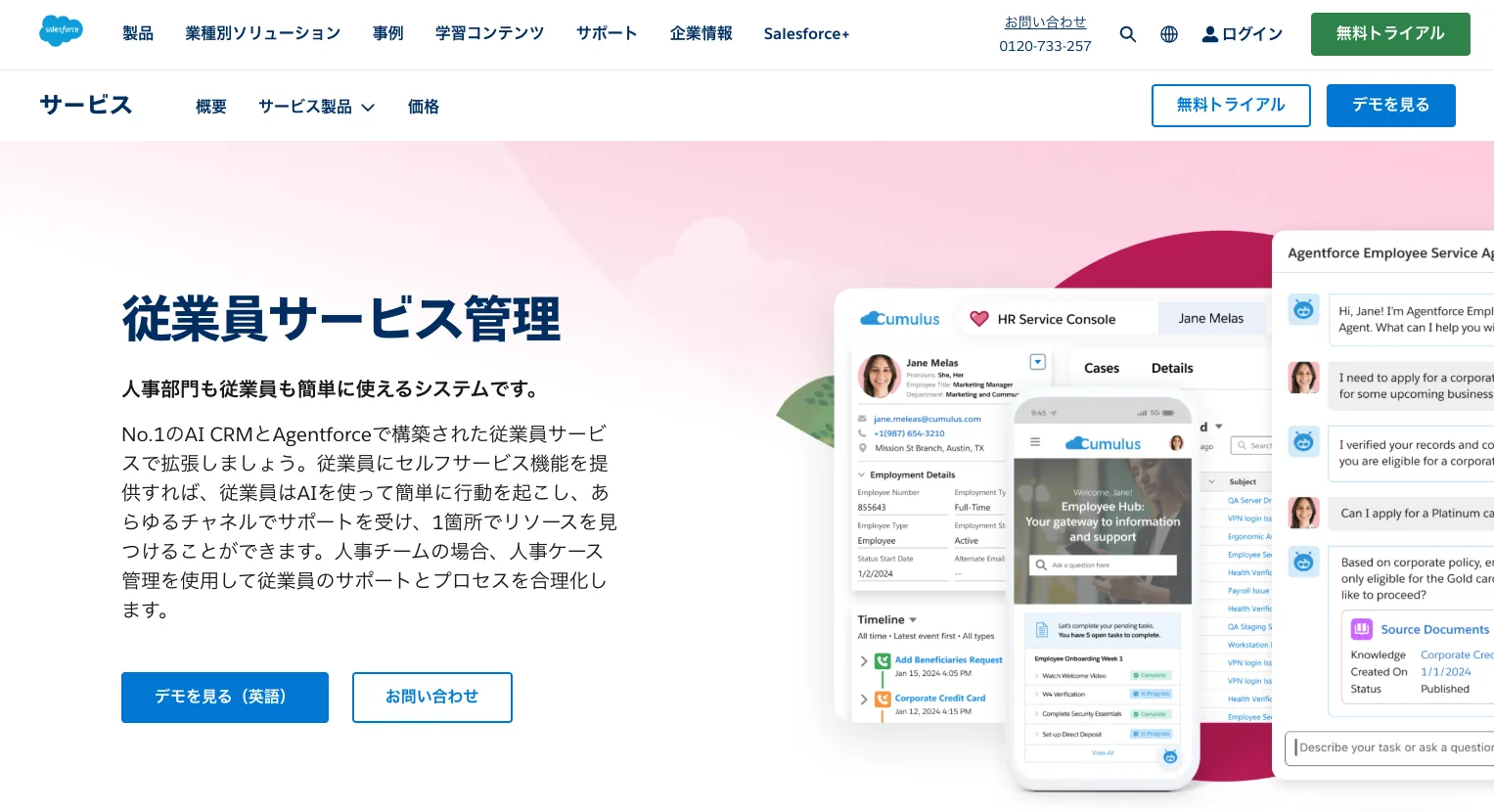
Agentforce for HR Service, offered by Salesforce, is a new set of AI capabilities designed to transform the work of HR teams. It is built directly into the Employee Portal and the HR management screens, so it is easy to use for both employees and HR staff.
The system comes with “topics,” which define the broad categories of work the AI agent can handle, and “actions,” which carry out specific tasks. A welcome point is that these can be freely customized for each company, so they fit the HR operations of almost any organization.
Strong Support for Employees: Key Features
Agentforce for HR Service offers a range of features that help employees complete HR procedures more smoothly.
Conversational procedures: On Slack or the Employee Portal, employees can complete HR procedures conversationally, just as if they were talking to a person. For example, they can file tickets, find company policy documents and carry out operations that span several systems, all in one place. That is genuinely convenient.
Personalized answers: The AI provides the best answer for each person’s situation based on employee data and company policies. Questions like “What happens in my case?” can be resolved right away.
Progress and case management: It is easy to check the progress of HR programs and to track the status of inquiries and requests. Being able to see their own status at a glance gives employees peace of mind.
Automatic profile updates: Changes to an address, phone number or last name are updated in the HR system automatically, with a simple instruction in natural language. Eliminating manual entry is a major benefit.
Smart leave management: Employees can request paid leave, sick leave, parental leave and more through conversation. The AI answers questions based on the knowledge base and processes requests in line with company policy, so requests go through smoothly with fewer mistakes.
Automated payroll and expenses: Updating payroll deposit accounts and submitting and tracking expense claims are also automated, which greatly lightens employees’ administrative load.
Dramatically Improving HR Staff Efficiency
Agentforce for HR Service is a powerful ally not only for employees but also for HR staff.
Integration with the HR Service Console: AI capabilities are integrated into the HR Service Console that HR staff use every day, so they can handle employee requests efficiently.
Real-time response generation: Based on the conversation context and the knowledge base, the AI automatically drafts the best replies and summaries, enabling fast, high-quality responses.
Centralized information and faster responses: Employee data is pulled in from HR systems and can be viewed and updated in the HR Service Console, so information is centralized instead of scattered. This makes personalized responses for each employee faster.
Remarkable Results Inside Salesforce
Salesforce uses Agentforce for HR Service and the Employee Portal in its own HR department. As a result, HR tasks such as well-being support, benefits selection and guidance on transfer processes have become much more efficient. Most notably, the Employee Portal handles about 10 million searches a year, and employees resolve 96% of those inquiries on their own without relying on HR. It is an excellent example of efficiency that strengthens employees’ ability to help themselves while greatly reducing the HR department’s workload.
PeopleX “HR Operator”
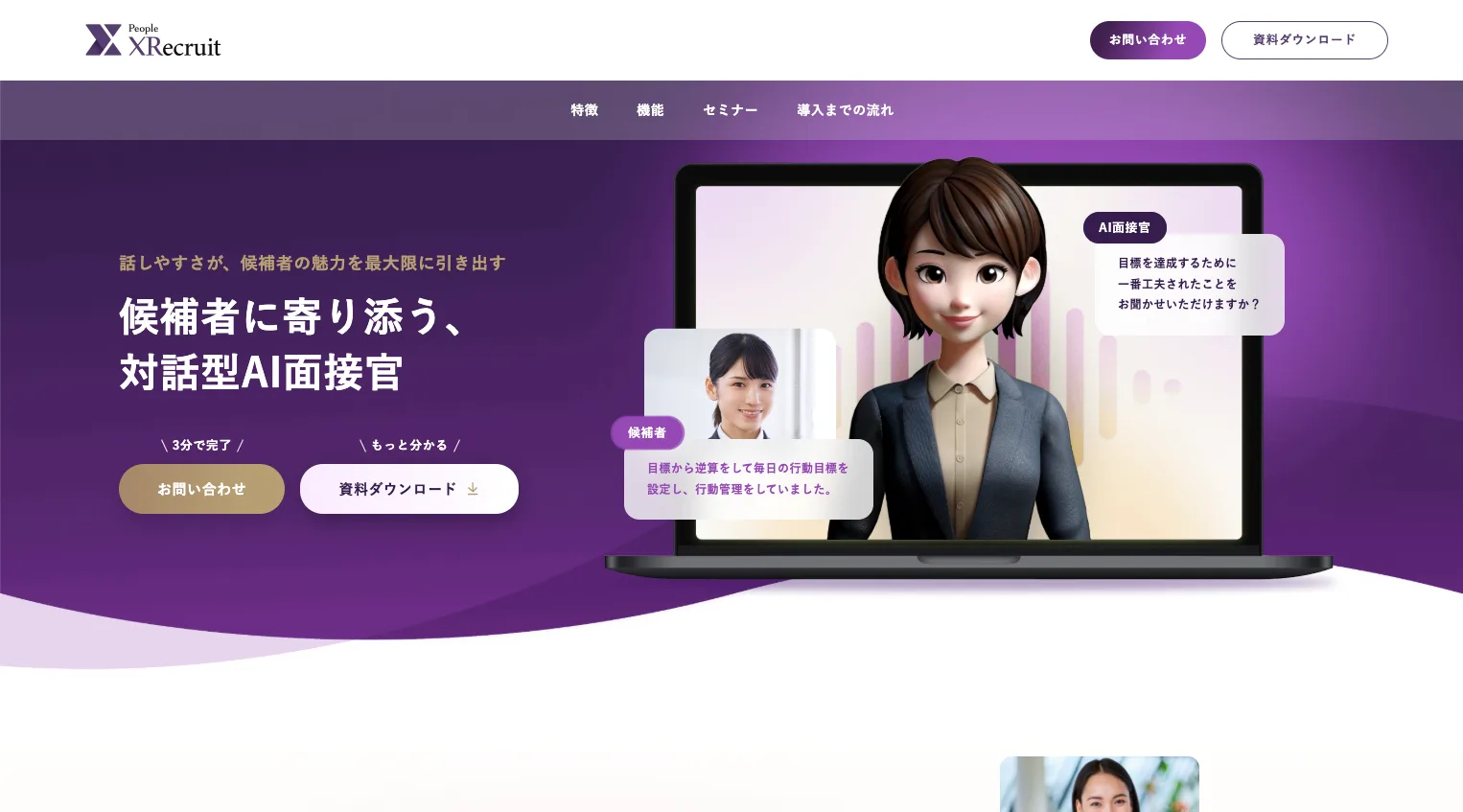
HR Operator, offered by PeopleX, is a service that analyzes each company’s HR requirements and business processes in depth and builds an AI agent system tailored to that company. It supports a broad range of HR work, from recruiting to employee management and performance evaluation.
The AI agent combines a company’s large volume of HR data with cutting-edge LLMs (large language models), and its key feature is that it lets companies build and run an HR system aligned with their business strategy. It promises a level of flexibility and advanced analysis that sets it apart from conventional HR systems.
HR Operator: A Powerful Ally for Management
HR Operator is also a strong ally for managers. It analyzes behavioral data from internal communication tools and other sources and evaluates each employee’s situation from multiple angles. This helps managers make better decisions and give higher-quality feedback in one-on-one meetings with their team members. That should translate directly into higher team productivity.
More efficient scouting AI also supports scouting in recruiting. By automating the process of sending scouting messages to candidates, it lets HR staff focus on more strategic work.
PeopleXRecruit: A Conversational AI Interview Service That Puts Candidates First
PeopleXRecruit is built around the appealing concept of “a conversational AI interviewer that is there for the candidate.” It aims to provide fair, objective interview opportunities and achieve fair hiring decisions.
Interviews available 24 hours a day, designed to be kind to both companies and candidates A major benefit of this service is that applicants can take interviews anytime, anywhere, 24 hours a day. Companies can greatly reduce the hours spent on interviews while offering interviews to more applicants. It is great that it covers not only new-graduate hiring but also mid-career, part-time and hourly hiring.
Generative AI follow-up questions that get to the heart of things PeopleXRecruit is a conversational service that uses generative AI. In addition to preset questions, the AI asks deeper follow-up questions based on each applicant’s answers, which helps reveal the applicant’s true abilities, personality and fit with the company. Interviews can be reviewed through recordings and transcripts, which makes looking back easy.
Case studies and partnerships Super Hotel has adopted the service and reportedly aims to shorten hiring lead times, reduce the interview workload and improve the candidate experience.
Also notable is a partnership with PERSOL Innovation. The service provides “AI mock interviews” to users registered with Pitaten, a job placement service for young people and essential workers. This helps job seekers improve their interview skills while also making career advisors’ work more efficient.
PeopleWork: An HR Platform That Supports Employee Success
PeopleWork is an HR platform that supports the success of each employee (employee success). The service holds a patent on its feature for entering employee skills and qualifications, and its unique approach sets it apart. Its breakthrough is that it goes beyond simple data entry by adding elements of gamification. By using AI to suggest options that match each person’s interests and career goals, it motivates employees to enter their own information and helps build a reliable foundation of employee data. A system that makes employees want to update their own information is extremely valuable for a company.
Workday “Illuminate Agents”
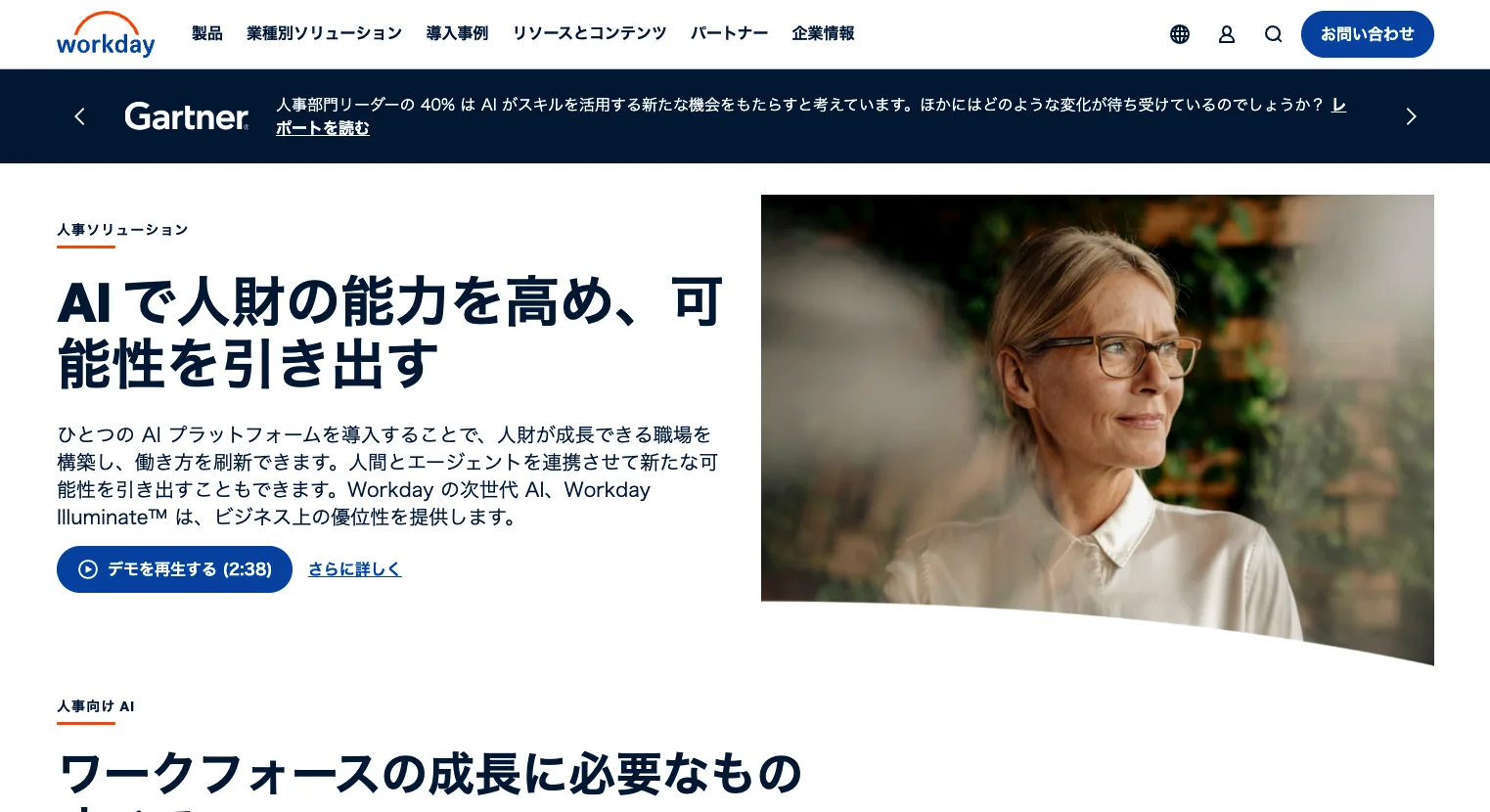
Workday’s Illuminate agents use AI to shorten the hiring process, improve the experience of frontline employees, streamline complex financial processes and help employees find information quickly. Picture a team of AIs, each with its own specialty, helping the company solve its challenges.
A Wide Range of Illuminate Agents
External talent sourcing agent: This agent efficiently finds people interested in temporary positions (for example, staff for short-term projects) and moves them smoothly through the hiring process. It helps companies find the right people quickly, exactly when they need them.
Frontline agent: It lets frontline employees report an absence easily by text message. The AI then quickly identifies the best replacement, so work is less likely to stall when someone is suddenly absent. This is a groundbreaking feature that keeps on-site disruption to a minimum.
Self-service agent: The AI instantly answers questions from employees and managers. It also assists with complex tasks and handles routine procedures (such as address changes or issuing certificates), making work much easier for both employees and HR staff. Finding an answer right away when you are stuck is a real help.
Contract intelligence agent: It reviews contracts quickly, identifies potential risks and automatically tracks important deadlines and fees. This is a very reassuring feature for legal and accounting staff.
Contract negotiation agent: It helps draft language that fits the terms of a contract, detects risks and suggests revisions.
Document-driven accounting agent: It extracts the necessary data from documents such as receipts and automates accounting tasks such as billing, invoice creation and journal entries. It is expected to reduce manual entry errors and greatly improve the accuracy and speed of accounting work.
Supplier contract agent: It proactively reviews supplier contracts, clarifies contractual obligations and finds opportunities to cut costs. This should contribute greatly to cost control and stronger supplier relationships.
Deployment, Management and the Foundation Behind Them
These diverse agents can be deployed and managed through an integrated system called the Workday Agent System of Record. This maximizes the impact of the AI agents and strongly supports higher employee productivity and better business outcomes.
Workday’s AI agents are built on one of the world’s largest and highest-quality HR and financial datasets. This rich data lets the AI deeply understand the business context behind the data. By supporting employees, streamlining finance work and managing AI agents across the whole organization in one place, it transforms business operations as a whole.
Maki
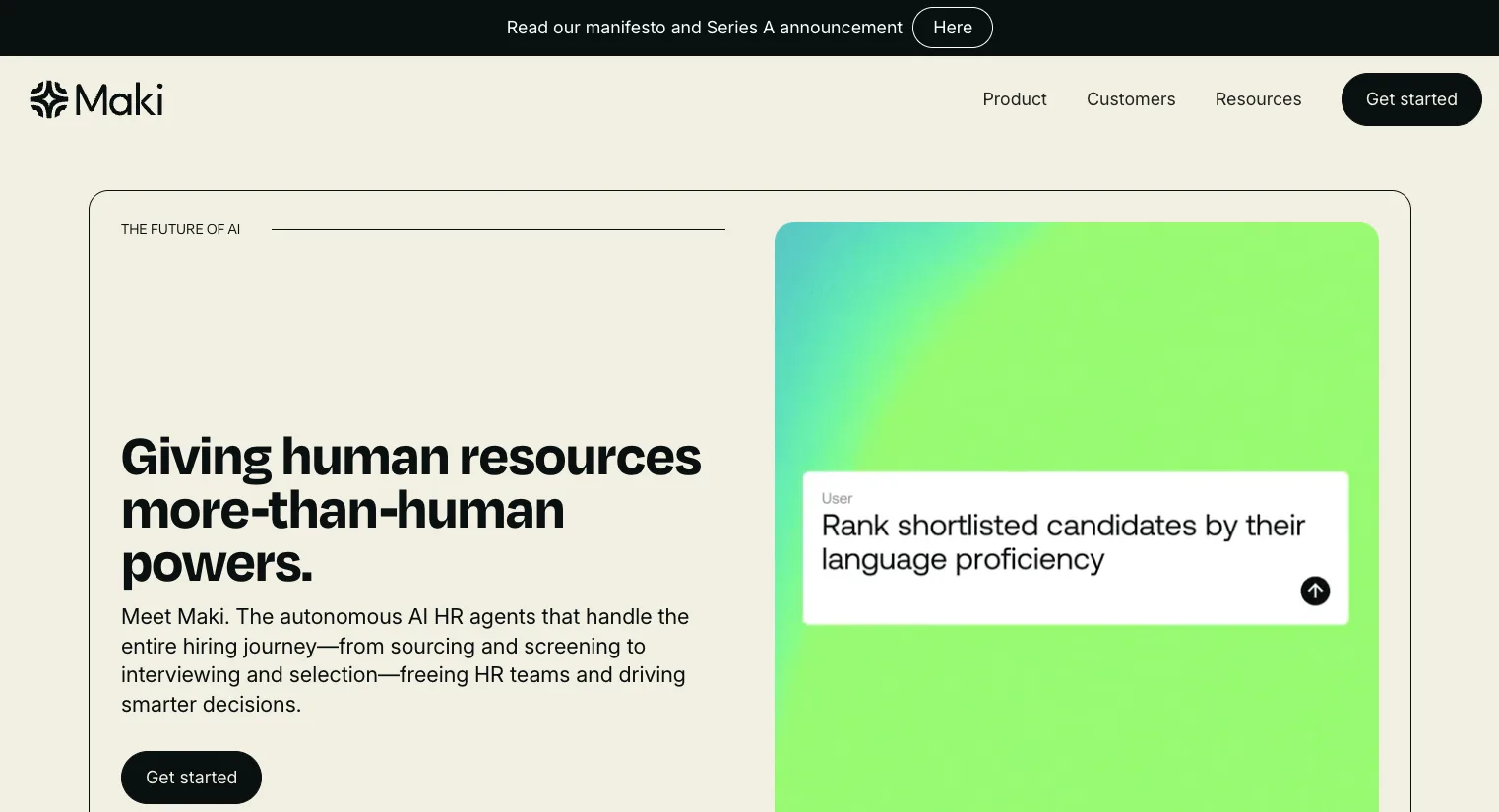
Maki aims to automate the entire recruiting process with AI, from beginning to end: from sourcing (finding talent) to screening (narrowing down candidates), interviews and final selection. A major strength is that its AI recruiting agents can be flexibly customized to match each company’s own workflows, brand image and specific hiring goals.
The Impressive Features of Maki’s AI Agents
Maki’s AI agents offer a variety of features that reduce the burden on recruiters and enable higher-quality hiring.
Screening: Even when there are many applicants, the AI evaluates them quickly and fairly based on their skills, so companies can efficiently find the people they truly need. Fair evaluation matters a great deal to both companies and candidates.
Interview scheduling: Candidates can book interviews instantly, without back-and-forth emails. Both candidates and companies save a great deal of scheduling effort and can move smoothly to the next step. It is a wonderful, stress-free feature.
Adaptive AI-led interviews: Maki’s AI can run interviews efficiently at large scale. Like a veteran interviewer, it digs deeper based on candidates’ answers to draw out more detailed information.
Sourcing (coming soon): Once this feature launches, the AI will be able to identify top talent faster. Finding excellent people quickly translates directly into a stronger competitive position.
Talent assessment: By combining its own fine-tuned LLM (large language model) with psychometrics, Maki can assess more than 300 skills in real time, with high accuracy and fairness. Being able to assess that many skills objectively is remarkable.
Maki’s Real Value, Shown by Its Results
Companies that adopt Maki can expect concrete results.
Up to 80% of screening and interviews automated: This frees recruiters to spend more time on strategic work.
Time to hire shortened by 2 to 3 times: Companies are more likely to secure top talent ahead of competitors.
Turnover reduced by 20–30% through smarter hiring decisions: The AI identifies people who fit the company’s culture and the role, preventing mismatches after hiring.
Positive candidate experience ratings above 95%: A smooth, fair selection process leaves candidates with a positive impression.
Easy Integration with Existing Systems and Robust Security
Maki is compatible with more than 30 ATSs (applicant tracking systems) and integrates seamlessly with major HR systems such as Workday and SAP. Smooth integration with existing systems is a big advantage when adopting it. In addition, Maki meets enterprise-grade security standards. It is ISO 27001 certified and uses end-to-end encryption, giving global organizations confidence that their strict security needs are met. Because it handles valuable candidate information, strong security is extremely important.
IBM
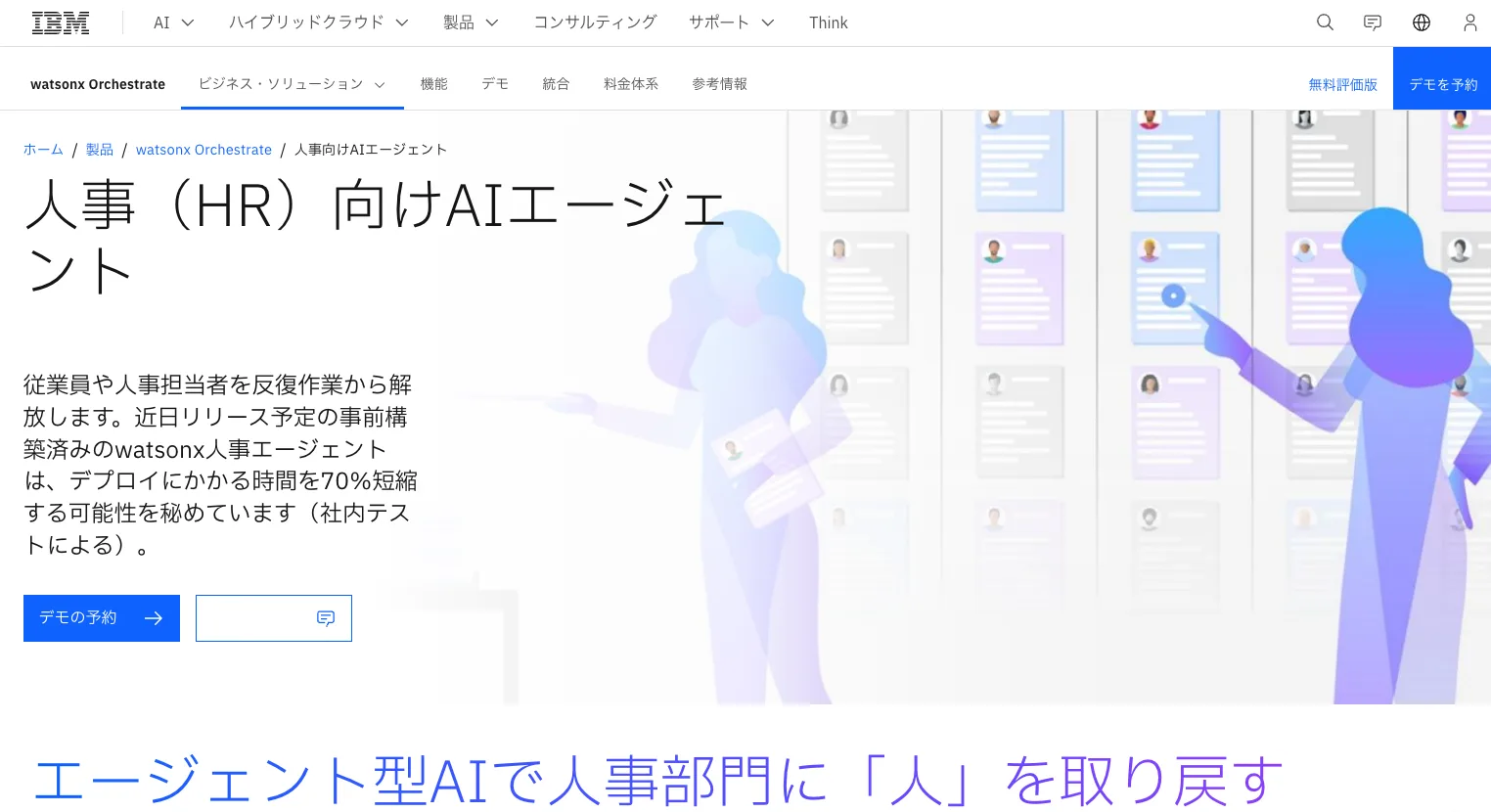
IBM’s AI agent for HR is built on the company’s powerful AI platform, watsonx Orchestrate. The platform connects with the many enterprise applications we use in everyday work, as well as a rich catalog of prebuilt tools, so it can support every kind of HR work.
The AI agent can carry out fairly complex and important HR tasks reliably while firmly following the company’s compliance requirements and policies. It looks like a dependable presence you can trust with the work.
Possibilities Expanded by Specialized Agents
IBM’s AI agent works as a set of “specialized agents,” each focused on a particular area of HR.
Employee support: Beyond answering FAQs, it handles a wide range of employee questions and procedures, such as leave requests, payroll questions and benefits management. An environment where employees can ask questions easily leads to greater workplace satisfaction.
Talent acquisition: It helps write job postings, finds highly talented people and even schedules interviews automatically.
Employee onboarding: It answers questions from new hires, provides the guidance they need to get started, manages checklists and recommends the learning they need for their work. It is reassuring to have AI carefully helping new hires settle into the company smoothly.
Major Expected Benefits
Adopting IBM’s AI agent is expected to bring the following benefits.
Better and faster hiring: Talent acquisition teams can make better-informed hiring decisions, which shortens time to hire and improves the overall candidate experience.
More efficient onboarding: A streamlined onboarding process helps new hires blend into the company smoothly, easing their anxiety and helping them contribute sooner.
Flexible Customization and Strong Security
A major attraction of IBM’s AI agent is that, through an intuitive interface, users can build, extend and customize AI agents without programming knowledge. It also offers prebuilt tools that connect to more than 80 major enterprise applications, closing integration gaps between different applications. That should lower the barrier to adoption considerably.
On security, IBM provides enterprise-grade controls. Authentication across multiple APIs and systems can be managed centrally, and agents can be deployed to the channels of your choice, so they can be used with confidence.
Efforts Toward Fast Deployment
IBM is focused on delivering prebuilt HR agents quickly. In internal testing, the company says deployment time could be cut by as much as 70%.
elu Inc.
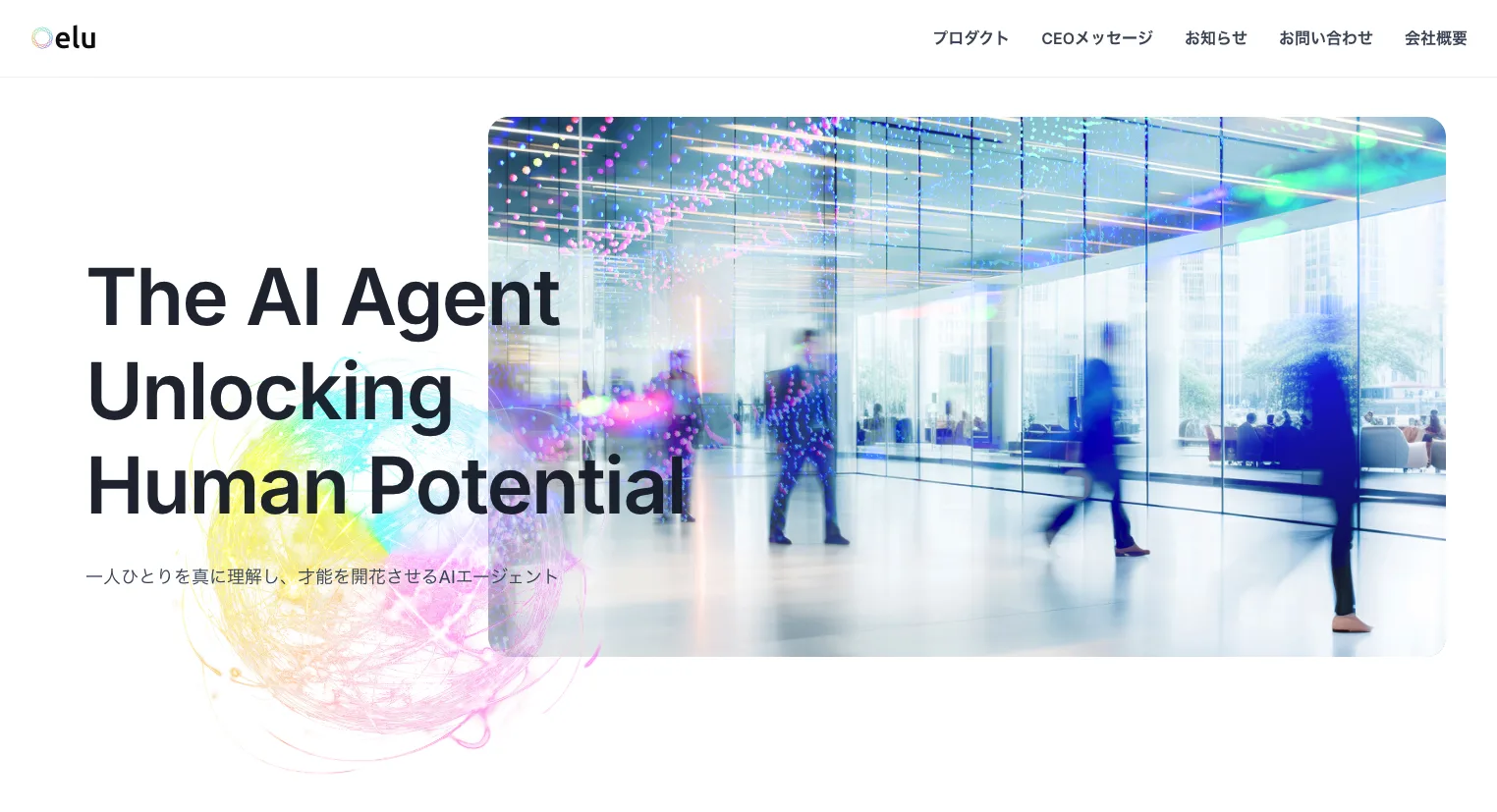
Activity around AI agents in HR is very lively, with new players appearing one after another. One worth highlighting is elu Inc., which focuses on developing AI agents specialized for HR. elu develops and provides AI agents specialized for human resources (HR). What the company values most is staying closely aligned with each company’s unique culture and strategy, and with its view of “which people it values” (its philosophy on talent).
It provides AI agents that learn and evolve autonomously to solve company-specific problems that general AI solutions struggle with. The goal is to turn HR from mere administrative work into a “strategic driver” that accelerates company growth. It is a very exciting effort that greatly expands what HR can do.
A Strong Partnership with SHIFT and a Research Framework
One of elu’s big strengths is that it has partnered with SHIFT Inc., which has one of Japan’s top HR organizations and a vast amount of HR data, and has begun full-scale joint research on next-generation HR AI models. With SHIFT’s extensive knowledge and data, more practical and effective AI agents are expected to emerge. It is an excellent example of AI technology and HR practice coming together.
elu also completed a funding round totaling more than 110 million yen shortly after its founding. The funds will reportedly be used to further strengthen its world-class AI research framework. Its commitment to cutting-edge technology is clear, and we are very much looking forward to its future growth.
Algomatic “Recruita AI Pre-Interview for Staffing Agents”
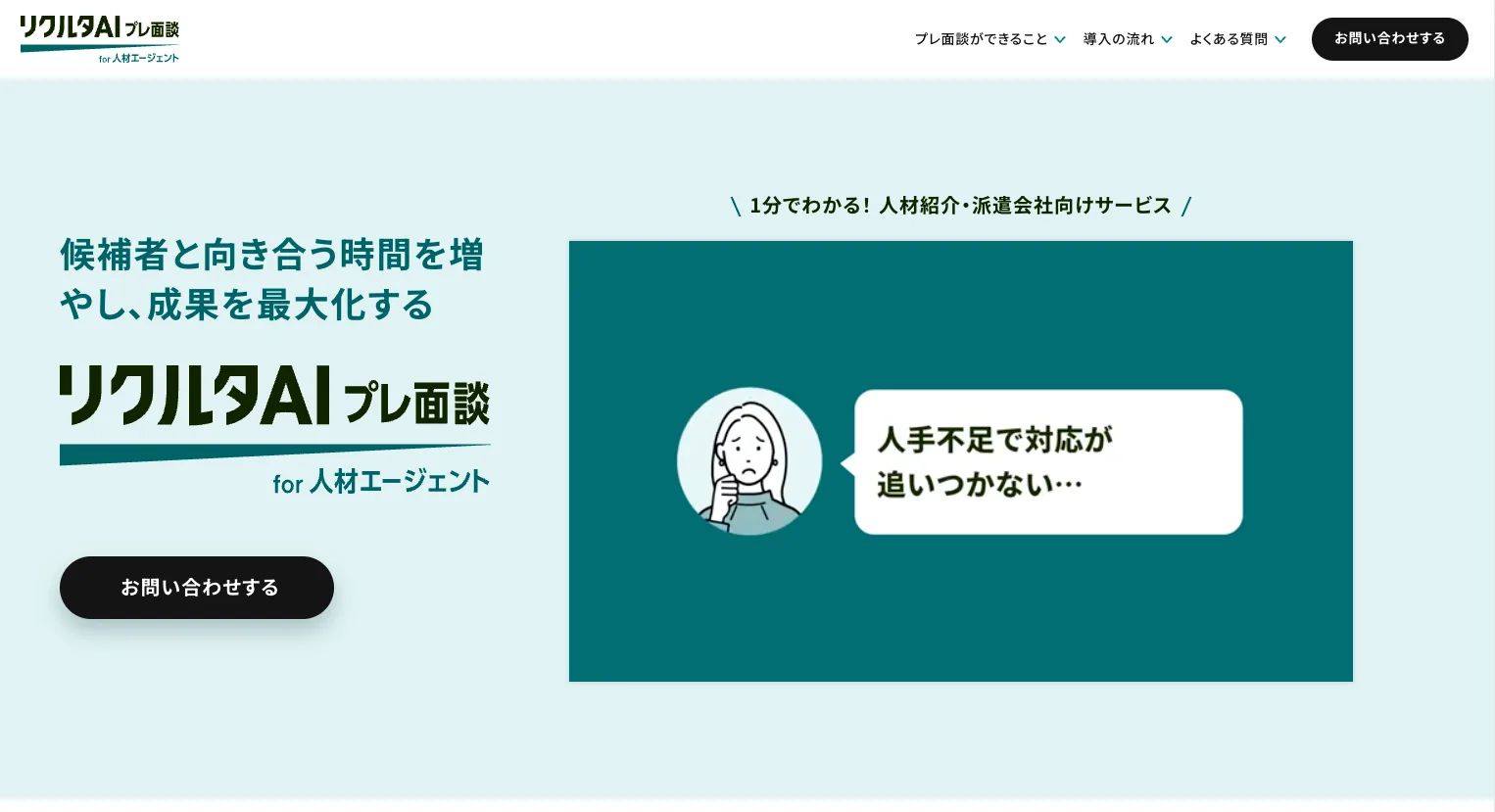
Algomatic plans to launch Recruita AI Pre-Interview for Staffing Agents, a recruiting AI agent for placement and staffing companies, in June 2025. The service is groundbreaking in that an AI agent takes over the initial interview that staffing agents conduct with candidates.
Specifically, the AI agent interviews candidates, helps create skill sheets and even pulls out the best-matching job openings, all in one continuous flow.
Solving Problems with AI That Combines Multiple LLMs
Algomatic’s AI agent was developed by combining multiple large language models (LLMs), including GPT, Claude and Gemini, in its own way. By working alongside staffing agents, this cutting-edge AI helps solve person-dependent problems that have long been an issue, such as growing workloads, uneven response quality among staff and missed checks. It is wonderful when AI brings out people’s strengths and makes up for their weaknesses.
Main Features of Recruita AI Pre-Interview for Staffing Agents
The service’s features greatly improve the quality and efficiency of placement work.
Standardized counseling quality: Through conversation, the AI carefully asks about each candidate’s preferences (what they want to do), skills (what they can do) and mindset (how they think). Counseling quality stays consistent, so even less experienced staff can conduct high-quality interviews.
Automatic résumé and skill sheet generation: The AI automatically creates résumés and skill sheets from what was learned in counseling. This greatly reduces the time candidates and agents used to spend preparing documents.
Counseling available 24/7: Candidates can receive counseling from the AI whenever it suits them. This is a huge benefit for candidates who are busy during the day, and it helps companies avoid lost opportunities.
Automatic recommendation of the best job openings: If the company’s job listings are connected to its business system, the AI compares candidate information with the listings and automatically recommends the best matches. This should improve matching accuracy and connect the right people with the right jobs faster.
In HR and recruiting, AI technology is bringing innovation to how companies hire. Next, we turn to the AI venture NexusAdvisors, which has announced a groundbreaking service for achieving more meaningful matches.
NexusAdvisors “HR Next”
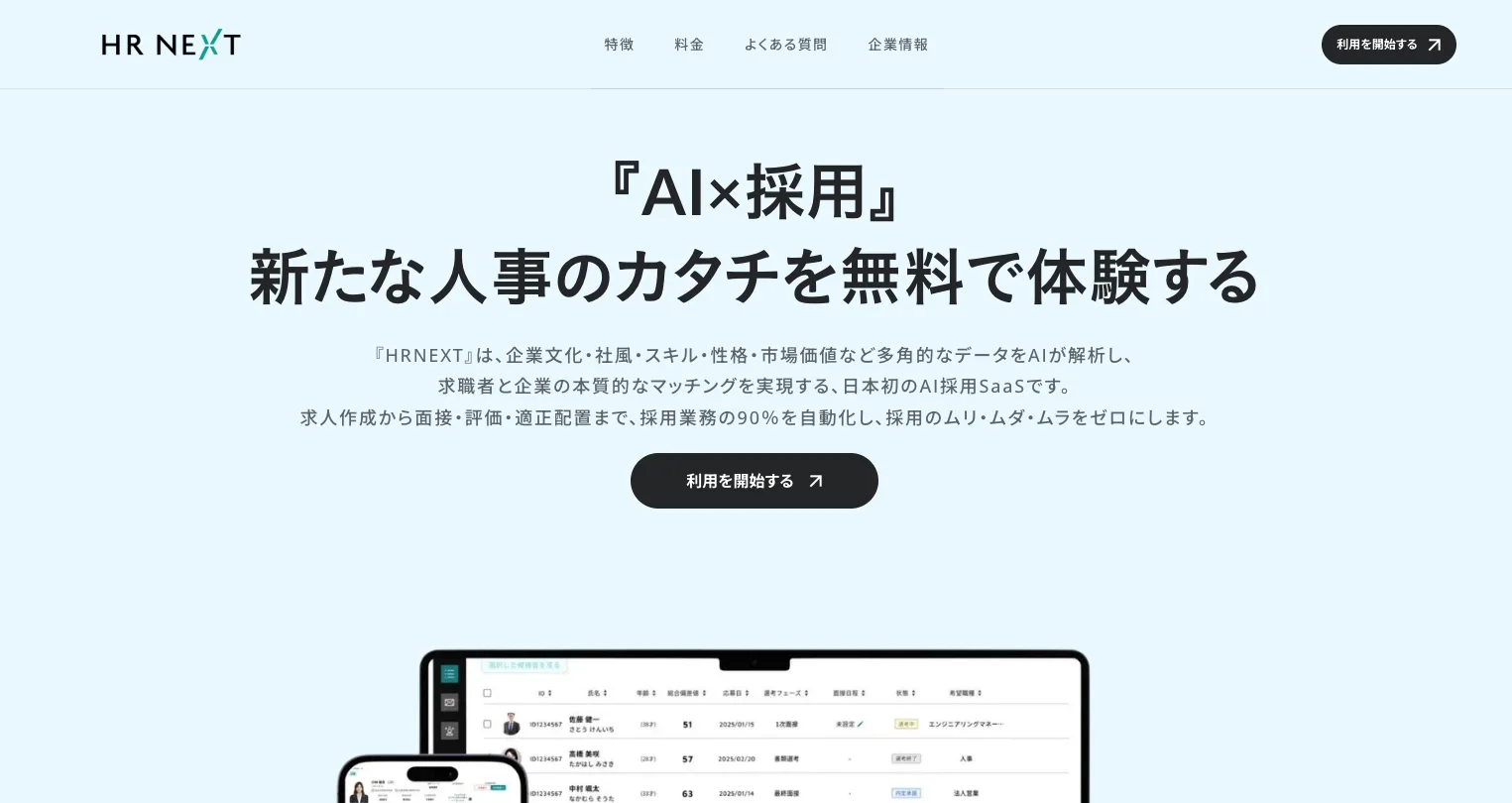
The AI venture NexusAdvisors has announced the free release of HR Next, an AI-powered recruiting management SaaS (Software as a Service). That is very welcome news for companies that are hiring.
The service’s main goal is to achieve “essential matching” between job seekers and companies, with AI deeply analyzing multidimensional data such as corporate culture, workplace atmosphere, skills, personality and even market value, rather than only checking whether skills and experience fit. It is a powerful tool for building relationships that truly fit both companies and job seekers.
HR Next Features That Dramatically Streamline Recruiting
HR Next offers a variety of features that greatly streamline recruiters’ daily work and enable higher-quality hiring.
AI-created job postings: The AI creates attractive job postings tailored to the company’s needs, cutting the time and effort spent on writing them so recruiters can spend more time communicating with candidates.
Automatic reading of résumés and CVs: The AI automatically reads the résumés and CVs that applicants send and efficiently extracts the necessary information. Not having to enter and check information by hand is a real help.
AI work history scoring and personality analysis: The AI analyzes each job seeker’s work history in detail and turns it into a score. It also analyzes personality, which makes it easier to understand in advance how well a candidate will match the corporate culture and fit into the team.
Matching score display: The AI displays a score showing how well a job seeker matches the company and a specific job opening. This makes it easy to see visually which candidates are the best fit and keeps the selection process moving smoothly.
Through these features, HR Next aims to automate about 90% of recruiting work. This is expected to create a highly efficient, high-quality hiring process free of waste, overburden and inconsistency.
DuDo Inc.
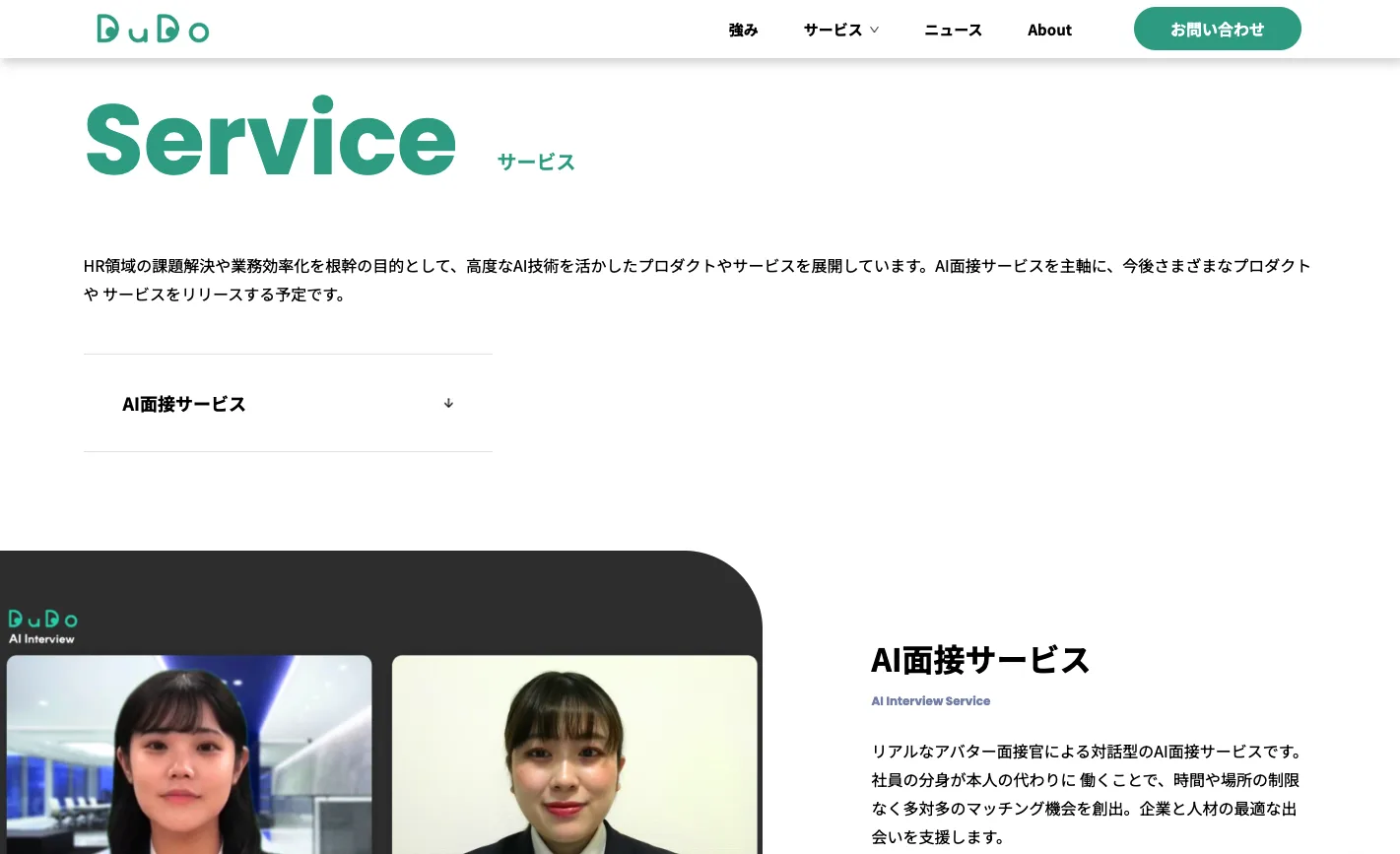
DuDo Inc. offers an “AI interview service,” an HR and recruiting solution built on advanced AI technology. The service is distinct from a simple chatbot: it delivers a natural interview experience, as if a person were conducting it.
DuDo’s Features and Benefits
A high-precision AI avatar interviewer that looks just like a real person A high-precision AI avatar that captures the features of the person it is modeled on serves as the interviewer. It works as a “digital double” of the company’s HR staff and can provide interviews with human warmth. It should also help with corporate branding.
No limits of time or place, available 24/7 Because the AI avatar works in place of employees, there is no need to coordinate interviewers’ schedules. Interviews can be offered to applicants anytime, anywhere, which greatly reduces lost hiring opportunities. That should be a big advantage for companies.
Follow-up questions tailored to each applicant Based on company and applicant information loaded in advance, the AI avatar can ask each applicant different questions. This is expected to draw out applicants’ latent abilities and motivation to join more deeply.
Retakes allowed, lowering the barrier to apply Applicants can retake the interview as many times as they like until they submit it. Because they can keep trying until they are satisfied, the psychological barrier to applying drops, which should help companies meet a wider range of talented people.
Versatility that improves both efficiency and quality It also offers the standard strengths of AI interview services: lower labor costs, faster hiring through 24/7 availability, and careful assessment through interview records and evaluation reports.
Case Study
This groundbreaking AI interview service has already been selected by Mercury Inc., a company in the sales promotion business. We look forward to seeing it at work in real hiring.
Skystone Inc. “Minna no Manager®”
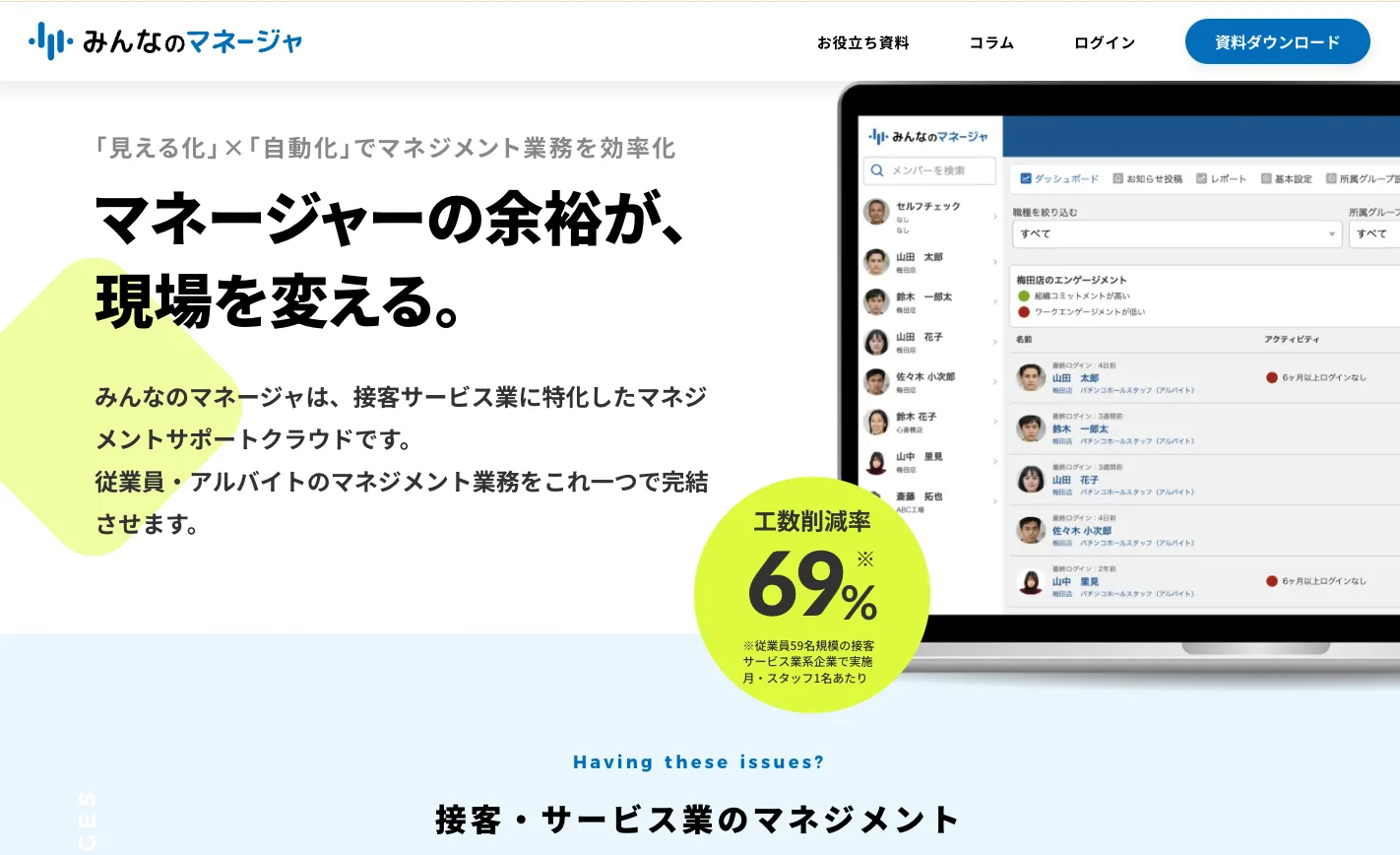
Skystone Inc. has officially released the “AI Action List,” a new feature of Minna no Manager® that combines employee surveys with an AI agent. It is a groundbreaking feature in which the AI immediately analyzes employee survey responses and offers concrete action suggestions for individuals and teams with a single click.
Middle managers have often been caught between “old-style administration” and “new-style management,” leaving them exhausted. Through the AI Action List, Skystone aims to greatly reduce managers’ uncertainty and help them change from mere “cogs” into “engines” that grow their teams and organizations. Having AI as a strong supporter for managers is very reassuring.
Main Features of the Minna no Manager® AI Action List
The service’s features help raise employee engagement and reduce the burden on managers.
Visible priorities and concrete action suggestions: The AI analyzes survey results and clearly shows the most effective action plans on a single screen, along with their “priority,” “time required” and “rationale,” so managers can act quickly without wondering what to do next.
Personalized growth support: The AI identifies each member’s strengths and generates individual action suggestions that build on them. Detailed support tailored to each person’s traits should encourage members to grow on their own.
Integrations that encourage ongoing use: With regular reminder notifications and integration with a mobile app and LINE, busy managers can easily check the AI’s suggestions and act on them.
Leading Mark Inc. “Mikiwame”
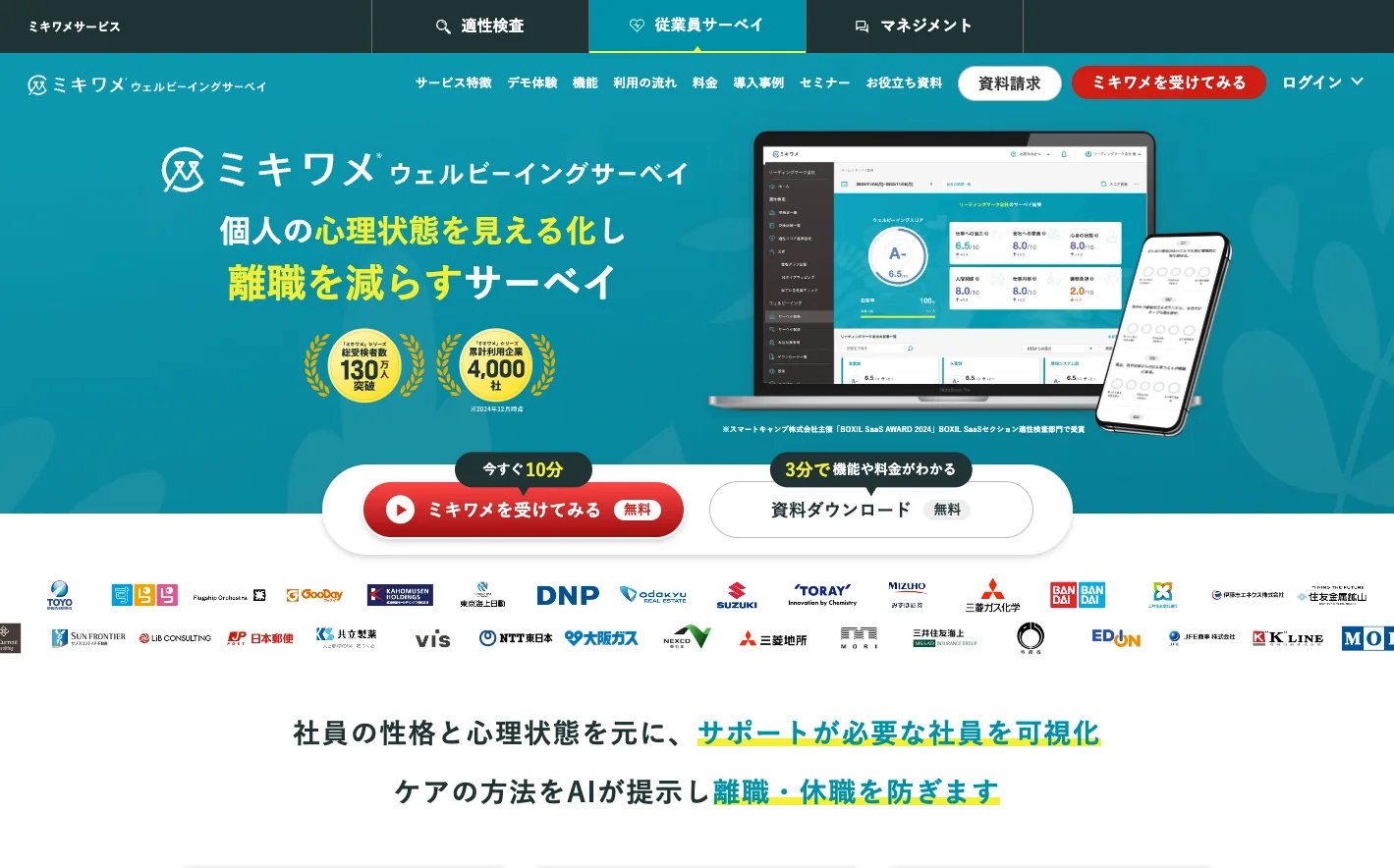
Mikiwame, an HR platform from Leading Mark Inc., aims to solve two major corporate problems, “hiring mismatches” and “employee turnover,” through its own “Personality Tech.” Mikiwame has now released a new single sign-on (SSO) integration based on SAML (Security Assertion Markup Language), which greatly improves both security and convenience when connecting systems.
Benefits of SAML SSO Integration
SAML SSO is a mechanism that lets users log in to multiple cloud services with a single authentication. For example, simply logging in to the company system also logs the user in to Mikiwame automatically.
Mikiwame’s Comprehensive HR Solutions
With the addition of SAML SSO, Mikiwame is even easier to use, and its wide range of features strongly supports companies’ HR strategies.
Preventing hiring mismatches with the Mikiwame Aptitude Test The AI compares and analyzes the results of a personality test that takes about 10 minutes against the traits of employees who perform well at the company, then shows how strongly each candidate is recommended and any concerns. Companies can identify the people who best fit them and are expected to effectively reduce mismatches after hiring. Objective data from AI should be a big help to recruiters.
Partnership example Through a partnership with CPA Jobs, a job site specializing in accounting and finance talent, it also helps people without experience find companies that suit them and helps companies assess candidates’ potential.
Preventing turnover and leaves of absence with the Mikiwame Well-being Survey The AI analyzes employees’ personalities and psychological states and makes visible who needs support. By also suggesting specific ways to provide care, it enables early, appropriate action and helps prevent employees from leaving or taking leaves of absence.
Supporting effective one-on-ones and better performance with Mikiwame Management Taking into account each employee’s personality, physical and mental condition and progress toward goals, the AI advises managers on how to run one-on-ones and how best to manage each member. AI that supports management tailored to each person’s situation is a groundbreaking feature.
Findy Inc. “Findy Team+”
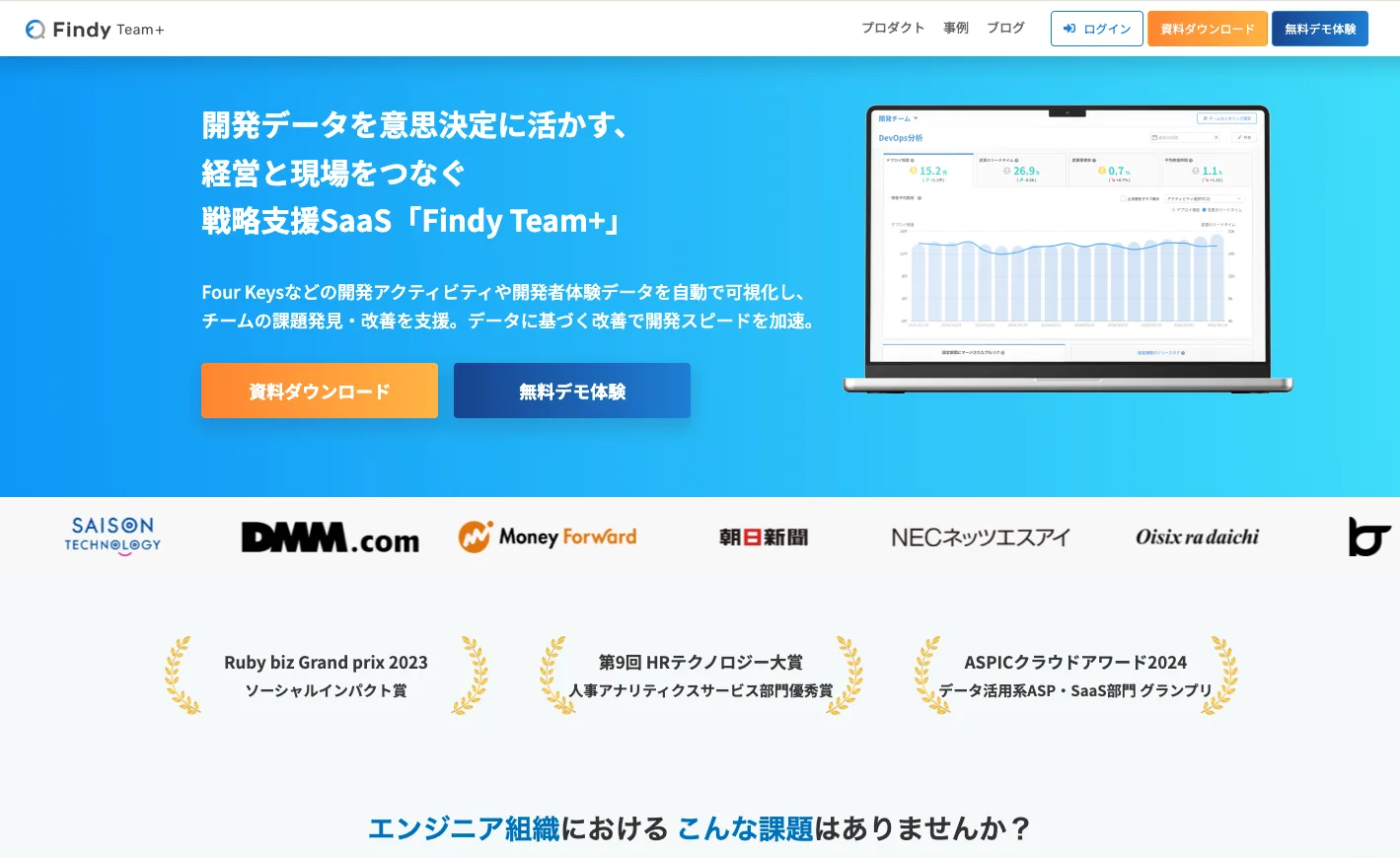
Findy Team+, a strategy support SaaS from Findy Inc., acts as a bridge between management and development teams, making the performance of the entire development organization visible and helping improve it. It aims to build a more efficient and productive development organization by clarifying the problems development teams face based on data and using AI to find solutions.
Findy Team+ analyzes data from tools used every day in development, such as GitHub, GitLab and Jira. Its key feature is that it makes development productivity and the developer experience concretely visible. It also uses generative AI to analyze the state of development in depth, pinpointing the organization’s bottlenecks and the areas that most need attention right now. It is impressive that AI can analyze development this deeply.
Main Features and Benefits of Findy Team+
The service’s features translate directly into solving development organizations’ problems and improving their performance.
Making development performance visible: It collects and analyzes a wide range of data on development activity, such as the number of code commits and the time spent on reviews, and presents it clearly as numbers.
Detailed analysis with generative AI: Beyond collecting data, generative AI analyzes it and tells you specifically where the problems in the development process are and what to work on next. Accurate, data-based advice from AI is very dependable.
Helping choose the right tools and improve processes: The AI’s analysis is also useful when considering new tools such as AI agents. It contributes to improving the development process as a whole.
Findy Team+ is a powerful partner for helping development organizations grow “clearly” instead of “vaguely,” through the power of data and AI.
ailead Inc. “ailead”
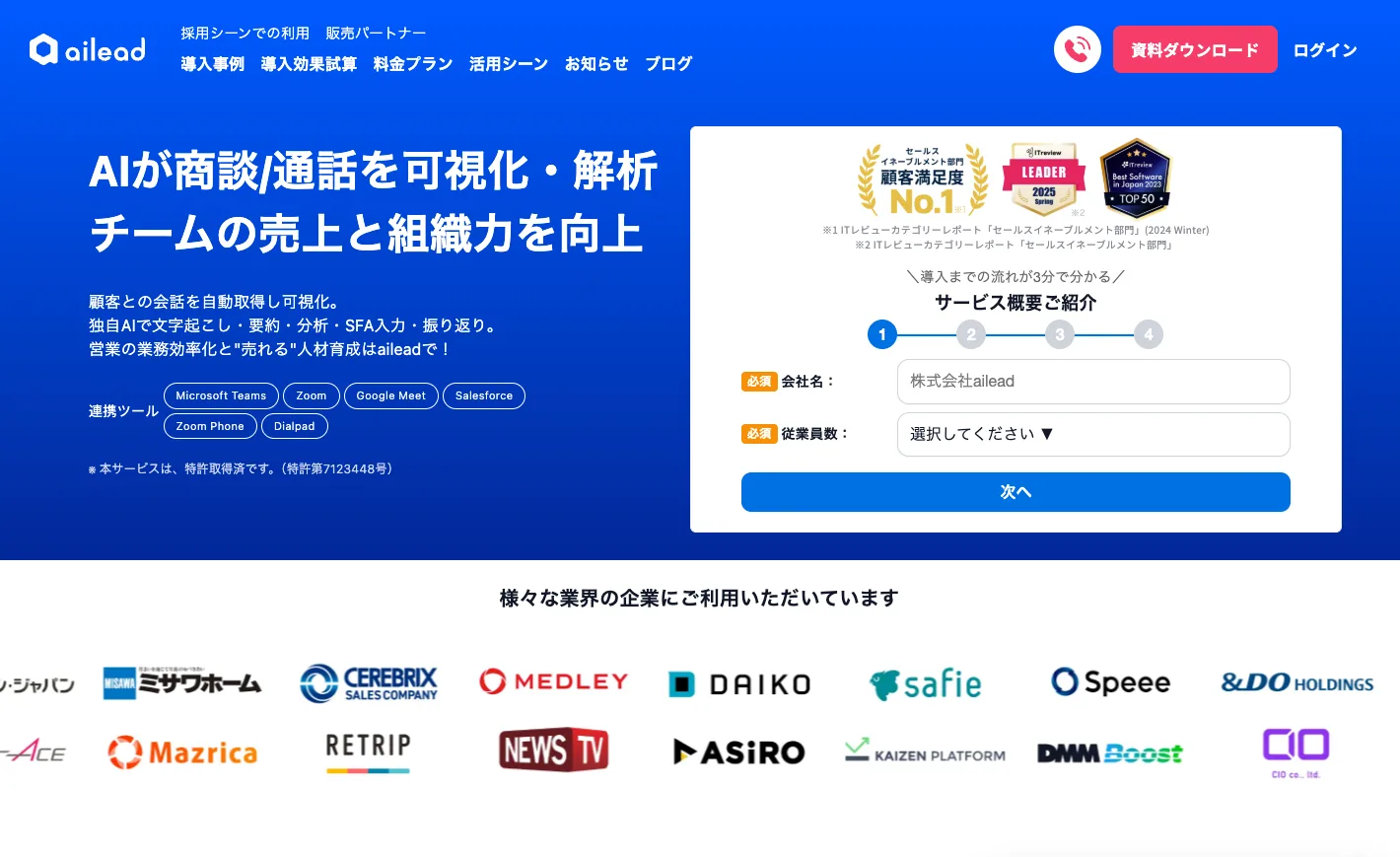
ailead Inc., which provides ailead, a cloud service that analyzes sales meeting and interview data with AI, has now fully entered the HR field. Working with Talent Palette, a talent management system from Plus Alpha Consulting Co., Ltd., the company has begun offering a “recruiting interview summary and evaluation feedback feature” powered by generative AI.
The new feature raises the quality of interviews in recruiting and dramatically improves efficiency. Generative AI not only summarizes the conversations in recruiting interviews automatically but also analyzes interviewers’ evaluations of candidates, making recruiting interviews visible, streamlining interview work and standardizing evaluation criteria.
Generative AI Transforms Recruiting Interviews: ailead’s New Feature
Efficiency through automatic interview summaries and evaluation analysis Generative AI automatically summarizes the conversations held in recruiting interviews, greatly reducing the time spent writing reports afterward. The AI also analyzes interviewers’ evaluations of candidates, reducing variation in evaluations and enabling more objective judgments. Less work after interviews is a welcome benefit for busy recruiters.
More advanced evaluation criteria through the Talent Palette integration The AI combines interview data from ailead with data on high-performing employees stored in Talent Palette and analyzes them together. By comparing candidates with how high performers came across in their own interviews, it aims to raise the standard of interviewers’ evaluation criteria and help train interviewers. AI that reveals “what high performers have in common” feels like a groundbreaking feature for improving hiring accuracy.
By making the recruiting process more transparent and raising the quality of interviews, which tend to depend on individual interviewers, this feature should reduce mismatches with the people companies really want and strengthen their hiring power.
AI inside Inc. “DX Suite”
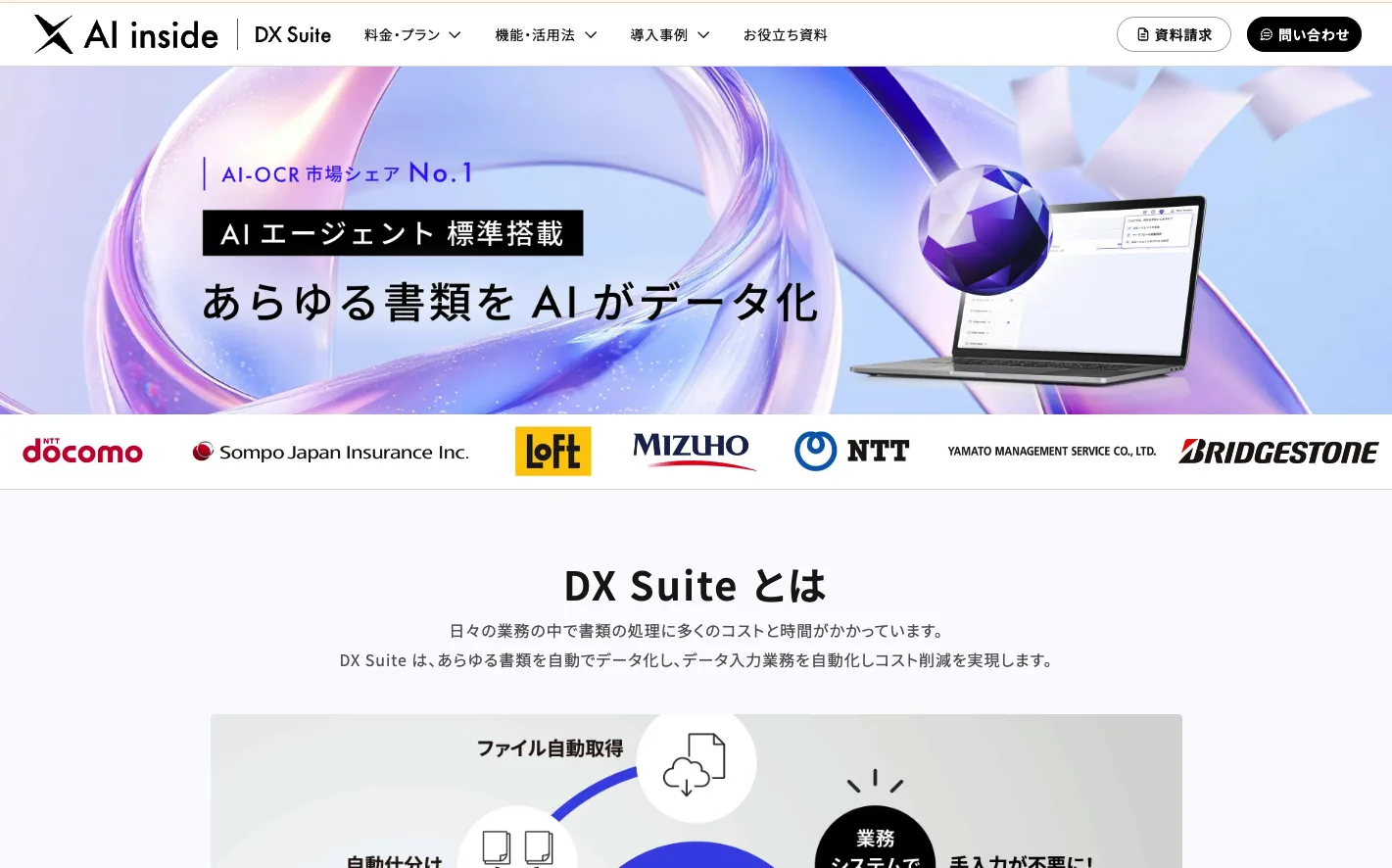
DX Suite, the AI-OCR service from AI inside Inc., now includes an AI agent, eliminating the form-reading setup that used to be done by hand. By combining RPA (robotic process automation) with AI in the OCR (optical character recognition) process that turns paper information into digital data, it greatly streamlines operations.
The AI-OCR Service DX Suite Evolves: AI Agents Accelerate Business Automation
A key strength of the AI agent in DX Suite is that it does more than read text: it also automates the work before and after reading, from start to finish.
Freedom from form setup: Reading forms in different formats used to require detailed setup for each one. With the AI agent, this time-consuming setup is no longer needed. The AI automatically understands the structure of each form and recognizes the information needed, so users can start reading right away. Greatly shortening the time before work can begin is a welcome feature.
Fully automated data processing: There is no need even to upload files. The AI agent automatically handles the whole process, from retrieving data to OCR processing, exporting the read data as CSV and finally storing it.
New ways of working created by collaborating with AI: A survey AI inside conducted among 220 people in charge of DX promotion and AI adoption at large companies with annual sales of 5 billion yen or more found that 91.1% of companies that adopted AI agents saw “positive changes in how people work.” Notably, the most common answer, at 52.0%, was that “skills for collaborating with AI are now required.” This suggests that AI is not taking jobs away from people but encouraging new skills and supporting a shift toward more advanced work.
The evolution of DX Suite is one example of how AI agents can become powerful allies and improve efficiency in workplaces where paper is still in use.
freee K.K.
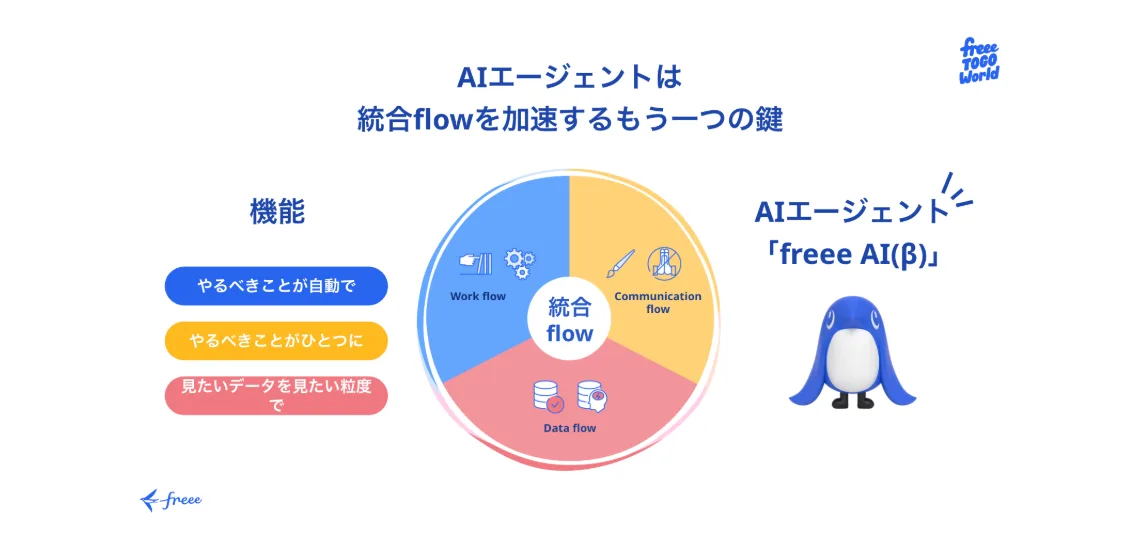
freee K.K., well known for cloud services that streamline back-office work, has started trial operation of services that use AI agents to automate expense reports and more. It is a new freee initiative that aims to greatly reduce the burden of employees’ daily requests and enable more efficient ways of working.
AI Agents Make Expense Reports and Time Tracking Dramatically Smarter
freee’s goal is to connect AI agents with its existing expense and time-tracking services and automate advance requests through methods such as chat analysis.
Greatly reducing the work of submitting requests: AI agents automate much of the expense reporting and time tracking that employees used to do by hand, greatly reducing the time each employee spends on requests. That should be a huge benefit for busy businesspeople.
More efficient back-office work: With requests automated, back-office staff also spend less time checking and processing them. This lets them focus on more strategic, high-value work that only people can do.
This freee initiative shows that AI agents can do more than replace a few tasks: they can fundamentally transform a company’s entire workflow and change the way employees work for the better.
United Recruitment and Forward Inc.
United Recruitment Inc., a consolidated subsidiary of United, Inc., and Forward Inc., which offers Ace Job, a SaaS that uses generative AI to streamline recruiting, have signed a business partnership agreement and launched a new service that strongly supports recruiting. The partnership combines two strengths, recruitment process outsourcing and generative AI, enabling companies to recruit with higher quality and greater speed than ever before.
Generative AI Becomes a Powerful Partner for Recruiters: The Power of Ace Job
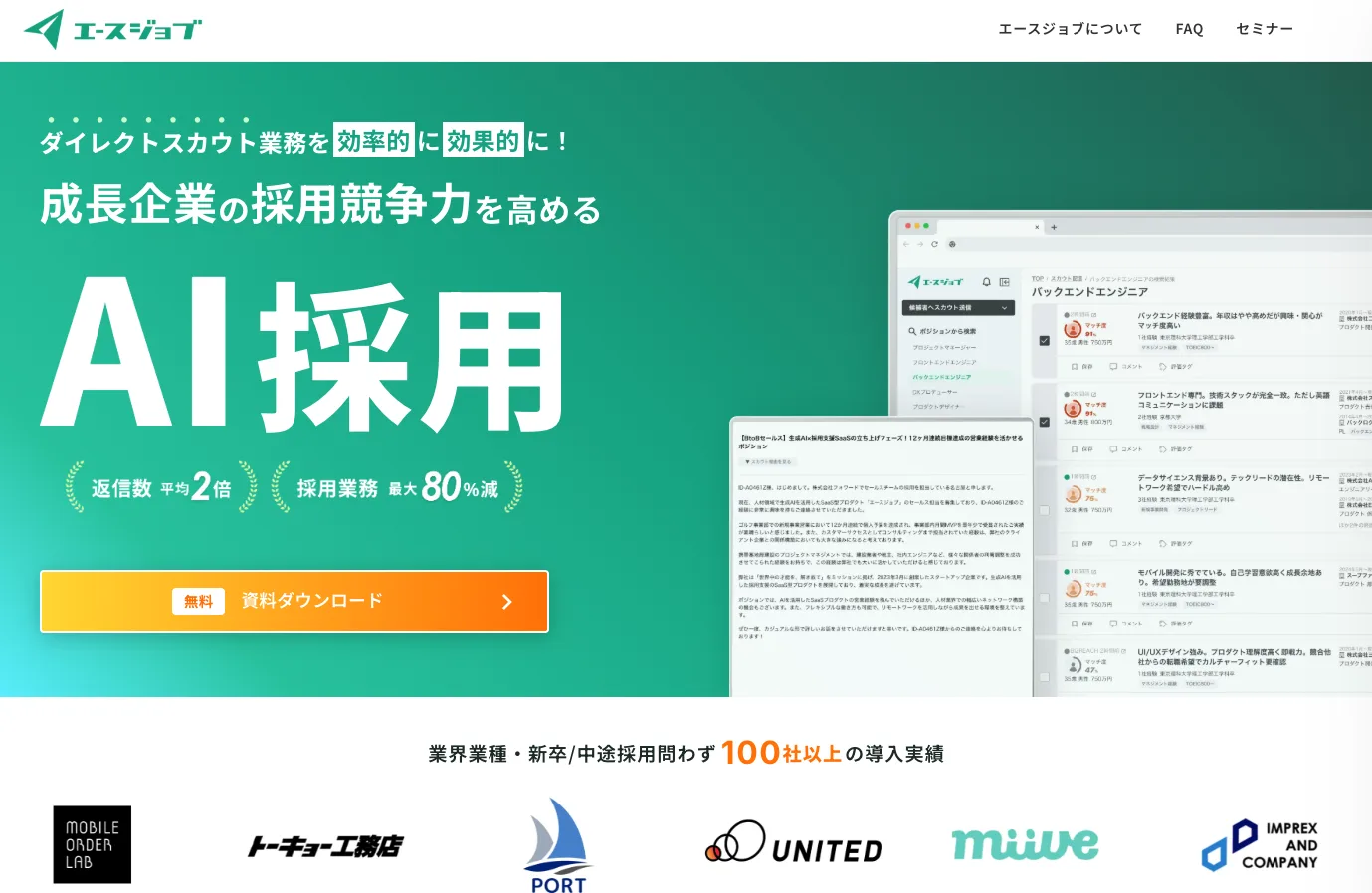
Ace Job is an AI agent service that makes the most of generative AI to automate and streamline companies’ recruiting work. It supports the entire recruiting process end to end, from automatically generating and sending scouting messages to creating job postings and even automatically evaluating application documents. It is a groundbreaking service that raises both the quality and the speed of recruiting at the same time.
The Future of AI Agents: Expectations and Challenges
So far, we have looked at how AI agents are transforming business, with a focus on HR and recruiting. It is also true, however, that several challenges remain before AI agents become widespread.
Where AI Agents Stand and How They Are Perceived
According to a survey by Neo Marketing, 52.1% of respondents said they “don’t know” about AI agents, which shows that awareness is still low. On the effect of reducing work hours, 35.7% answered “less than 10%,” suggesting that the benefits are not yet fully understood.
Even so, while overall intent to use AI agents stands at only 27.5%, more than half of businesspeople in HR and labor management roles show a positive attitude toward using them. This is evidence that the potential of AI agents is starting to be strongly recognized in certain areas of work.
Main Challenges to Wider Adoption
Several concerns stand in the way of wider adoption of AI agents. The main ones are “accuracy and reliability of judgments” (25.4%) and “security and privacy” (23.3%). After all, the key to wider adoption is whether companies can adopt AI agents and use them in their work with confidence. Addressing these concerns and offering more reliable services will be important.
Outlook: A Future Where Collaboration Between AI and People Accelerates
Despite these challenges, the adoption and use of AI agents in HR and recruiting is predicted to accelerate further, driven by major companies promoting AI agents and by technical advances such as Google’s A2A (Agent-to-Agent) protocol.
Adopting AI agents also increases the need to redeploy employees and to reskill them (help them learn new skills). Some predict that “collaboration,” with AI and people working together, will become the mainstream way of working. Companies will need to treat AI agents not just as efficiency tools but also to create environments where employees can work effectively with AI and focus on higher-value work.
Key Trends in HR and Recruiting
- “Automation” and “higher quality” in the hiring process: Moves are accelerating to streamline hiring through AI interviews, document screening and automatic generation and sending of scouting messages, and to raise hiring quality by drawing out candidates’ true feelings and motivation to join.
- Supporting employee engagement and retention: Services that support retention after hiring are evolving, with AI analyzing employees’ personalities and psychological states, suggesting the best management approaches and helping provide care that prevents turnover and leaves of absence.
- Broad automation of back-office work: AI agents now automatically handle routine tasks that used to be done by hand, such as expense reports, time tracking and reading and digitizing forms, which improves efficiency and reduces human error.
- Transforming work through “collaboration” with AI: Adopting AI agents goes beyond simply handing off tasks. It encourages employees to focus on higher-value work and is creating a new way of working in which AI and people work together.
- Building trust and awareness is the key to adoption: Addressing concerns about the “accuracy of judgments” and “security and privacy,” and deepening awareness and understanding of the benefits, will be essential for further adoption and faster uptake by companies.
Marketing: Stronger Customer Engagement and More Efficient Operations with AI Agents
AI agents are spreading quickly in marketing as well. By handing a wide range of work to AI agents, from planning and running campaigns to market research, content creation and optimization, companies are making their marketing faster, more efficient and more precise.
AI agents are especially good at handling complex, repetitive tasks. They shine in marketing, where work often requires connecting multiple systems and responding flexibly to varied input from customers.
Benefits AI Agents Bring to Marketers
Adopting AI agents brings marketers a wide range of benefits.
Much higher operational efficiency: AI automates repetitive tasks that used to consume much of marketers’ time, such as data entry, scheduling emails and posting to social media. Marketers can then focus on more creative and essential work such as data analysis and strategy, which is expected to raise the productivity of the whole team. Being freed from daily routine work is a real help.
Personalized customer engagement: AI agents can analyze customer data in detail, deliver content tailored to each customer and recommend products likely to interest them. This deepens customer relationships and raises customer satisfaction.
Better data-driven decisions: With advanced analytical capabilities, AI agents provide deep insight into trends in consumer behavior and the performance of past campaigns. Based on that information, marketers can make decisions grounded in clear data rather than intuition and optimize their marketing strategy.
Scalable marketing: AI agents can process huge volumes of tasks and adapt flexibly to changing marketing needs as markets shift and the business grows. Even as the business expands, marketing activities can be scaled up efficiently.
AI agents are especially effective in environments where high engagement can be expected, or where they receive continuous feedback. Because they keep learning and improving, they are also well suited to sustained marketing strategies such as long-term customer engagement and cross-selling.
Warmly
In today’s business, especially for B2B marketing and revenue teams, acquiring customers efficiently and growing sales is a major challenge. Warmly has arrived as a “full-funnel GTM (go-to-market) copilot” that addresses exactly this challenge. It is an AI agent service designed to detect prospects’ behavior (buyer signals) quickly and turn it into concrete marketing actions.
Warmly’s biggest appeal is that it lets teams efficiently scale outreach (approaching prospects), ad operations and general operations without adding headcount. Note: Warmly’s AI agent features are available only on paid plans.
AI Marketing Ops Agent: Automating and Optimizing Full-Funnel GTM
Warmly’s AI Marketing Ops Agent strengthens the link between marketing and sales and automates complex tasks, greatly raising the productivity of revenue teams.
Connecting tools and capturing intent signals: It connects with a range of marketing tools and captures “buyer intent signals,” showing that a customer is interested in a service or product, in real time. Knowing precisely what a customer wants right now and approaching them quickly is a wonderful capability.
Automatically identifying and refining the ideal customer profile (ICP): The AI Marketing Ops Agent handles everything from automatically identifying and refining the ideal customer profile (ICP) to automatically launching and running personalized multichannel campaigns (LinkedIn, email and more) that respond to customers’ real-time behavior (live signals). It also automatically runs “smart sequences and fallback logic,” deciding the best order of communication and switching automatically to another approach if there is no response. It automatically routes acquired leads to the right owner, preventing missed follow-ups and maximizing sales opportunities. The AI also continuously monitors campaign results and automatically suggests and makes improvements, raising the efficiency and results of marketing.
Lead engagement with an AI chatbot and identification of hot leads: An AI chatbot talks with website visitors in real time to raise engagement. The AI also identifies “hot leads” with especially high purchase intent and notifies the sales team, reliably turning prospects into sales meetings.
Jasper
For marketers and copywriters who create content, producing large volumes of high-quality content quickly while staying true to the brand’s tone is a constant challenge. Jasper is an AI-powered content engine built to solve this challenge. It helps content marketers and marketing teams efficiently produce, and scale up, high-quality copy, blog posts, ads and more that fit their brand image.
AI Learns the Brand’s “Voice” and Speeds Up Content Creation
Jasper’s big strength is that its AI does more than generate text: it learns the brand’s unique tone and style and reproduces them across many types of content. This gives all content a consistent brand image, so the company’s message comes across more strongly.
Brand voice memory keeps everything consistent: Once Jasper has learned a company’s brand voice, it remembers that unique tone and style and applies them to all the content it generates. Sending consistent messages, from blog posts to ad copy, should be very helpful for strengthening the brand.
SEO support and multilingual content for a wide range of needs: It supports an “SEO mode” designed to help content rank higher in search engines, so the content is easier for more people to find. It also supports content creation in more than 30 languages, making it a powerful tool for global companies or anyone who needs to publish in multiple languages.
By combining the fast generation of AI with the intelligence to understand and reproduce a brand’s personality, Jasper lets marketers focus on more strategic and creative work.
Smartly.io
Digital advertising evolves every day, and running effective campaigns across platforms such as Meta (formerly Facebook) and TikTok is essential for performance marketers and growth teams. Yet running ads optimally on each platform takes a great deal of work. Smartly.io is a “paid media automation agent” built to solve this problem. It uses AI to automate ad campaign operations and maximize results.
AI Optimizes Ad Operations: Maximizing Results with Smartly.io
Smartly.io is designed to run ad campaigns across multiple ad platforms. Its key feature is that it optimizes ad creative (images, videos and more), bidding strategy and placement (where ads appear) in real time.
Higher efficiency through creative automation and cross-platform campaign management: It automatically generates and tests ad creative to find what works best and deliver it efficiently. It manages ad campaigns on multiple platforms such as Meta and TikTok in one place, with AI optimizing for each platform’s characteristics, greatly reducing management work and improving overall performance. In addition, the AI analyzes ad performance in real time and automatically reallocates budget to the campaigns and platforms it judges most effective.
Real-time optimization prevents lost opportunities: By capturing changes in the market and among users in real time and instantly optimizing creative, bidding and placement, it prevents lost opportunities and always pursues the best ad results. Being able to respond quickly is a huge advantage in digital advertising.
With the help of AI agents, Smartly.io removes the complexity of ad operations and lets marketers focus on more strategic thinking and creative work.
Mutiny

In B2B marketing, the website is an important place that serves as the first point of contact with customers. But showing every visitor the same information makes it hard to capture each one’s interest fully. Mutiny strongly supports B2B marketing teams as a “website personalization agent” that solves this problem.
Mutiny’s goal is to let companies dynamically adjust their website’s messages and layout to match the characteristics of each visitor. In this way, it aims to raise on-site conversion rates (for example, document requests or inquiries) without help from developers.
AI “Personalizes” Websites and Raises Conversion Rates
Mutiny uses AI to provide a range of features that optimize the website visit experience.
Individual optimization with dynamic content blocks: It changes specific content blocks on the website (such as headings, text, images and CTA buttons) in real time based on each visitor’s attributes and behavior history.
Deep understanding through AI-powered account research: The AI researches website visitors’ company information, industry, job titles and more to gain a deep understanding of the challenges and needs of that account (company).
Verifying impact with A/B and multivariate tests: Through A/B tests and multivariate tests, it verifies the effect of different personalization measures and keeps finding the best content and layout. Being able to keep improving based on data is very reassuring.
Mutiny is an innovative tool that improves the customer experience and drives business results by giving each of the many different customers who visit a website the information that suits them best.
Seventh Sense
Email marketing is still a very important way to build relationships with customers. But an email that goes unread is pointless. Seventh Sense is an “email optimization agent” for email marketers, demand generation teams and revenue leaders.
The service uses AI to identify the “exact time” each contact is most likely to open and engage with an email, and sends the email at that time. Note: At present, it supports only two major marketing automation tools, HubSpot and Marketo.
AI Finds “When an Email Should Arrive” and Maximizes Engagement
Seventh Sense offers unique features that optimize send times and achieve high engagement rates.
Higher open rates through personalized send times: The AI analyzes past behavior data and various other factors to work out the best send time for each recipient. Because emails arrive when they are “most likely to be read,” open and click rates are expected to rise.
Reliable delivery through deliverability optimization: The AI optimizes the timing and method of sending so that emails reliably land in the inbox instead of being flagged as spam.
Visible results through engagement analysis: It analyzes open rates, click rates and levels of engagement for sent emails in detail and provides them as reports. These reports let marketers objectively evaluate the effectiveness of their email marketing and apply the lessons to their next campaigns.
Ocoya
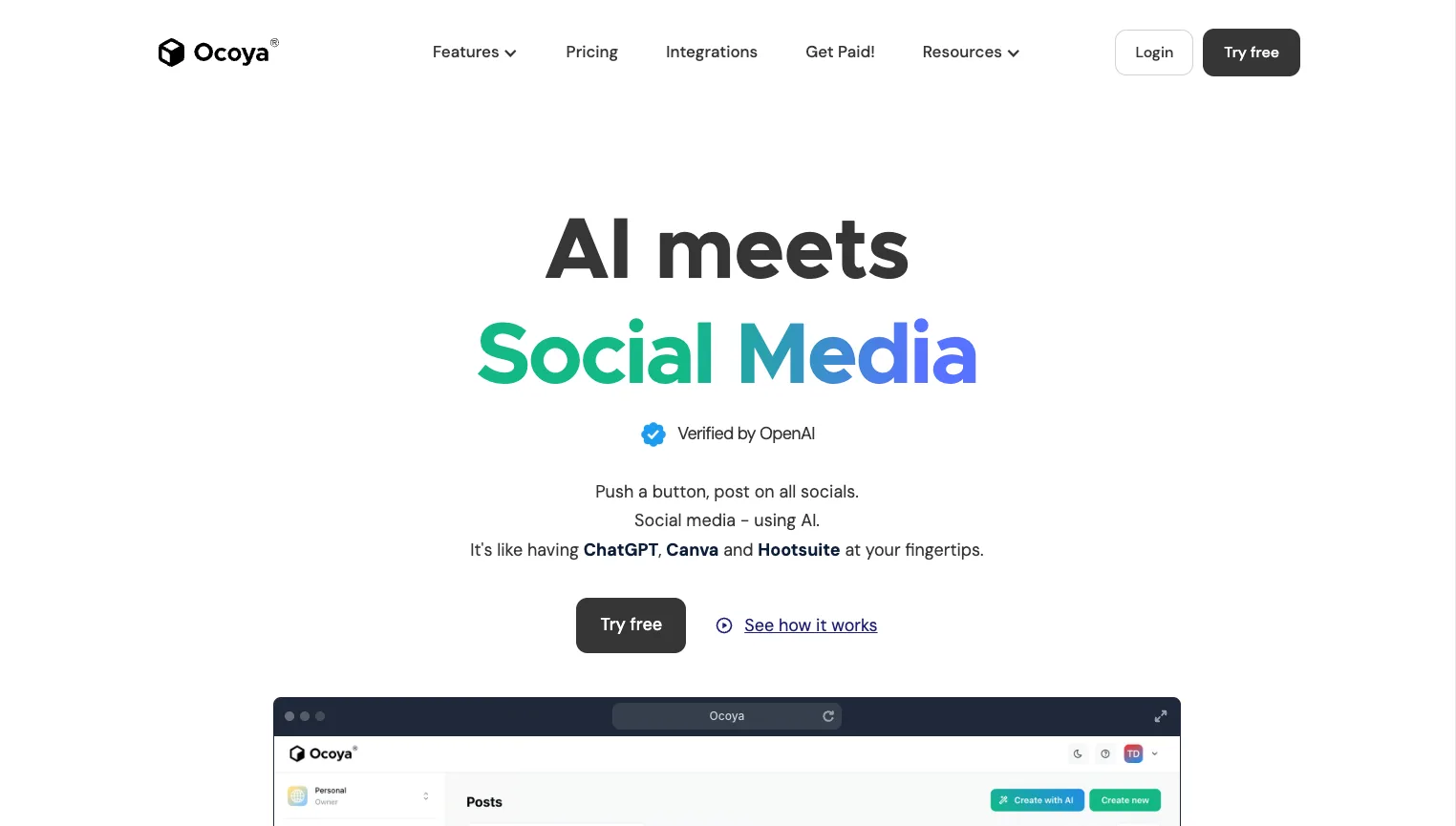
Social media is now an indispensable marketing tool. But continually posting content on multiple platforms and analyzing the results is a heavy burden for social media managers and content marketers. Ocoya is a “social media scheduling and copywriting agent” built to solve this problem.
With Ocoya, the entire social media marketing process can be managed from a single platform. It uses AI to create content for multiple platforms and publish it automatically, greatly reducing the work involved. Having AI support everything from planning content to posting it is very efficient.
AI “Automates” and “Optimizes” Social Media Operations
Ocoya uses AI to support everything from creating and publishing social media content to predicting its performance.
Faster content production with AI-generated copywriting: The AI automatically writes engaging social media posts. Being able to produce fresh, highly engaging content quickly is a big help.
Social media automation and performance prediction: The AI automatically publishes the content to multiple platforms at the best times. It can also predict a post’s performance in advance, which helps build a more effective content strategy.
Centralized management on a single platform: Everything needed for social media marketing, including a social media scheduler and a visual editor, is brought together on one platform. That means work proceeds smoothly without switching between complicated tools.
Ocoya uses AI to reduce the burden of running social media and enables more strategic and effective marketing.
Drift
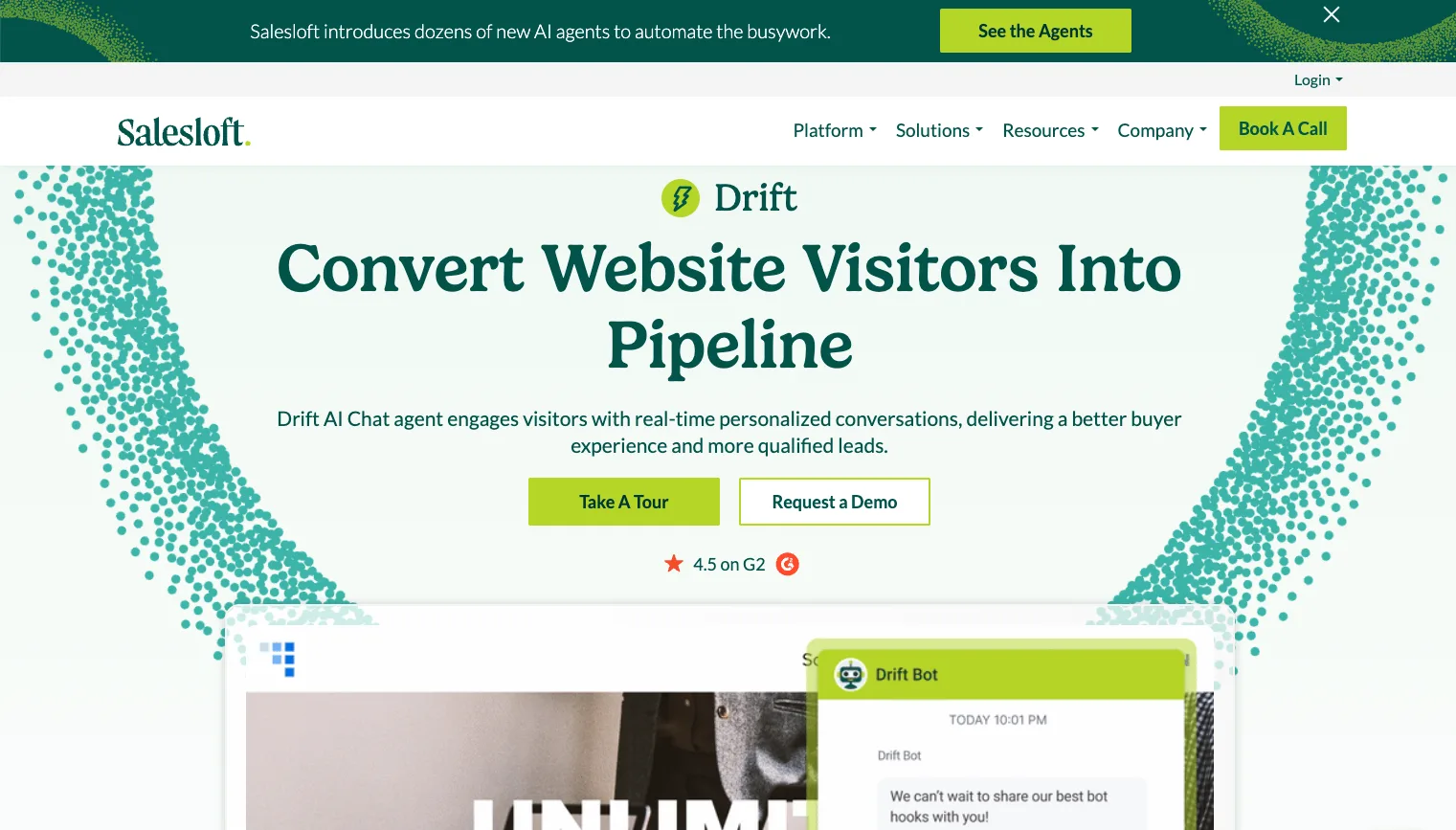
In B2B business, efficiently capturing prospects who visit the website and turning them into sales meetings is extremely important. Drift is a “conversational AI agent” that powerfully drives this kind of inbound marketing. Note: Drift was recently acquired by Salesloft.
Drift’s goal is to qualify website visitors properly through a chatbot and let them book meetings on the spot. This can turn a website into a powerful inbound engine that runs 24/7. It is like having a skilled salesperson stationed on your website.
A Conversational AI Agent Automates “Pipeline Creation”
Drift seamlessly automates everything from capturing prospects to booking sales meetings through real-time conversations with website visitors.
Automating customer interactions with a trainable AI chatbot: The AI chatbot can be trained on the company’s business, products and services. Once trained, it answers a wide range of questions from website visitors appropriately and raises engagement with natural conversation that feels like talking with a person.
Lead qualification and routing for efficient meetings: The chatbot asks visitors for information and evaluates the quality of each prospect against preset criteria. It then identifies high-quality leads and automatically assigns (routes) them to the right sales rep, preventing missed follow-ups and raising the rate at which leads turn into deals.
Sales alerts so no opportunity is missed: When a “hot lead” that meets specific conditions visits the website, or when an important action occurs, it alerts sales reps in real time.
HubSpot Breeze
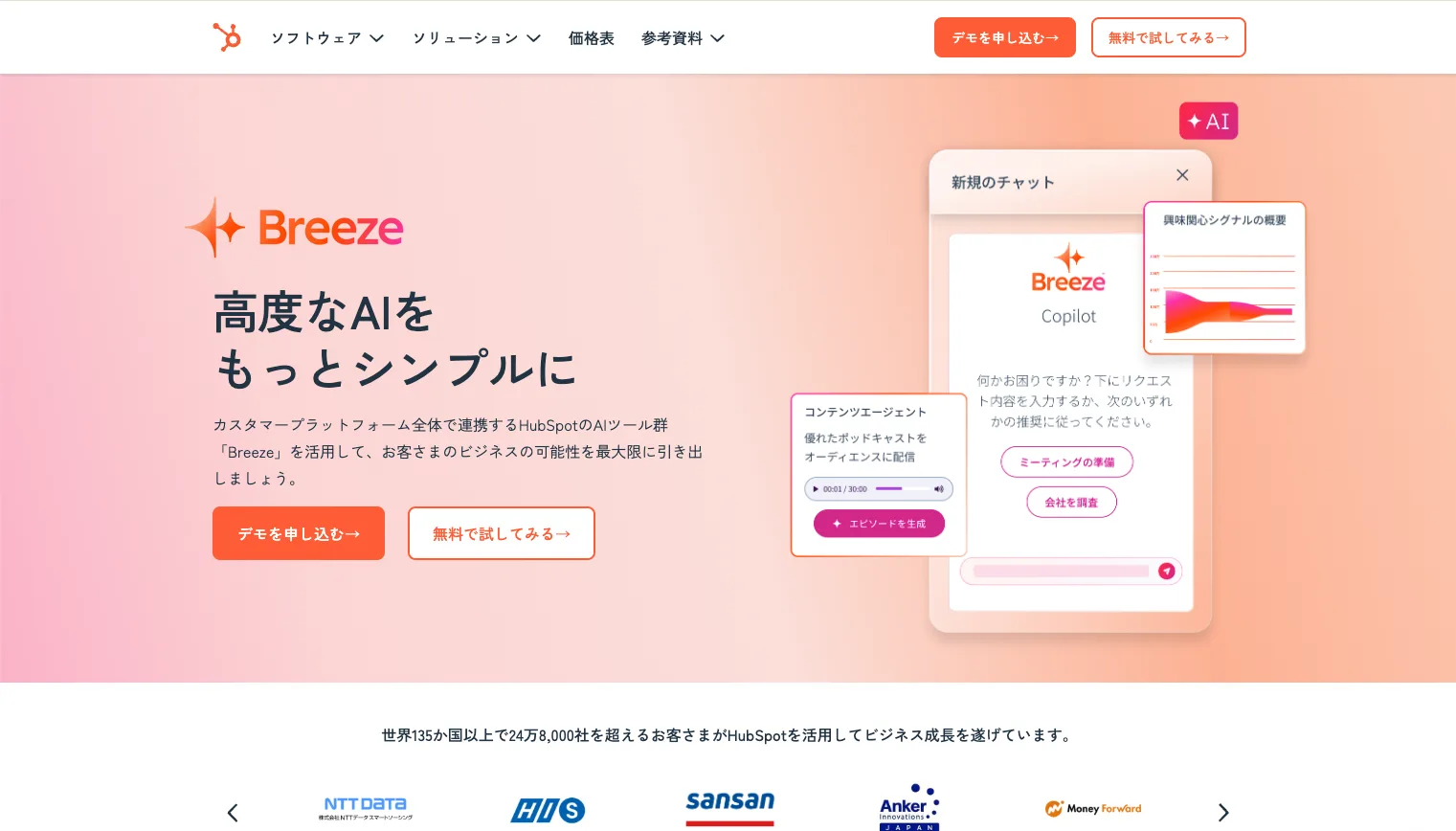
For small and midsize businesses and startups, expanding marketing while adding staff is a difficult challenge. That is where HubSpot Breeze, the end-to-end marketing automation suite built into HubSpot, comes in. The service aims to scale go-to-market (GTM) operations without additional staff.
AI Gives Strong Support to Small Business Marketing
HubSpot Breeze consists of two main components. One is Breeze Copilot, a conversational AI assistant. It helps with tasks such as creating content and updating the CRM (customer relationship management) system through chat. It is very convenient, like having a dedicated AI assistant.
The other is Breeze Agents, specialized AI agents focused on specific functions such as content creation, social media management and finding prospects in sales (sales prospecting). By working together, these AI agents can automate and streamline much of the marketing workload.
Streamlining daily work with Breeze Copilot: The AI assistant supports everyday work conversationally, from brainstorming blog post ideas to entering data in the CRM.
Specialized AI agents optimize each area: AI agents specialized in content, social media and sales prospecting each carry out expert work automatically. If AI suggests the best social media posts for you, that saves a lot of effort.
HubSpot Breeze is included in the Marketing Hub Professional and Enterprise plans, and it should be a powerful ally that helps small businesses and startups achieve the best marketing results with limited resources.
Lavender
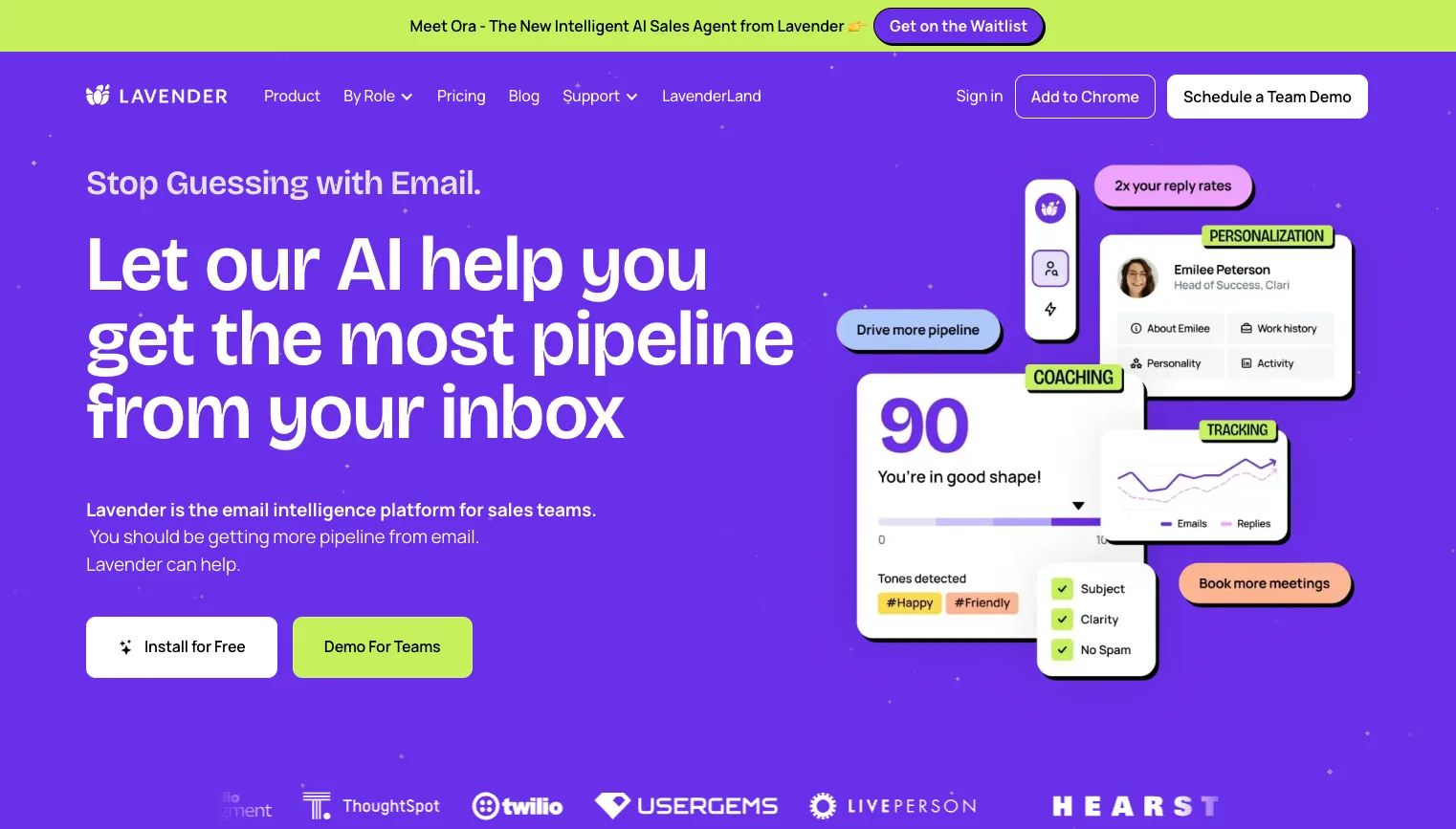
In sales and business development, “cold emails” to prospects (emails to people you are contacting for the first time) play a very important role. But simply sending an email rarely gets a reply. Lavender is an “email copilot” for SDRs (sales development representatives), AEs (account executives) and others.
The service’s goal is to help write cold emails that get high response rates, through real-time coaching and personalization suggestions. Think of it as AI sitting next to you and helping you write your emails.
AI Helps You Write “Emails That Get Replies”
Lavender focuses on one-to-one emails and is not really suited to bulk sends such as newsletters. Instead, it offers a wealth of features specialized for reaching individual customers.
Individual optimization with real-time coaching and a personalization assistant The AI gives real-time advice while you write an email. It also offers personalization suggestions for writing emails tailored to each recipient. Because the AI suggests the best opening and content based on the recipient’s information and behavior history, you can send emails that resonate more with the reader.
Coaching on tone and clarity for effective writing The AI analyzes whether an email’s tone is appropriate and whether the message you want to convey is clear, and tells you what to improve. Appropriate tone and clarity are very important in business email, so this is reassuring support.
With the help of AI, Lavender is a powerful tool for raising the quality of every email and maximizing business opportunities.
Optimizely
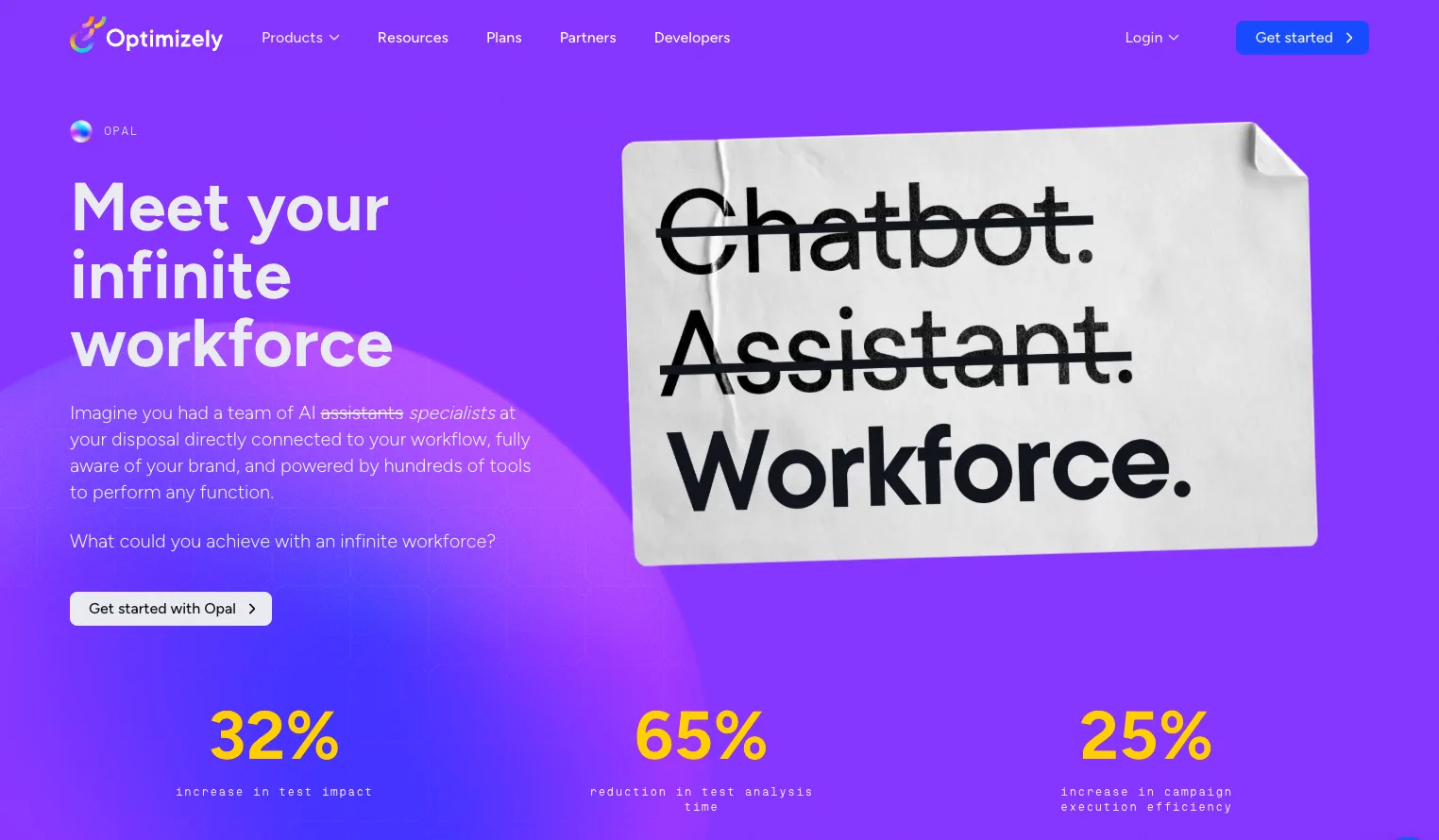
Digital marketing involves many complex processes, from brainstorming campaign ideas to creating content, personalizing for customers and measuring results. Optimizely offers Optimizely One, a platform that streamlines this entire marketing lifecycle, and has now integrated the AI assistant Opal into it.
Optimizely’s goal is to use AI to help users achieve bigger results with less effort. Especially for users already on the Optimizely platform, it should be a dependable way to drive marketing even further. It is also notable that it uses Google’s Gemini LLM (large language model).
The AI Assistant Opal Transforms the Marketing Lifecycle
Opal uses AI at various stages of marketing work to improve efficiency and results.
Specialized agents optimize each task: A “campaign planner agent” handles planning, a “copywriter agent” handles writing, a “segment recommender agent” optimizes customer segments and a “customer insight generation agent” provides insights for understanding customers more deeply. A “brand positioning agent” also supports brand strategy, with AI agents specialized in each area working together. It is as if an excellent marketing team were made up of AI.
Ampcome
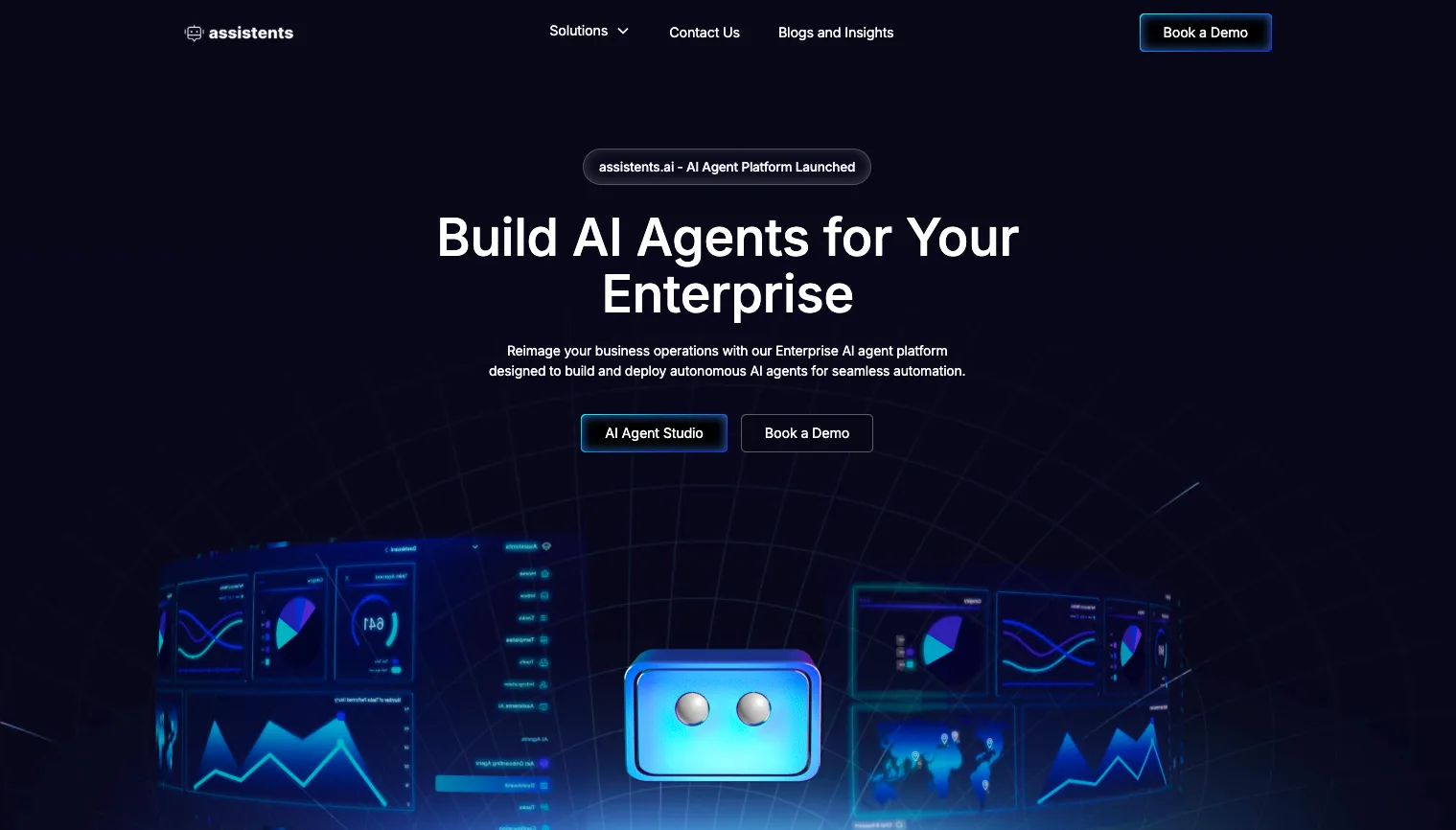
Marketing automation matters to many companies, but building complex AI agents from scratch is hard without specialized knowledge. Assistents.ai, offered by Ampcome, is “a conversational code platform for building AI marketing agents” that solves this problem.
The goal of Assistents.ai is to let marketers themselves build fully autonomous AI agents without writing code (no-code). This makes it possible to automate a wide range of marketing workflows, such as email marketing, lead scoring (evaluating prospects), customer profiling, ad optimization and competitor tracking. Being able to build AI agents without specialized knowledge is truly groundbreaking.
Building “Autonomous AI Marketing Agents” Without Code
Ampcome’s Assistents.ai offers intuitive features that let marketers easily create, deploy and scale AI agents.
Easy creation with prebuilt templates and a no-code builder: “Prebuilt templates” for various marketing tasks are available, so AI agents can be launched quickly. In addition, a “no-code visual builder” lets you create visually clear, customizable agents without programming knowledge.
Omnichannel marketing automation: The AI agents you build can automate marketing across multiple channels, such as email, websites and social media. Covering customer touchpoints from many angles and providing a consistent marketing experience is a major advantage.
Writesonic Inc. “Chatsonic”
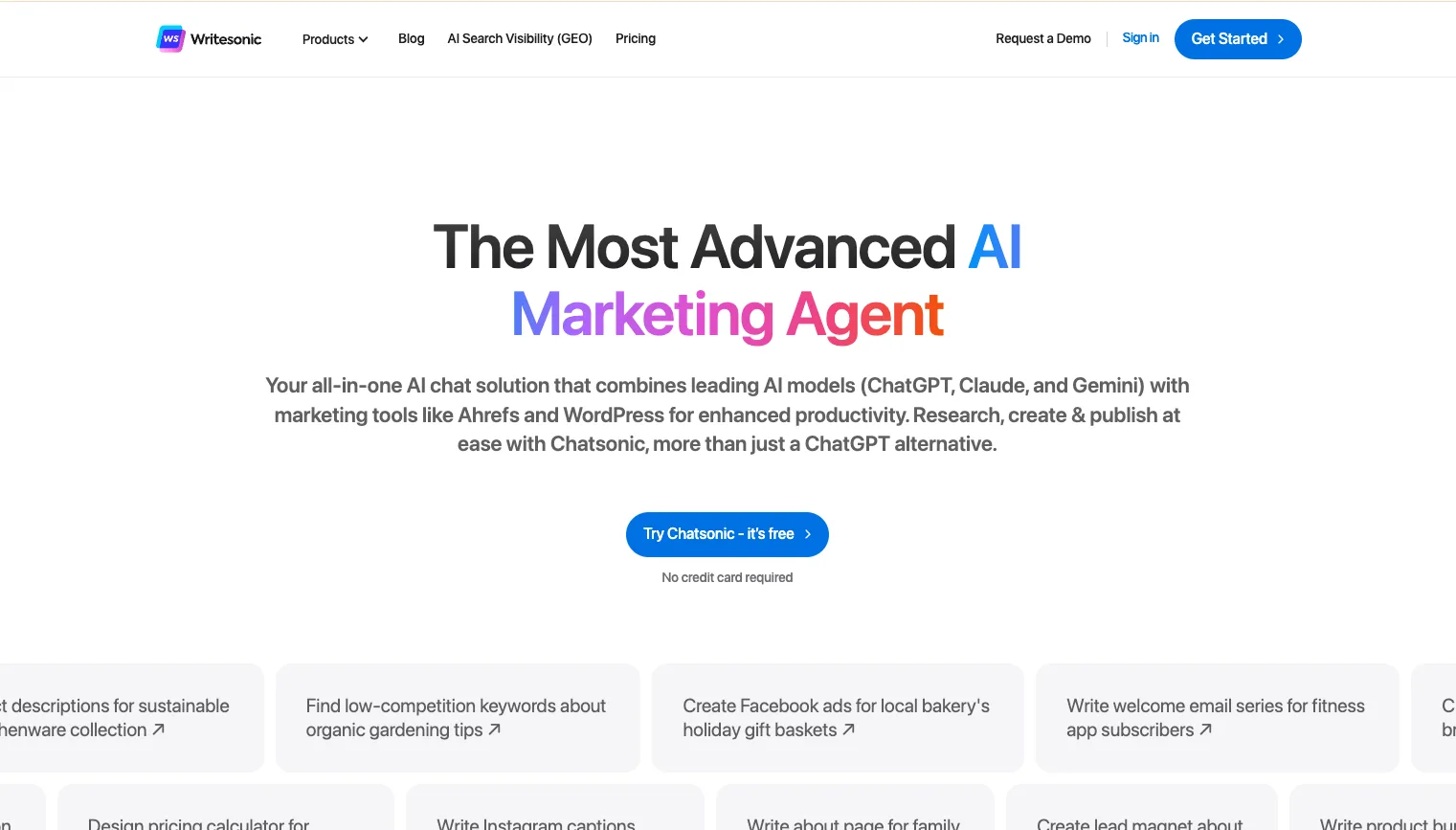
Many marketers are busy every day with a wide range of tasks, including market research, content creation, optimization and running personalized campaigns. Chatsonic, an AI marketing agent from Writesonic, was developed to strongly support this work and raise the efficiency and quality of marketing as a whole.
Chatsonic: AI That Works Alongside You as a “Marketing Pro”
Chatsonic is powered by the latest large language models (LLMs), such as GPT-4o, Gemini and Claude, so advanced AI becomes the marketer’s right hand. It also integrates well with marketing-specific tools such as Ahrefs and Google Search Console, enabling more practical use.
Remembers the brand voice and generates consistent content: Chatsonic can learn a company’s own brand voice (the tone and style of its writing) and keep it while creating various kinds of content. That way, any content, whether blog posts, social media posts or ad copy, maintains a consistent brand image.
Multifunctional agents that cover the marketing process: Specialized agents take on various roles: as a blog assistant that helps from brainstorming to writing, as an SEO content generator that creates content aimed at top search rankings, and as a creator of engaging social copy. There are also a keyword researcher, a campaign optimizer, an analytics agent and more, so marketers can benefit from AI at every stage of marketing.
Lyzr AI
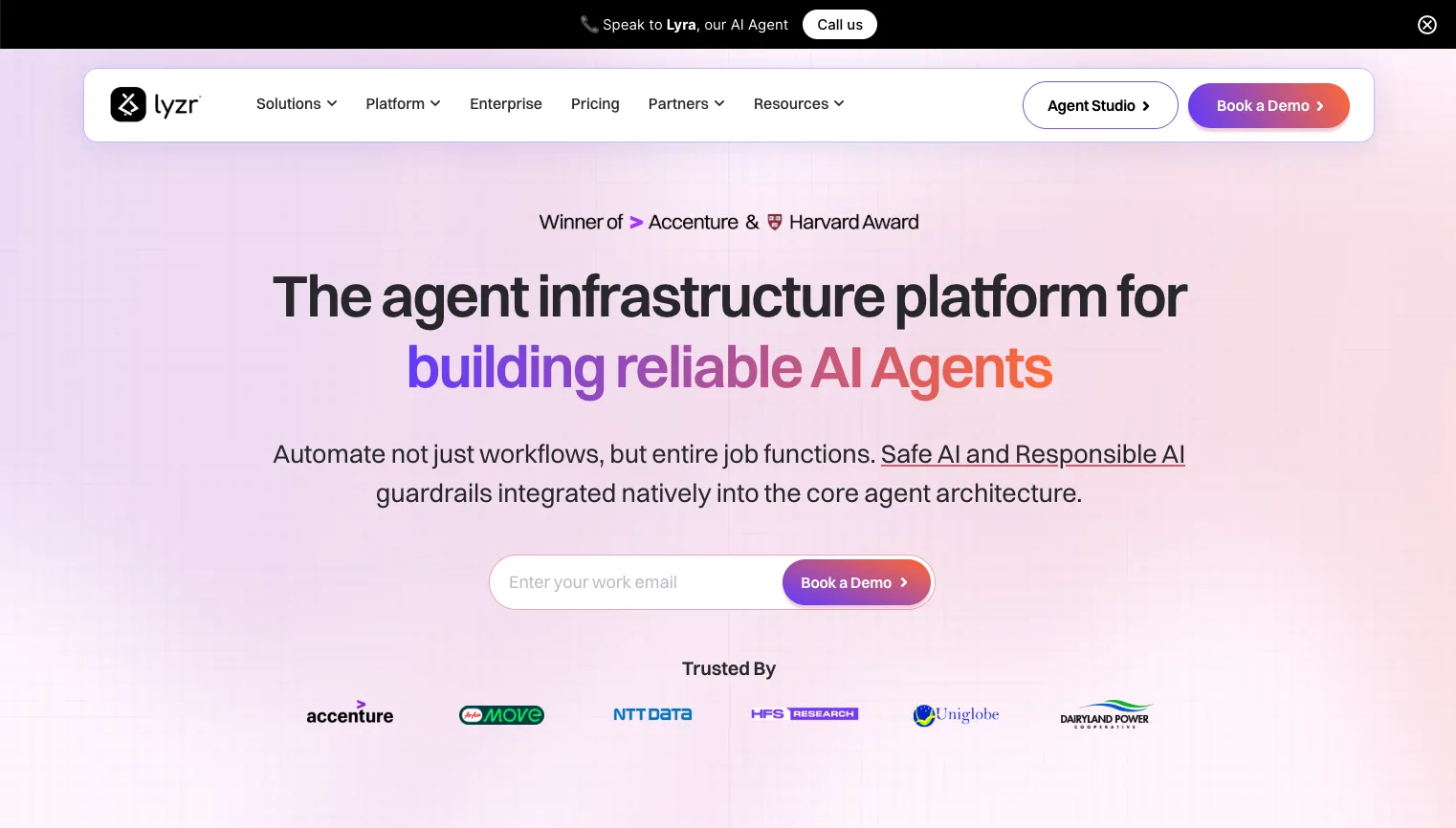
Automating marketing workflows and analyzing data are important challenges for many companies. The AI marketing agents from Lyzr AI solve these challenges and strongly drive companies’ marketing. These AI agents not only automate work but also run analysis at the same time, helping optimize marketing strategy.
Building “Customized AI Marketing Tools” with Flexible Deployment
Lyzr AI’s marketing agents streamline a wide range of work, including campaign management, generating marketing assets with attention to regulatory compliance, analyzing performance metrics, automating lead (prospect) workflows and maintaining the brand voice across channels.
Flexible deployment and customization: Besides cloud use as SaaS, it also supports fully on-premises deployment (such as on a company’s own servers) to meet corporate security requirements. That should suit companies that put a premium on data security.
Create fully customizable AI tools: With Lyzr AI’s platform, companies can freely create fully customizable AI marketing tools tailored to their needs, such as voice agents, task agents, SQL agents and customer profiling agents. Being able to build AI agents specialized for specific tasks and fine-tuned to each company’s needs is a major advantage.
Akira AI
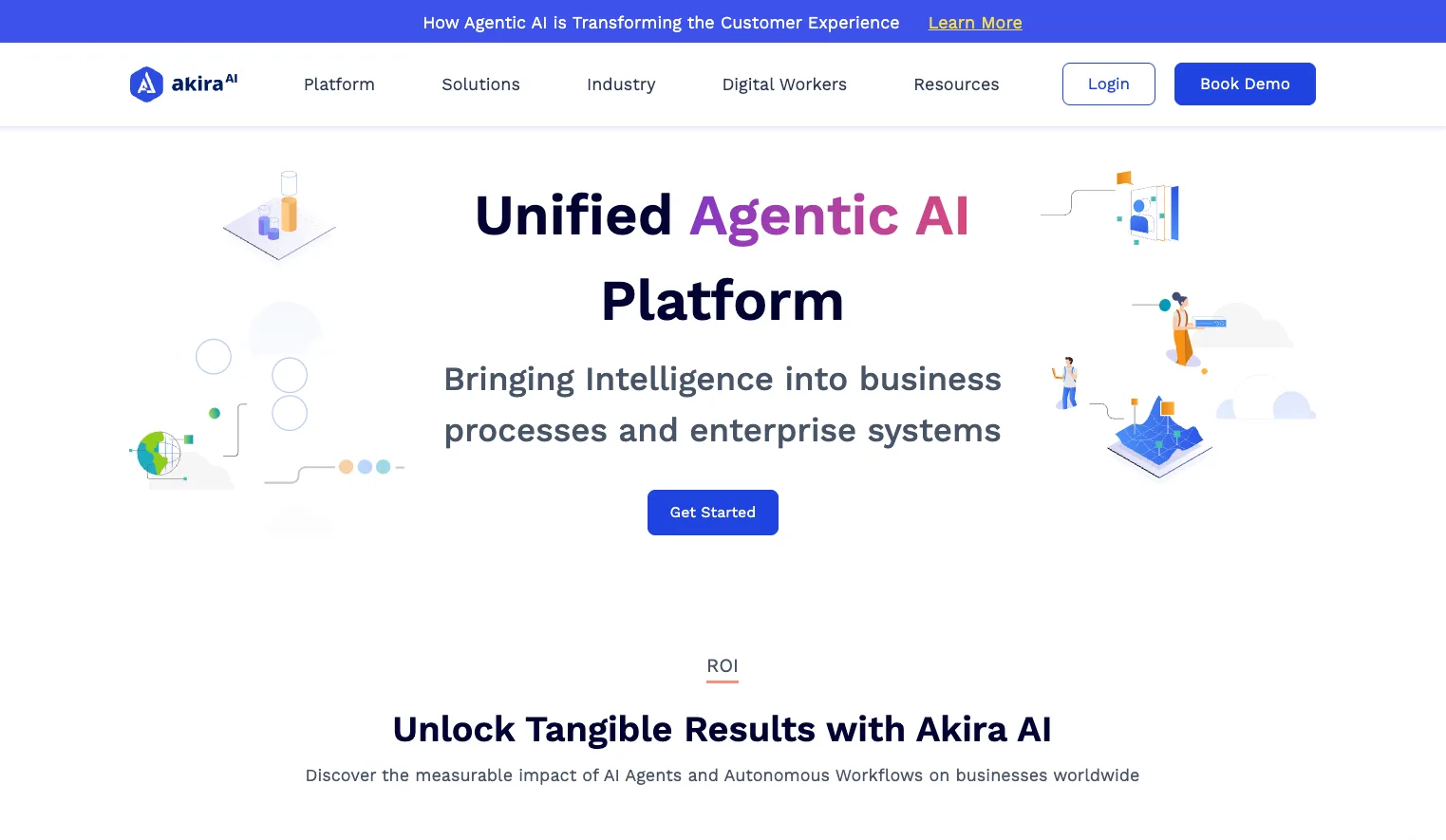
Today’s marketing demands fast decisions and the ability to execute at scale. To meet this need, Akira AI brings a new approach called “agentic automation” to marketing through intelligent, fully autonomous AI marketing agents. Akira AI’s goal is to automate key marketing workflows, such as email marketing, digital marketing, branding and personalized campaigns. This lets marketers always have a clear strategy and execute quickly and accurately.
AI Optimizes Marketing Autonomously
Akira AI offers a range of powerful features so marketers can always operate with clarity, speed and strategic precision.
Comprehensive campaign monitoring and real-time adjustment The AI constantly monitors running campaigns and adjusts target audiences and strategies in real time based on their performance. This lets marketers respond immediately to market swings and customer reactions and always aim for the best results.
Brand content generation and predictive analytics: Beyond generating content that fits the brand image, it offers “predictive analytics” that forecast future trends and customer behavior from past data. Having AI predict the future based on data is very reassuring.
Specialized agents support each area: A “campaign optimization agent” maximizes campaign effectiveness, and a “brand monitoring agent” tracks the brand’s reputation and market position. A “customer segmentation agent” classifies customers effectively and a “predictive analytics agent” forecasts future trends, with AI agents specialized in each area working together to carry out marketing work.
Relevance AI
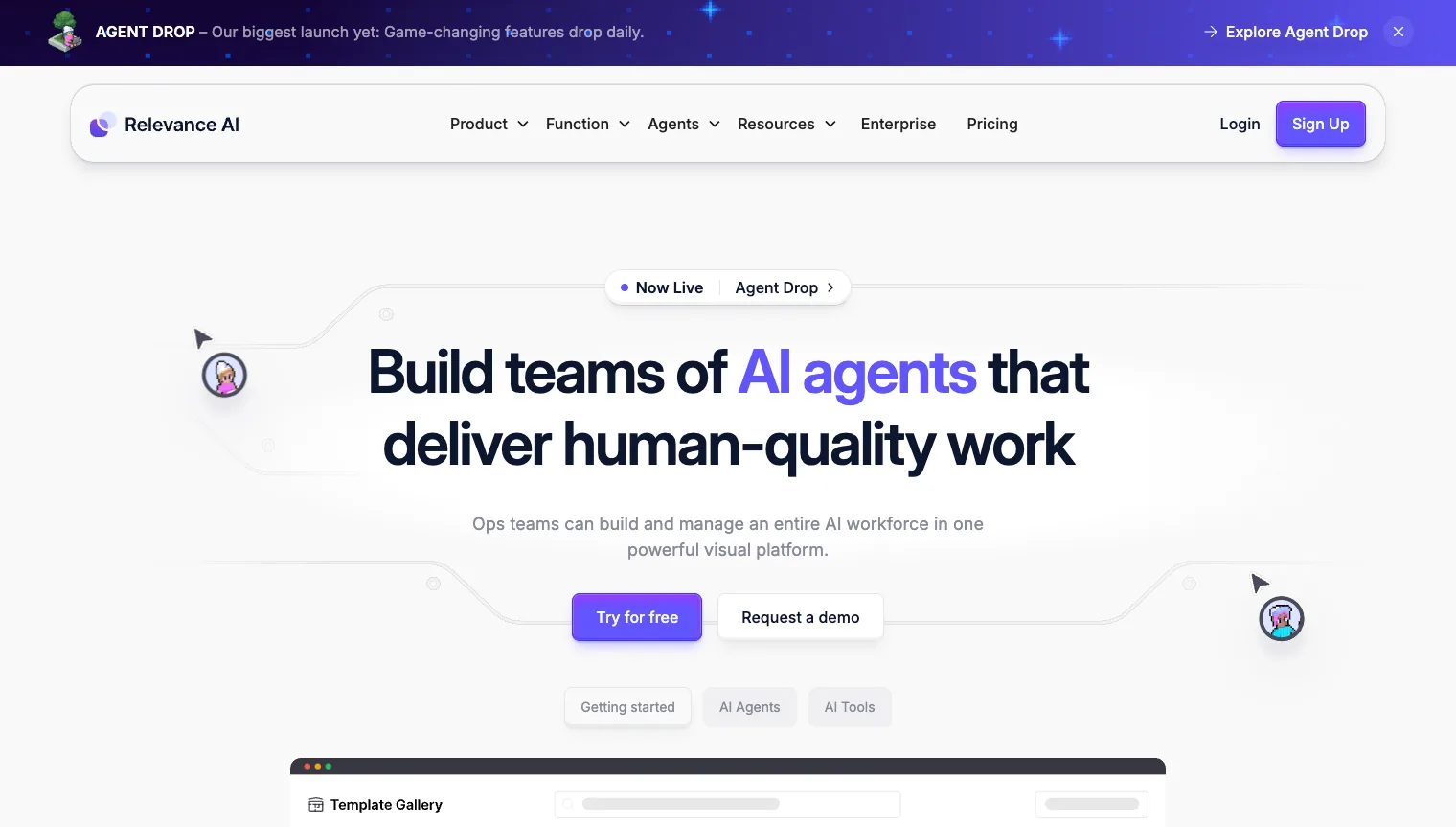
Marketing involves a lot of daily work, such as reaching out to prospects, doing market research and enriching customer data. The AI marketing agents from Relevance AI can be built directly into existing workflows and automate this work without writing code (no-code).
Relevance AI’s goal is to let marketers use a visual, no-code AI agent platform to easily “train” AI agents tailored to their needs and scale them.
Building AI Agents Without Code and Automating Marketing Workflows
Relevance AI’s marketing agents are built to fully support the series of touchpoints across many places, from the moment a customer becomes interested in a product or service to the purchase (the so-called “multi-touch marketing journey”). This provides powerful capabilities for optimizing the entire flow of marketing work.
Personalized outreach and data utilization: It can run fully personalized cold outreach (approaching customers for the first time), and the AI also automates customer list enrichment (adding and filling in information) and campaign performance analysis. It can also deepen customer understanding, develop original content and run nurturing sequences tailored to each person. It is amazing that AI can handle things in such detail.
Identifying at-risk customers and building a variety of agents The AI identifies customers at risk of churning, so you can act early and prevent them from leaving. A key feature is that companies can build a variety of AI agents to suit their needs, such as BDR (business development) agents, lead enrichment agents, customer support agents, lifecycle marketing agents and prospecting agents.
Botpress
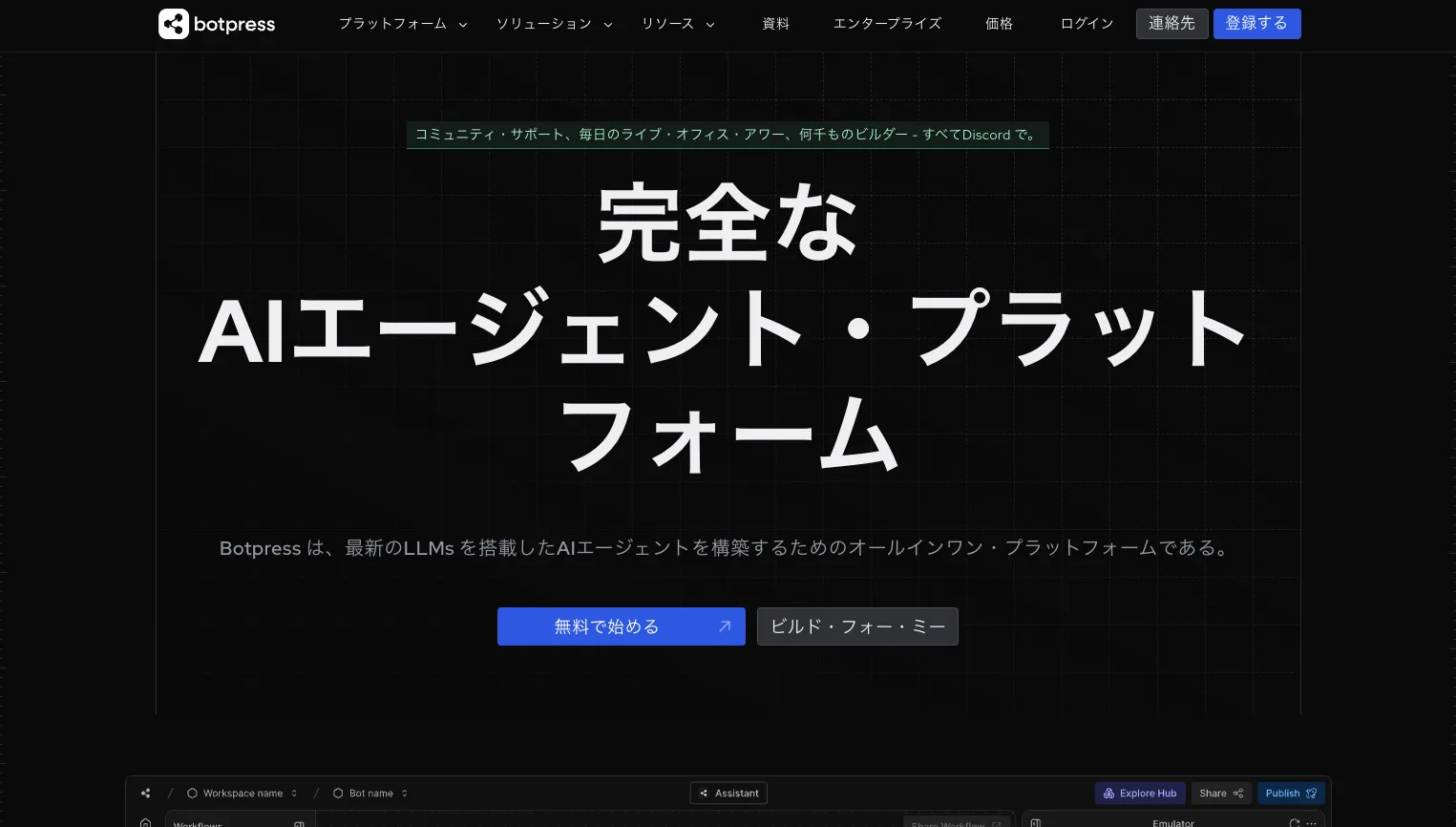
Many companies in industries such as SaaS, education and e-commerce want to streamline customer communication and marketing. Botpress provides highly scalable AI marketing tools for these sectors.
At the core of Botpress are “conversational AI agents” that understand the brand’s tone and context and can consistently run large-scale marketing workflows. A key feature is that it goes beyond building chatbots: agents can be freely customized by connecting them to the company’s existing knowledge base, APIs and even its own code.
Automating Marketing and Customer Support with AI Agents
Botpress’s AI agents automate a wide range of tasks and make digital marketing more efficient.
Automating many kinds of work: AI agents automatically handle a variety of routine tasks, such as customer onboarding (guidance when customers start using a service), answering FAQs, scheduling appointments, generating content and updating the CRM (customer relationship management) system.
Building your own AI marketing agents: Companies can build AI marketing agents tailored to their own needs, covering digital marketing, customer data integration, lead qualification (judging the quality of prospects) and customer interactions. Being able to build the best AI agent for your company from scratch is a huge strength.
Team-GPT
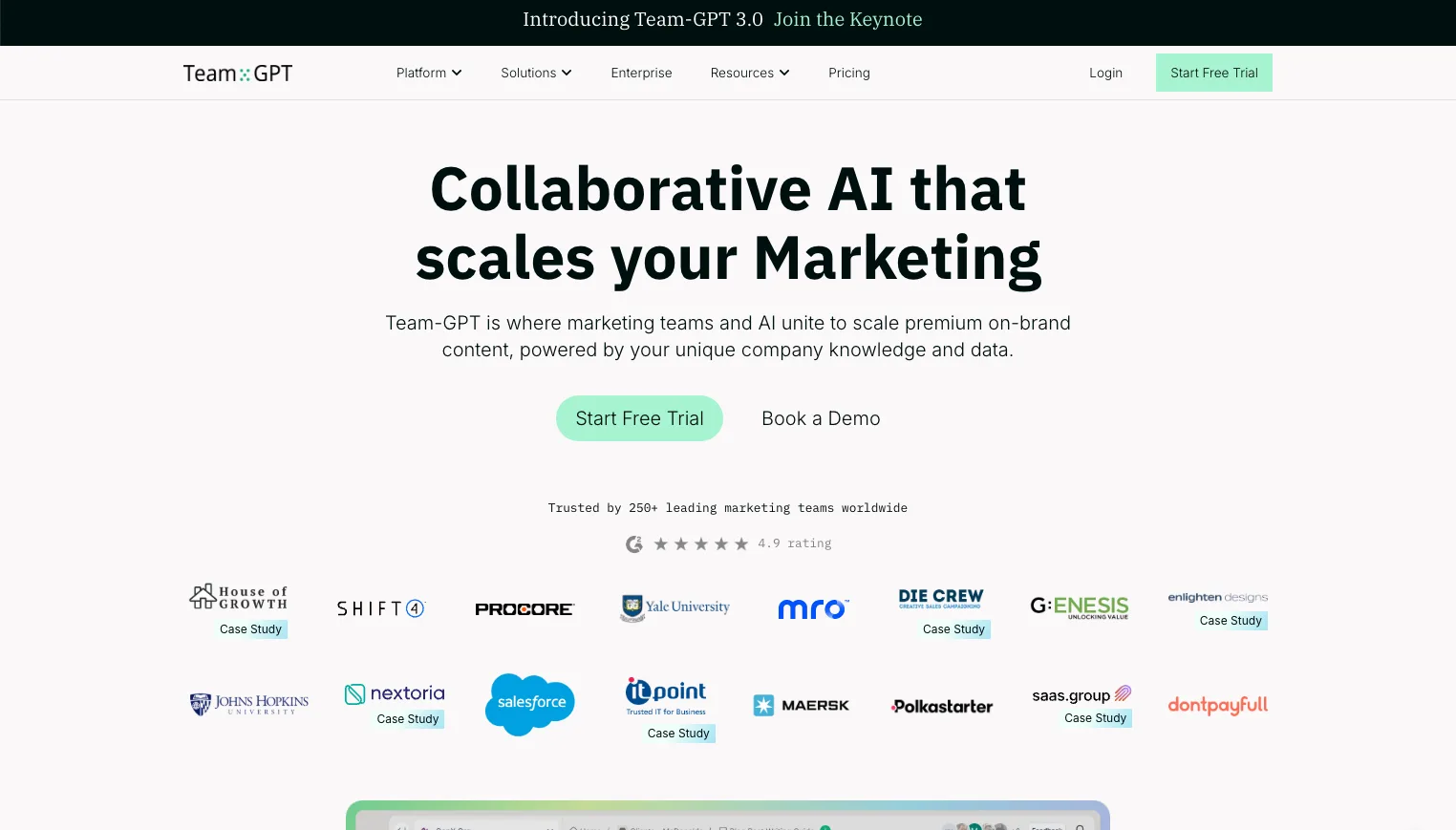
When a team works together on a marketing campaign, everything from brainstorming to content creation and measuring results requires a lot of communication and coordination. Team-GPT offers a “no-code way” to build customized AI marketing agents and strongly supports teamwork.
With Team-GPT, teams can co-create, edit and manage marketing campaigns smoothly. Because the whole team can collaborate in a single live conversation, it reduces communication loss and strengthens every stage of the marketing workflow, from refining prompts (instructions to the AI) in real time to generating campaign ideas and even testing headlines. AI that boosts team productivity is a big help.
AI and Teams “Collaborate” to Accelerate Marketing
Team-GPT offers features that make a team’s marketing more efficient and produce higher-quality results.
Support for many LLMs and seamless switching Users can switch freely between different large language models (LLMs), such as GPT-4, Claude and Mistral. By taking advantage of each LLM’s strengths, they can choose the best AI model for the purpose when generating content or running analysis.
Maintaining compliance and transparency: All interactions and activities with the AI are fully tracked, so companies can maintain compliance (adherence to laws and regulations) and ensure transparency in their marketing. An environment where AI can be used with confidence is an important point for companies.
Streamlining work with specialized agents: An SEO writer agent helps create content that performs well in search engines, and a persona-building agent helps clarify the target customer. A campaign strategist agent plans effective strategies and a copy assistant agent generates compelling copy, with AI agents specialized in each field raising the team’s productivity.
Zapier AI
Daily marketing work involves a great many needs to connect different applications and automate routine tasks. Zapier has long supported business automation through a wide range of app integrations, and now, as Zapier AI, it offers smart AI marketing tools that combine automation with natural language processing (NLP).
A key feature of Zapier AI is that it keeps Zapier’s strength of connecting with thousands of apps while using AI logic to create autonomous marketing workflows. Even complex, multistep marketing operations can be automated easily without writing code (no-code). AI that operates apps and moves work forward intelligently is truly the future of work.
AI Automates App Integrations and Marketing Workflows
Zapier AI offers a variety of AI agents that dramatically improve the efficiency of marketing work.
Streamlining customer support with automatic email replies: The AI understands the content of incoming emails and automatically generates and sends appropriate replies. This enables quick responses to customer inquiries and is expected to both raise customer satisfaction and reduce workload.
Automating data management with a CRM sync bot: The AI automatically enters and updates data in the customer relationship management (CRM) system. It reduces manual entry errors and keeps the latest customer information in the CRM, so sales and marketing teams can work from accurate data.
Accelerating results with lead qualification and an analytics uploader: The AI can automatically evaluate the quality of prospects (lead qualification), pass them to the right owner and automatically upload analytics data. It is very efficient because teams can understand marketing results more accurately and use them to plan their next strategy.
Improvado
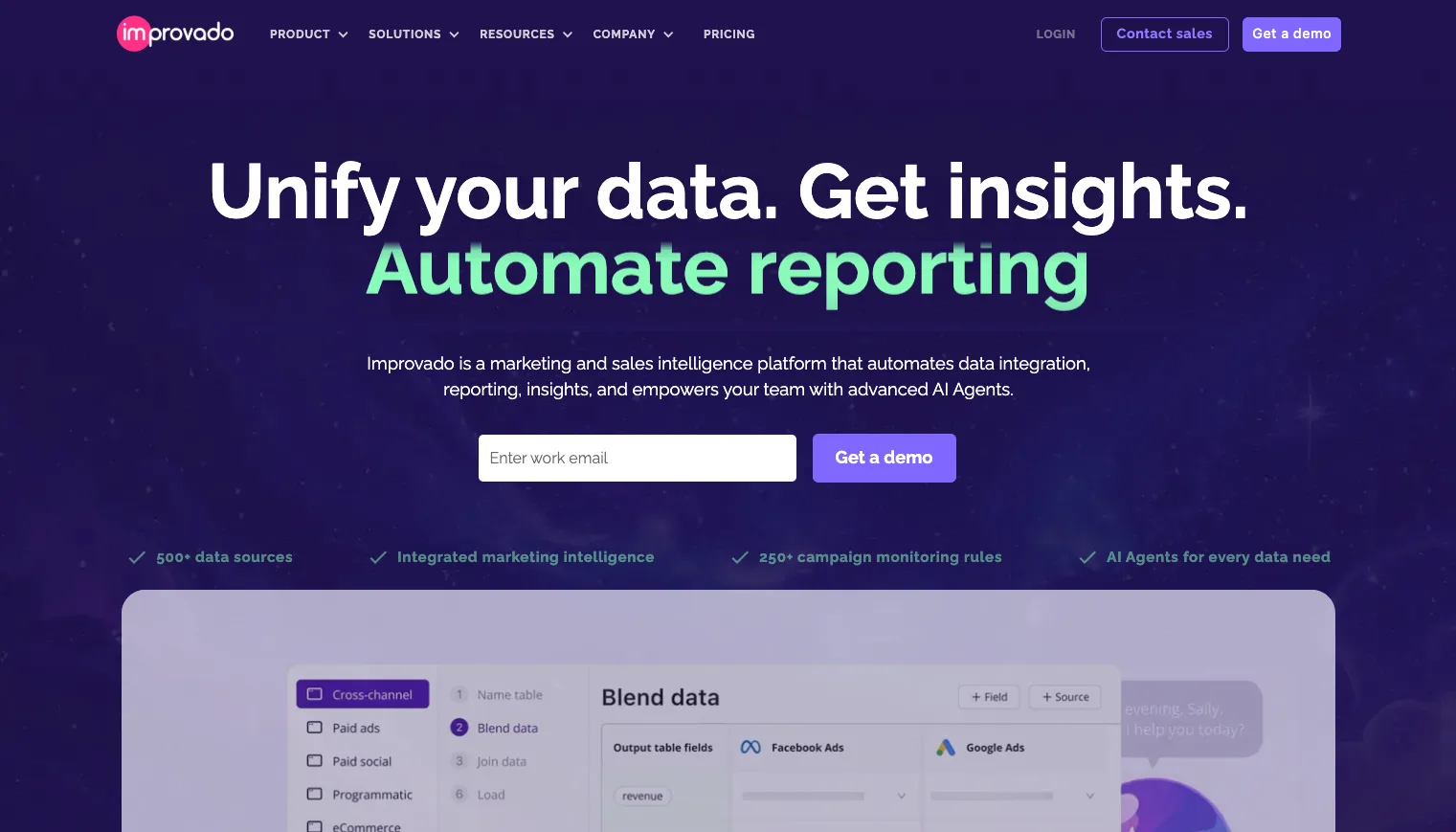
Marketing generates enormous amounts of data, and analyzing all of it to find meaningful insights is extremely difficult. Improvado’s marketing AI agent aims to analyze this complex marketing data and deliver “actionable insights” that tie directly to the business.
A key feature of Improvado is that it does not rely on a single AI model: it is a comprehensive ecosystem that integrates multiple AI models and infrastructure. It connects to all integrated ad platforms and builds a “unified command center” that manages data centrally, like a control tower. This structure enables analysis across many kinds of data, which should yield deeper insights.
AI Analyzes Complex Marketing Data “in Seconds”
Improvado offers powerful analytics that solve marketers’ data analysis challenges and enable fast decisions.
Advanced analysis tasks in seconds: The AI completes analysis tasks that would normally take a long time in just a few seconds, including campaign performance tracking, sales trend analysis, cross-channel performance breakdowns (how much each channel contributes), cost efficiency and ROI (return on investment) analysis and campaign performance breakdowns by device. AI that delivers analysis results this quickly is groundbreaking.
Insights tailored to your data ecosystem: It adjusts its analysis to the company’s existing data systems and provides more relevant insights. That means the results can be turned into business strategy right away.
Goodie AI
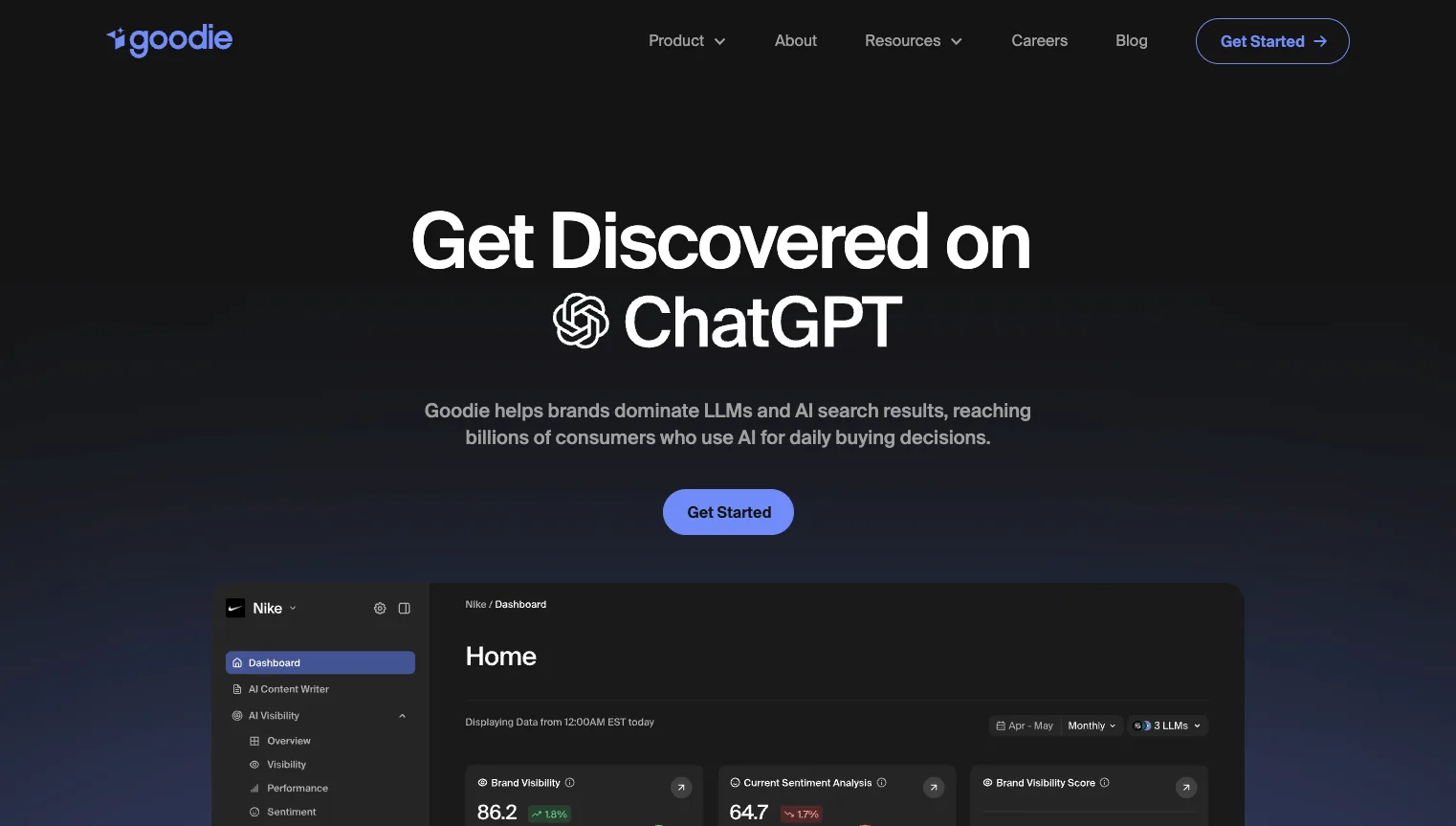
One new challenge companies face in today’s digital marketing is how information appears on “AI search engines” and “large language models (LLMs)” such as ChatGPT, Perplexity, Gemini and Claude. Beyond traditional search engine optimization (SEO), “AEO (Answer Engine Optimization),” which manages how a brand is perceived and displayed on these AI platforms, is becoming more important. Goodie AI is a platform specialized in AEO, designed to let enterprise brands control their visibility and reputation on AI search engines.
Brand Management in the Age of AI Search: Goodie AI Optimizes “How You Appear”
Goodie AI uses autonomous AI agents to help performance marketers, SEO leaders and content teams manage their brands efficiently in the age of AI search.
Comprehensive tracking, analysis and optimization by autonomous AI agents: AI agents continuously track, analyze and optimize a brand’s mentions, visibility, sentiment (positive or negative) and share of the market conversation (share of voice) on major AI platforms.
AI search monitoring and a brand intelligence layer: It monitors in detail how the brand appears in AI search results and provides the deep insights gained from that monitoring (brand intelligence). Companies can understand, based on data, how their brand “appears” in the AI era.
AEO visibility and a conversation explorer In addition to an “AEO visibility” feature that increases the brand’s exposure in AI search, it offers a “conversation explorer” feature that analyzes conversations with AI. This helps companies understand how users interact with their brand through AI and find areas for improvement.
Salesforce “Agentforce”
Salesforce, widely known in the world of CRM (customer relationship management), offers Agentforce, an AI-driven platform for further strengthening business operations. The platform makes it possible to create and manage autonomous AI agents across many areas of work, including marketing.
Agentforce: A Future Where AI Runs the Business Around the Clock
AI agents built with Agentforce run 24/7 and carry out tasks autonomously based on predefined rules and goals. This provides proactive support to both employees and customers and greatly improves operational efficiency. AI that works without rest is truly dependable.
A low-code agent builder lets anyone build AI agents A “low-code agent builder” lets users create AI agents easily through intuitive operations, even without programming expertise, so AI agents can be introduced flexibly to meet frontline needs.
Seamless workflows through Slack integration: Because it integrates with Slack, a communication tool used every day at many companies, users can receive notifications from AI agents in real time and give instructions to AI agents from within Slack.
Case study in the pharmaceutical and medical device industry: JSOL’s solution: JSOL Corporation uses Salesforce Life Sciences Cloud and Agentforce to provide a solution for pharmaceutical and medical device manufacturers. The solution helps optimize sales strategy, improve data access for MRs (medical representatives) and marketing staff, streamline indirect work and create time for them to focus on more essential core work. AI that can solve the challenges of a complex industry shows how far the technology has come.
ZBrain AI Agents
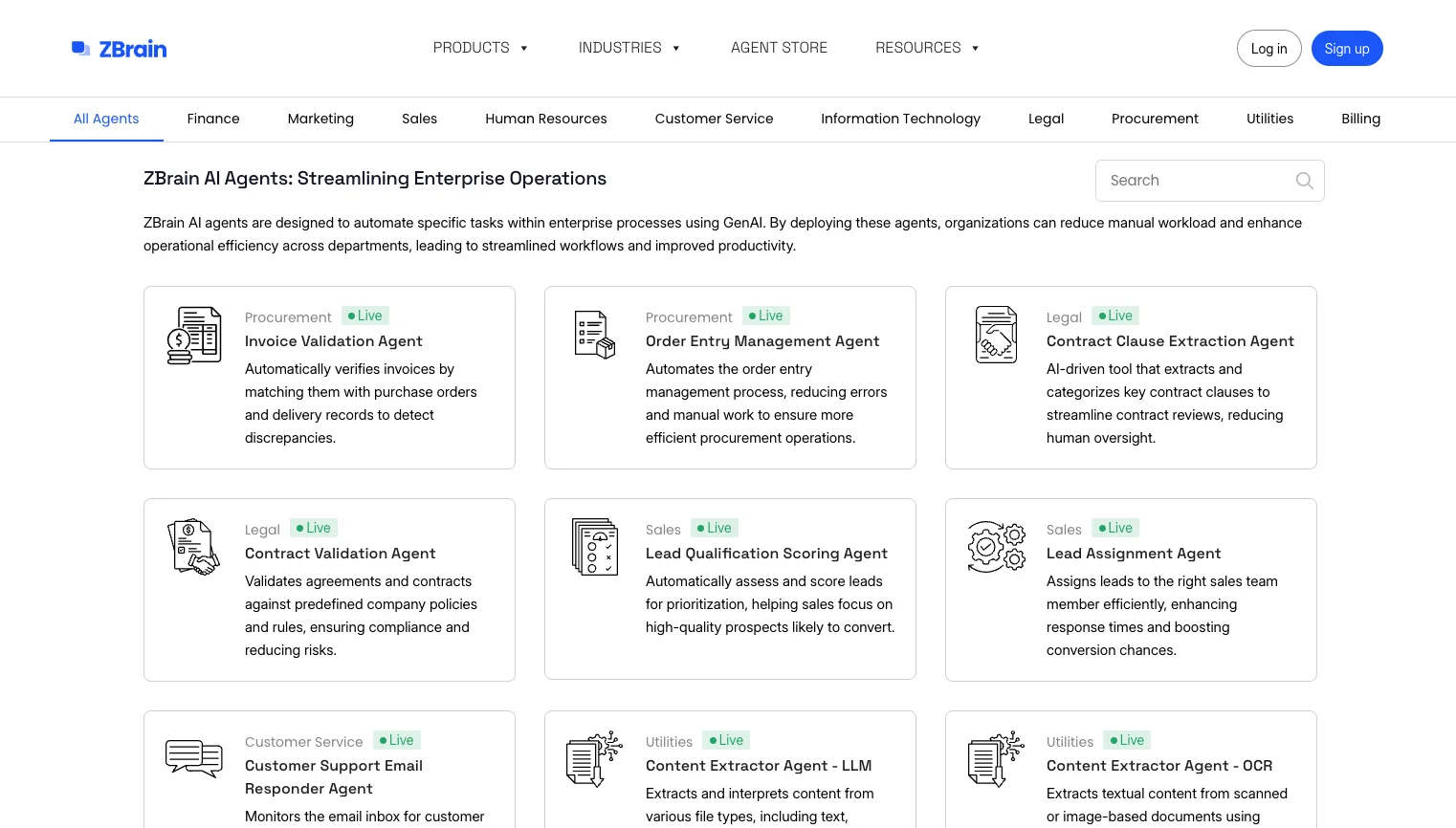
Today’s marketing work covers a wide range, and handling each task efficiently is very demanding. ZBrain AI Agents provides a suite of AI agents that strengthen marketing work, helping automate tasks, deliver data-driven insights and streamline entire workflows.
A key feature of the service is that it can connect and coordinate multiple different AI agents at the same time. This lets AI support a wide range of tasks across business functions. It feels like having several specialists working together, which is very reassuring.
AI Supports Marketing Work “End to End”
ZBrain AI Agents offers a wide variety of AI agents specialized in every aspect of marketing.
Content generation and optimization: There is a “blog topic generation agent” that brainstorms blog topics and a “content development agent” that creates the actual content. It also offers a “backlink analysis agent” and an “off-page SEO agent” to strengthen SEO (search engine optimization), helping produce high-quality content efficiently and get it seen by many people.
Market analysis and competitor tracking: A “market research summary agent” summarizes complex market data in an easy-to-understand way. A “competitor news aggregation agent” automatically collects and analyzes competitors’ latest moves, helping teams always stay on top of the market and plan strategy quickly.
Customer engagement and communication: An “email campaign personalization agent” helps run personalized email campaigns tailored to each customer. A “customer feedback sentiment analysis agent” analyzes customer feedback and identifies whether the sentiment is positive or negative, helping improve customer service.
Social media management and PR: A “social media content generation agent” creates engaging posts, and a “social media trend monitoring agent” tracks the latest trends. A “press release drafting agent” also helps create PR materials, covering a wide range of work.
Growf
In B2B marketing, it is important to find the right customers, deliver messages that resonate with them and ultimately turn that into sales. Growf is an AI-driven platform specialized for these B2B marketing needs, aiming to streamline and strengthen marketing strategy as a whole.
Growf uses AI to streamline and strengthen many aspects of marketing strategy, from audience research to content creation, SEO optimization and automated ad campaigns.
Strengthening B2B Marketing Strategy “Comprehensively” with AI
Growf offers a wealth of features that strongly support the entire B2B marketing process.
Clarifying target customers and crafting value propositions: The AI creates an “ideal customer profile (ICP)” and develops detailed “buyer personas” (fictional customer profiles), so companies can clearly define their most valuable customers and craft concrete “value propositions” that resonate with them. A clear target is a very important point in strategy planning.
Content and SEO optimization: The AI efficiently carries out SEO and keyword research and, based on the results, helps create SEO-optimized content. This increases traffic from search engines and helps reach more prospects.
Campaign management, analysis and optimization: The AI supports everything from generating campaign ideas to managing LinkedIn ads and analyzing and optimizing campaigns. It is expected to maximize ad effectiveness and improve marketing ROI (return on investment).
Rox Inc. “RoxDirector”

In recent years, short social media videos have become a very important marketing tool. However, continually producing and improving effective short videos requires expertise and effort. RoxDirector, offered by Rox Inc., solves this problem as an AI-director-style “analysis × generation” tool specialized for short social media videos.
RoxDirector’s goal is to analyze and improve videos efficiently through AI script editing, structure analysis, automatic audio transcription and overall scoring, reducing the effort of production while raising video engagement (viewer response). It is reassuring, as if AI were supporting you as your own dedicated video director.
RoxDirector: AI Supports Even the “Direction” of Short Videos
RoxDirector offers unique features that support short videos from production through improvement.
Automatic checks and edits just by uploading a script Just upload a video script, and the AI automatically checks the content and suggests edits to make the video more engaging. This feature helps improve script quality and supports the first step toward videos that capture viewers’ interest.
Automatic audio transcription for more efficient editing The AI automatically transcribes the audio in videos, greatly reducing the effort of creating captions and checking content during editing. This is a wonderful feature that dramatically improves the efficiency of video production.
Scoring direction, structure and script to clarify what to improve The AI analyzes each element of a video’s direction, structure and script and gives each a concrete score. It becomes clear which parts of the video to improve to make it more effective, enabling a data-driven improvement cycle.
AICE Inc. “ADGo”
Marketing is always evolving, and with the rise of AI search engines and large language models (LLMs) in particular, companies face new places to publish information. ADGo, offered by AICE Inc., strongly supports marketing in this new era as “the world’s first Marketing Deep Dynamic AI Agent system for professional marketing applications.”
ADGo is a system that integrates multiple large language models (LLMs) with knowledge built up over many years by marketing professionals. More than 60 customized AI agents work together to handle needs such as market research, marketing planning and creative content. It is very reassuring that AI covers every aspect of marketing. The company is currently aiming to expand across the Asia-Pacific region and has already finished building data infrastructure in Taiwan, Japan and Singapore.
AI Automates Marketing “Deeply”
Through the coordination of advanced AI agents, ADGo improves the efficiency and strategic precision of marketing work.
Comprehensive support from market research to content creation: The AI deeply analyzes market trends and customer needs and, based on the results, helps draw up the best marketing plan. It also handles brainstorming and generating the creative content needed, which is expected to greatly reduce the burden on marketing staff.
More than 60 specialized AI agents working together: More than 60 types of AI agents, each specialized in an area of marketing, work together using their own expertise. These specialized agents approach even complex marketing challenges from multiple angles and arrive at the best solutions.
HOUSEI Inc. “imprai ezBI”
In business, it is very important to analyze a company’s sales and accounting information in real time and use it in management. imprai ezBI, offered by HOUSEI Inc., is a “generative AI chat-based BI tool” that meets this need.
The biggest feature of imprai ezBI is that, by working with an AI agent specialized in BI (business intelligence), it lets users analyze sales and accounting information in real time, as if they were chatting. Getting the data you need just by asking, without learning complicated operations, seems very convenient.
Making Data Analysis Accessible with the AI Chat-Based BI Tool imprai ezBI
imprai ezBI makes business data analysis more intuitive and efficient.
Real-time analysis in chat form: When users ask what they want to know in a chat, the AI agent analyzes the company’s sales and accounting data and answers on the spot. Quick access to information, for example when data is suddenly needed during a meeting, is a big advantage.
Enhanced CSV import and a variety of charts CSV data import has been enhanced, so data in various formats can be imported smoothly. It also supports a wide range of chart types, including radar charts, as well as dual-axis graphs, so data can be shown visually and analyzed from multiple angles.
Deeper insights with in-depth questions (LLM integration): Through integration with large language models (LLMs), the AI can answer probing questions such as “Why did this number come out this way?” Users can understand not just a list of numbers but the meaning and factors behind them, enabling higher-quality decisions.
free web hope Inc.
Raising a website’s conversion rate (CVR, the share of visitors who take a target action) is always an important marketing challenge. MagicLPO, offered by free web hope Inc., solves this problem as an AI-powered LPO (landing page optimization) support service.
MagicLPO’s goal is to raise a website’s CVR quickly and at low cost by having AI automatically suggest highly accurate improvements based on website data, combined with no-code tools and support from expert analysts.
Dramatically Raising Website CVR with AI and Professional Expertise
MagicLPO offers a wealth of features for optimizing websites efficiently and effectively.
AI automatically suggests highly accurate improvements The AI analyzes website visitors’ behavior data and other information and automatically suggests concrete improvements that lead to higher CVR, so teams can act efficiently without wondering what to improve.
Using original data from user interviews: Beyond website data, the AI uses original data in the form of “real voices” from actual user interviews, enabling a deeper understanding of user needs and problems and more accurate improvement suggestions. Being able to use qualitative as well as quantitative data is appealing.
Fast improvements with no-code editing and A/B testing: Website changes are easy to make with no-code tools, so improvements can be carried out right away without specialized knowledge. An A/B testing feature lets teams compare the effects of multiple improvement ideas and choose the most effective one based on data.
Integrated marketing data management and support from expert consultants: Various kinds of marketing data can be managed centrally, which helps optimize not only the website but marketing as a whole. In addition to AI suggestions, customers receive hands-on support from experienced expert consultants, so they can pursue LPO with confidence.
Baymon Inc. “simon”
In marketing strategy, which ad media you choose and what ad copy you write have a huge effect on results. simon, the AI marketing platform from Baymon Inc., includes AI agents to transform traditional marketing work that starts with choosing ad media.
simon, currently offered as a beta, has two main powerful features: choosing ad media and generating ad copy. Having AI show the best path for ad operations is a big help for marketers.
simon: AI Automatically Leads the Way to “Ad Optimization”
simon uses AI to support ad optimization and flexible ad operations tailored to the target audience.
Choosing the best ad media and allocating budget: It covers a wide range of ad media in Japan, from online to offline, and the AI chooses the best media for each characteristic and target audience. It also calculates how much budget to allocate to each medium, so ad spend can be used efficiently.
Automatically generating ad copy that resonates with the target: The AI automatically generates ad copy that speaks to the target audience, greatly reducing the time and effort of creative production and making it possible to put out more compelling ads.
RUFU Inc. “emma”
Business on e-commerce marketplaces (such as Amazon and Rakuten) is highly competitive, and sellers must constantly monitor the situation and act quickly. emma, offered by RUFU Inc., combines AI agents with BPO (business process outsourcing) and is a service that lets sellers run the PDCA cycle for marketplace operations as much as 10 times faster.
emma’s goal is to automate and streamline marketing work on these highly competitive marketplaces and help companies grow sales. With AI and expert support working as one, running an online store becomes far easier, which makes it seem like a dream service.
“Ultra-Fast” Marketplace Operations with AI Agents and BPO
emma supports the main tasks of marketplace operations with AI and BPO.
Competitor research handled by AI agents: AI agents automatically research competitors’ moves and strategies and report the results. This should help sellers grasp the market quickly and plan their own strategy.
Reports with hypotheses on what drove sales changes When sales change, the AI automatically analyzes possible causes and provides its hypotheses as a report, so problems can be identified quickly and turned into next actions.
Actions carried out on your behalf: Based on the AI’s analysis and suggestions, the BPO service carries out the actions that need to be taken on the marketplace (such as improving product pages or adjusting ads). Being able to entrust everything from analysis to execution is very reassuring.
TOPPAN Inc.
As digital transformation (DX) advances, using AI in marketing work has become unavoidable. TOPPAN Inc. has developed a “generative AI management platform” for making companies’ marketing work AI-powered, and offers AI adoption and operation support services that use it.
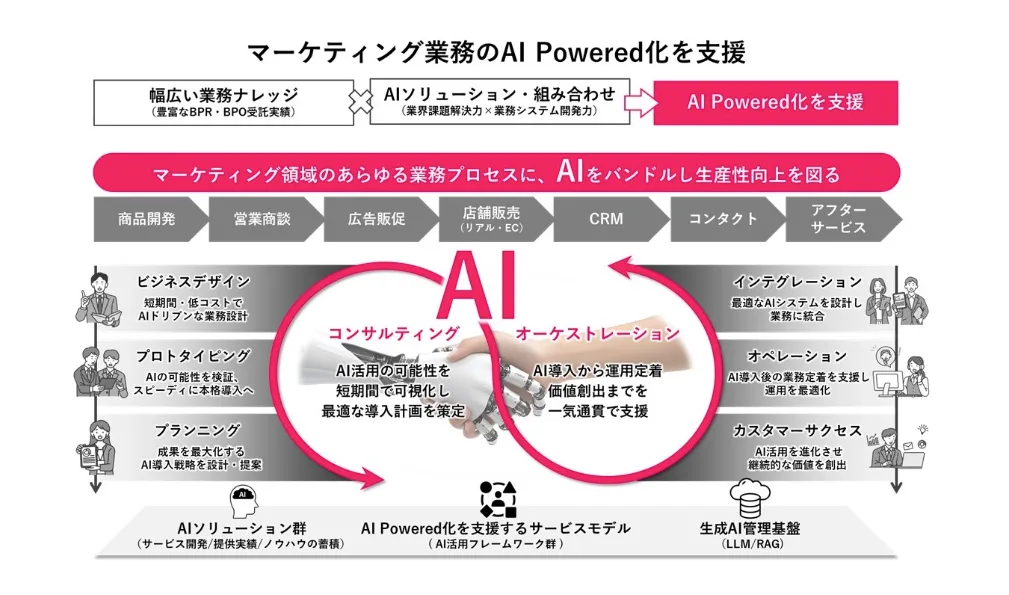
A key feature of this generative AI management platform is its RAG (retrieval-augmented generation) capability, which lets AI use a company’s highly confidential data securely, and planned future support for autonomous problem solving by AI agents. It also supports low-code development, so AI systems can be built without writing code, and because it is offered as SaaS, it is easy to adopt.
TOPPAN’s Support Services Drive “Marketing DX” with AI
TOPPAN’s generative AI management platform and its AI adoption and operation support services aim to reform business processes in marketing DX.
Secure use of company data through RAG: With RAG, AI can safely learn from and use a company’s vast data and confidential information. This enables more accurate AI use that fits the company’s actual situation.
Future autonomous problem solving by AI agents: A feature is planned in which AI agents autonomously find marketing problems and carry out solutions. Imagining AI that thinks and acts on its own feels like the future of work.
Easier adoption through low-code development and SaaS delivery: Low-code development, which lets people build AI without specialized knowledge, and SaaS delivery, which makes it easy to use as a cloud service, make it easier for many companies to adopt AI.
AI strategy and adoption consulting, and AI orchestration: TOPPAN does more than provide tools. It offers comprehensive support, from planning AI strategy and adoption to “AI orchestration,” in which AI works with multiple systems to carry out business tasks.
GO Inc. and CyberAgent
The Breakthrough Company GO and CyberAgent, Inc., both leaders in Japan’s marketing industry, have signed a business partnership agreement. The partnership aims to further strengthen support for Japan’s top marketing leaders, specifically CMOs (chief marketing officers) and executives.
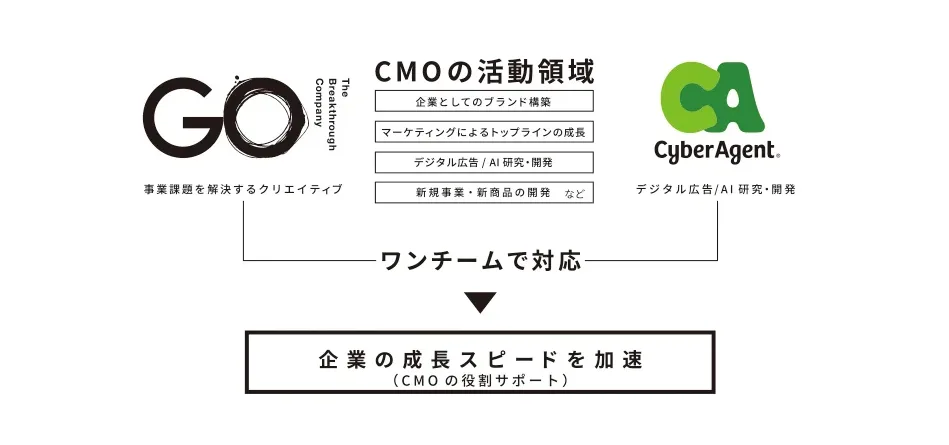
The solution offered through the partnership combines CyberAgent’s digital advertising technology and AI research built up over many years with GO’s strength in creative-led branding support. It supports everything from branding to integrated marketing end to end, including AI-powered brand development and business strategy planning.
UXLINK “UXLINK AI Growth Agent”
In the world of Web3 (the decentralized web), new projects are emerging one after another, and reaching and growing a large user base is critical. To meet this challenge, UXLINK, a provider of Web3 social infrastructure, offers a tool called UXLINK AI Growth Agent.
The goal of this AI growth agent is to accelerate the growth of Web3 traffic (such as website visits) through AI-driven innovation. It strongly boosts the growth of Web3 projects through processes fully automated by AI.
An AI Growth Agent That Accelerates the Growth of Web3 Projects
UXLINK AI Growth Agent offers a range of features that efficiently support the growth of Web3 projects.
Automation and efficiency through AI: AI automates much of the marketing work, greatly reducing the workload for project teams.
Targeting with data-driven insights: The AI analyzes data and provides insights for reaching the target user base effectively.
Expansion through social media integration: It connects with major social media platforms such as Twitter and TikTok, making it possible to reach a much wider range of users.
Building a sustainable growth model with easy adoption: With AI, projects can build a model for sustainable growth, not just temporary spikes. Adoption is easy, so even Web3 startups can get started without hassle.
Metareal Inc. “Metareal Analytics”
For marketers and social media managers who handle online media and social networks, understanding user behavior in depth and planning the next strategy is a major daily challenge. Metareal Analytics, offered by Metareal Inc., is a “meme analysis AI agent” designed to support exactly these people.
A “meme analysis AI agent” is an AI agent that gains insights from user behavior data by analyzing “memes” (jokes and trending expressions) that spread on social media and elsewhere. With this AI agent, user behavior data is visualized clearly in just a few minutes, and the AI suggests the “next move,” that is, what strategy to pursue next. It can also generate reports automatically (in PDF or PowerPoint format), which makes it convenient to share results right away.
AI Suggests the “Next Move”: The Meme Analysis AI Agent Metareal Analytics
Metareal Analytics was developed with the following users in mind.
Research departments and analysts at online media companies It helps them quickly grasp market trends and user reactions.
Editorial planning departments and hypothesis-testing teams in content production They can use the “next move” suggested by the AI to develop strategies for content that gets people talking.
Marketing departments and growth teams A deep understanding of user behavior lets them plan and run more effective marketing measures and growth strategies.
Metareal Analytics is a tool that uses AI to dramatically shorten data analysis time and help marketers and social media managers make faster, more effective decisions.
Intimate Merger, Inc.
Companies hold vast and varied customer data, but making full use of it and turning it into concrete marketing measures is not easy. To solve this problem, Intimate Merger, Inc. has announced the “Data Discovery Agent (DDA),” a vision for next-generation data utilization.
Along with this, the company has begun recruiting “co-creation partners” who share the DDA vision and will build a new future for data utilization together. A new effort is getting under way that uses the power of AI agents to “discover” the dormant data companies hold and turn it into business growth.
What Is the DDA Data Utilization Vision?
The goal of DDA is to let AI agents use the various marketing data a company holds to extract customer segments and automatically generate concrete proposals for marketing measures. This helps companies bring data-driven marketing in-house in a more advanced and efficient way.
The Innovation DDA Brings and Its Main Features
The Data Discovery Agent (DDA) aims to help companies bring marketing in-house and make it more sophisticated, and has the following features.
Connecting with many data sources: AI agents connect with a variety of data sources, such as a company’s website behavior data, purchase history and customer attributes. This lets companies understand customers deeply from multiple perspectives and gain more essential insights.
Automatic analysis and recommendations by AI agents: AI agents automatically analyze this vast data and automatically generate concrete customer segments, for example “what message to send to which customer group,” as well as proposals for effective marketing measures.
Supporting in-house and more advanced marketing: With DDA, companies can drive data-driven marketing internally without relying on outside experts. Being able to execute more advanced marketing strategies with AI support should directly strengthen a company’s competitiveness.
JAPAN AI (a Geniee Group Company) “JAPAN AI AGENT”
To maximize the effect of ad campaigns, it is essential to constantly analyze the latest data and create reports. However, reporting takes a lot of time and often squeezes the time sales staff should spend on their core sales activities. The “ad report agent,” part of the JAPAN AI AGENT lineup of AI agents offered by JAPAN AI (a group company of Geniee), was developed to solve this problem.
The goal of the JAPAN AI AGENT ad report agent is to turn ad performance data into reports automatically and give sales staff as much time as possible to focus on core work such as talking with clients and planning strategy. Having AI quickly take over time-consuming reporting would be a real help.
AI Automatically Creates “Ad Reports” and Maximizes Sales Activity
The JAPAN AI AGENT ad report agent efficiently analyzes ad performance data and provides easy-to-understand reports.
Automatic analysis of ad data and PowerPoint report generation: The AI agent automatically analyzes CSV data exported from ad platforms. Based on the analysis, it automatically generates PowerPoint reports that include charts and commentary.
BigQuery integration for large-scale data: It can also connect with BigQuery, Google’s data warehouse service. Large volumes of ad data can be imported smoothly, and the AI agent can run advanced analysis.
The JAPAN AI AGENT ad report agent is a tool that uses AI to make ad performance more visible and creates an environment where sales staff can focus on higher-value work.
PIALA Group

Producing ad creative is critical for communicating a company’s message effectively, but balancing productivity and quality is a constant challenge. PIALA Group is strengthening its generative AI capabilities at its sites in Vietnam and Thailand and building them into an “AI Creative Center.”
The goal of the AI Creative Center is to maximize both “production productivity” and “quality of expression” by combining AI and people. Combining AI’s fast generation with human creative ideas should make possible a level of efficiency and quality in creative production that was unthinkable before.
Transforming “Creative Production” by Combining AI and People
PIALA Group’s AI Creative Center has built a large-scale system for mass-producing creative and provides the following capabilities.
More efficient production of ad banners, videos and landing pages: With AI supporting the production of ad banners, videos and landing pages (LPs), the hours spent on creative production, which used to take a long time, can be greatly reduced.
More varied expression through 3D modeling: Using AI in 3D modeling as well makes it possible to produce richer, more expressive creative. That should be a major strength for catching customers’ attention and raising brand image.
About 40% fewer production hours by using AI with shared existing knowledge: A result has been reported in which production hours were cut by about 40%, with AI learning from and using existing knowledge such as past creative and success stories.
tsumugi Inc. “tsumugi”

In content marketing, efficiently producing large numbers of articles that also perform well in SEO (search engine optimization) is a major challenge for many companies. tsumugi, a marketing AI agent offered by tsumugi Inc., is a service whose strength is exactly this combination of “mass production × SEO.”
tsumugi’s goal is to generate SEO- and AI-optimized articles tailored to the product and even complete automatic posting to platforms such as note. Having AI support every step of content production is efficient.
AI Automates Everything from Article Generation to SEO and Posting
tsumugi offers a variety of features that dramatically raise the efficiency of content production.
Collecting the latest information and generating articles from YouTube videos: The AI not only searches the web to gather the latest information but can also generate articles based on the content of YouTube videos, so articles packed with fresh information can be created efficiently.
Automatic generation of thumbnails and in-article images, and SEO keyword sets The AI automatically generates thumbnails and in-article images that match the article, making it easy to create visually appealing content. It also automatically generates sets of SEO keywords, so writing articles aimed at higher search rankings goes smoothly.
Google ranking tracking for each article It also has a feature for tracking where each generated article ranks in Google search. Because the AI keeps watch all the way to results, teams can concretely understand SEO effects and use them for the next round of improvements.
With the power of AI, tsumugi streamlines every step of content production and strongly drives companies’ content marketing.
Office Lacroix LLC “OpusBooster 2.1 ẞ”
With many separate marketing tools, each with different functions, connecting tools and managing data centrally can become a challenge. OpusBooster 2.1 ẞ, offered by Office Lacroix LLC, is a “no-code × AI integrated marketing OS” that resolves this “tool fragmentation.”
OpusBooster’s goal is to provide an environment where every phase of marketing, from attracting customers to selling and even running customer communities, can be completed in one place. By combining AI and no-code, the service makes integrated marketing possible even without specialized knowledge, which is truly groundbreaking.
No-Code AI Integrates “Every Step of Marketing”
OpusBooster includes several key features that help lighten the burden of content creation, making marketing more efficient.
Community, LMS and video hosting: It offers community features for deepening engagement with customers, an LMS (learning management system) for providing online courses and even hosting for video content. With these features, customer development and education can be handled in one consistent flow.
AI for high-quality articles and social media posts: The AI generates content for blog posts and social media posts, greatly reducing the time and effort of content creation. Being able to publish high-quality content consistently is an attractive point.
By combining AI and no-code, OpusBooster removes the complexity of marketing tools and gives companies an environment for building customer relationships more efficiently and in a more integrated way.
Logo Labo Inc. “AI Brand Review”
Keeping a consistent brand image is very important for companies. “Brand review,” which checks whether every element, such as logos, text and design, follows the brand guidelines, is time-consuming but essential work. AI Brand Review, the first feature of the “Brand AI Agent” from Logo Labo Inc., was developed to solve this problem.
The goal of the Brand AI Agent is to automate brand review with AI in order to maintain and improve the company’s brand image.
AI “Instantly Checks” Logos and Text and Raises Brand Literacy
AI Brand Review instantly reviews content against the brand guidelines, greatly improving efficiency and raising brand literacy across the company.
Efficiency through instant reviews The AI instantly checks whether logos and text are used correctly according to the brand guidelines and gives feedback on the results. This greatly reduces the time spent on checks that used to be done by hand and speeds up design and content production.
Raising brand literacy across the company: Because the AI provides specific feedback, each employee can understand and apply the brand guidelines more deeply. It seems very effective for raising brand literacy across the whole company.
The service can be used from a browser and also as a chatbot connected to business chat tools such as Microsoft Teams and Slack. Being able to run brand checks easily in daily work should make it easier to maintain brand consistency.
Sales Marker Inc. “Sales Marker Super Agent”
In business, people in all kinds of roles, such as sales, planning, marketing, HR and management, are busy with daily work. Sales Marker Super Agent, offered by Sales Marker Inc., is a new service that integrates a set of AI features supporting every kind of work businesspeople do.
The service’s goal goes beyond supporting sales: by having AI support a wide range of work, such as decision-making, creating documents, executing tasks and managing records, it aims to cut time costs and improve the accuracy of work.
AI Supports “Every Kind of Work” for Businesspeople
Sales Marker Super Agent uses AI to streamline many kinds of work. As its first step, the company has started offering “AI Slides,” which automatically generates slides that match a company’s corporate brand, starting from research.
More efficient proposals with AI Slides The AI automatically generates slides that match the company’s corporate brand (its image, logos and so on), starting from research, greatly reducing the time spent creating proposal materials so teams can focus on higher-quality proposals.
AI support for a wide range of work: Going forward, AI is set to support many kinds of work, such as decision support, task execution and record management.
To mark the launch of Sales Marker Super Agent, the company is accepting pre-registration, limited to 10,000 people. For details, see the official website.
Dentsu Japan’s AI Strategy “AI For Growth 2.0”
The Dentsu Group in Japan, a leading company in advertising and marketing, has announced its own AI strategy, AI For Growth 2.0, and is accelerating its shift to becoming AI-native. The goal of the strategy is to contribute to the growth of clients and society as a whole by combining “human intelligence” and “AI intelligence.”
The Dentsu Group is deepening its own “AI models,” which merge large-scale survey data with the expertise of its in-house specialists, to bring innovation to marketing methods. It aims to have AI agents support every step of the marketing process. AI and people joining hands to create new value is a very interesting trend.
AI Creates the Future of “Integrated Marketing”
The Dentsu Group’s AI strategy in Japan is being advanced through specific AI models and the development of an “integrated marketing AI agent.”
Understanding customers deeply with the People Model From a huge dataset covering 100 million people, the AI virtually recreates high-resolution personas (virtual customer profiles). Companies can understand target customers more deeply and develop marketing strategies that resonate with them.
Accelerating idea generation with the Creative Thinking Model This feature has AI learn the knowledge and ideas of in-house specialists and generate visual ideas. With AI supporting the creative idea generation process that used to rely on people, more diverse and original ideas are expected to emerge.
Developing the “integrated marketing AI agent” and offering it externally: By connecting this group of AI applications with data, an “integrated marketing AI agent” is being developed. The agent is also scheduled to be offered to clients and will comprehensively support companies’ marketing.
Stronger links with Dentsu Digital’s “∞AI”: By connecting with each solution in the Dentsu Group’s AI For Growth in Japan, ∞AI from Dentsu Digital has improved the answer accuracy of its virtual customer AI, expanded idea generation through dialogue with AI agents and strengthened the generation of brand ads. It is clear that the group is working to maximize AI synergies across the whole organization.
The Dentsu Group’s AI For Growth 2.0 in Japan is a very important initiative that shows how AI will shape the future of marketing.
itsumo Inc.
Succeeding in e-commerce requires analyzing huge amounts of data and quickly taking the best measures. itsumo Inc. has begun full-scale rollout of “Data Marketing (iDM.),” an integrated service that helps brands achieve results in e-commerce. At the core of the service is “itsumo. Agent AI,” which merges the company’s own “data,” “technology” and “methods” and makes particular use of generative AI.
Accelerating E-Commerce with AI: The Power of itsumo. Agent AI
itsumo. Agent AI uses AI to solve a variety of challenges in e-commerce and strongly supports brand growth.
Understanding the market deeply with the “3C research agent”: One feature already released is the “3C research agent,” specialized for major e-commerce platforms such as Rakuten Ichiba and Amazon. The AI researches and analyzes the three Cs, the Company, its Customers and its Competitors, in detail. Having AI explain market trends is very reassuring.
More AI agents specialized in e-commerce on the way: Going forward, itsumo. Agent AI plans to roll out AI agents specialized in a wide range of e-commerce areas, such as page creation, advertising and sales promotion. It helps brands run a “fast PDCA (plan-do-check-act) cycle” in brand e-commerce and efficiently find and implement “winning patterns” that lead to sales.
Through the use of AI agents, itsumo Inc. aims to make e-commerce operations more scientific and efficient and to help brands become more competitive.
Explaza Inc. “Mark”
The importance of content in digital marketing, including blog posts, email newsletters and social media posts, keeps growing. However, producing high-quality content consistently takes time and effort. Mark, the content generation AI from Explaza Inc., has supported many marketers as a service that uses AI to generate and convert content such as articles, newsletters and social media posts.
Now, an “AI agent feature” has been added to Mark, making editing of generated content easier and more efficient than ever. Having AI support everything from creating content to revising it seems very convenient.
The Content Generation AI Mark Evolves Further with an “AI Agent Feature”
The AI agent feature added to Mark greatly changes the “editing” phase of content production.
Revision instructions in an intuitive chat format Just drag over part of the text on the editing screen to give the AI revision instructions directly in chat. For example, simply state a specific request such as “Make this part easier to understand” or “Use more positive wording,” and the AI makes the revision on the spot.
Adding and correcting information through web search, and fact-checking: The AI agent also has web search, so it can refer to outside information as needed to add new information to content or correct existing information. It also includes a fact-checking feature, and being able to confirm the accuracy of generated content is very reassuring for quality control.
KnowledgeSense Inc. “ChatSense”
In business, getting the latest information quickly and accurately is extremely important. The Deep Research feature in ChatSense, the generative AI service for businesses from KnowledgeSense Inc., is an AI agent feature that meets exactly this need.
The feature works as a “research AI” that runs repeated web searches on the user’s behalf and compiles the results into a detailed report.
AI Researches the Web “Deeply”: ChatSense’s Deep Research Feature
ChatSense’s Deep Research feature is expected to complete, in just a few minutes, comprehensive web research that used to take people several hours.
Automatic web search and report creation: Based on the user’s instructions, the AI autonomously searches the vast information on the internet and gathers what is needed. It then organizes the information and summarizes it in an easy-to-understand report.
Comprehensive research with nothing missed: When people search by hand, oversights and bias can creep in, but by repeating broad web searches, the AI delivers more comprehensive and objective research results.
Secure and reliable to use: ChatSense, a security-enhanced ChatGPT service for businesses, has already been adopted by many companies. Strong security is a very important point when handling a company’s information assets.
KnowledgeSense’s ChatSense uses AI agents to streamline information gathering and analysis in business and will be a powerful tool for supporting higher-quality decisions.
GMO Internet Group “Tenbin AI Biz by GMO”
Corporate research covers a wide range of topics, including market trends, competitor analysis, laws and regulations and technology trends. Tenbin AI Biz by GMO, a generative AI platform for businesses from GMO Internet Group, was developed to streamline this research work. A key feature of the platform is that it lets users compare and use multiple generative AI models (OpenAI, Google, Perplexity AI and others) at the same time.
Now, a “Deep Research” feature has been added to Tenbin AI Biz. The feature uses cutting-edge technology, only recently implemented by OpenAI, Google, Perplexity AI and others, in which AI autonomously gathers and analyzes information in multiple steps.
AI Researches “Autonomously”: The Deep Research Feature of Tenbin AI Biz by GMO
The Deep Research feature of Tenbin AI Biz by GMO has the potential to fundamentally transform corporate research.
Understands the question, breaks it into tasks and executes them autonomously: The AI does not simply answer questions. It deeply understands the intent of a question and breaks it down into specific information-gathering and analysis tasks. The AI then autonomously carries out the whole process, from gathering information to evaluating and analyzing it and finally generating a report.
Handles a wide range of corporate research: It can handle the many kinds of research companies need every day, including market and competitor research, research on laws, regulations and compliance, the latest technology trends and marketing research.
Comparing multiple AI models for the best results: Because multiple generative AI models can be used at once, it can analyze information from multiple perspectives using each AI’s strengths, which is expected to produce more accurate and comprehensive research results.
Adobe

Content production and data analysis are very important elements of marketing work. Adobe offers a wide range of products, from creative tools to marketing platforms, and what stands out most are the AI agent tools for streamlining marketing work announced at Adobe Summit 2025.
Adobe’s goal is to make these AI agents comprehensively available on its own marketing tools. In this way, it uses AI to optimize the core parts of marketing, such as “user experience,” “audience extraction” and “journey analysis,” and helps companies achieve bigger results. The fact that they are already being used at large companies such as Marriott International and Coca-Cola shows what they can do.
Adobe’s 10 AI Agents That Accelerate Marketing Work
These AI agents from Adobe greatly streamline marketers’ daily work and support strategic decision-making.
Automatically extracting and proposing “high-potential audiences”: AI agents automatically extract, from huge amounts of data, the “high-potential audiences” most likely to respond to a campaign. They also clearly show, with charts, how those audiences were chosen, so marketers can target accurately based on data.
Supporting the whole marketing lifecycle: AI agents work at every stage of marketing, from analysis and suggestions for improving the “user experience” to “journey analysis,” which analyzes customers’ behavioral paths. With a total of 10 types of AI agents working together, marketers can focus on more strategic work.
Twilio
Communication with customers is a key factor in business success. Twilio offers a platform that lets developers build a wide range of communication features into applications, and at SIGNAL 2025 it showed a preview of its next-generation customer engagement platform for an AI- and data-driven world. It is a big step toward AI making “conversations” with customers smarter and smoother.
Twilio provides the infrastructure that supports advanced conversational AI experiences. Companies can achieve more personalized, higher-quality communication at every touchpoint with customers.
Taking Customer Engagement to the Next Level with Conversational AI
Twilio’s conversational AI capabilities provide a foundation for understanding and automating conversations with customers more deeply.
Building advanced natural voice AI agents with ConversationRelay: With this feature, companies can build natural voice AI agents that sound like talking to a person, using the LLM (large language model) of their choice and tailored to their business. AI may soon answer customer inquiries by voice, just like an operator.
Gaining insights from conversations with Conversational Intelligence The AI analyzes the content of voice calls and text-based conversations and turns the important information and trends in them into structured data and insights. This lets companies deeply understand customers’ needs and feelings and use that understanding to improve services and marketing strategies.
JSOL Corporation
In the pharmaceutical and medical device industry, MRs (medical representatives) and marketing staff spend much of their time on indirect work while building relationships with and providing information to their customers, healthcare professionals. JSOL Corporation is tackling this problem by providing CRM (customer relationship management) and data utilization solutions built mainly on Salesforce Life Sciences Cloud.
In this initiative, the company uses Salesforce’s autonomous AI agent Agentforce to improve data access for MRs and marketing staff, streamline indirect work and increase the time they can spend on the “core work” they should focus on (such as high-quality conversations with healthcare professionals). AI taking over tedious administrative work should greatly reduce the burden on frontline staff.
Salesforce Agentforce Transforms Work at Pharmaceutical and Medical Device Manufacturers
This solution from JSOL uses AI agents to streamline business processes in the pharmaceutical and medical device industry.
Faster decisions through better data access: AI agents help MRs and marketing staff access the data they need more easily. They can quickly get the information needed for conversations with healthcare professionals and for planning marketing strategy, enabling better decisions.
Streamlining indirect work to focus on core work: With AI automating indirect work such as data collection, report creation and organizing information, MRs and marketing staff can focus on core work such as preparing for meetings with healthcare professionals, providing higher-value information and contributing to patients.
JSOL’s initiative is a good example of how AI agents can improve efficiency and reform the way people work in a specific industry.
Algomatic Inc. “Neo Design AI”
Eye-catching, high-quality images are essential in marketing, but producing them takes time and money. Neo Design AI, offered by Algomatic Inc., is an image generation AI agent specialized for marketing that addresses exactly this problem.
The service’s goal is to make it possible to generate high-quality, commercially usable images quickly and in large volumes. With AI supporting design work, marketers can raise both the speed and the quality of content production at the same time.
AI Transforms the Design Workflow: Neo Design AI
Neo Design AI offers powerful features for efficiently producing the images marketing needs, even without design expertise.
Following the “tone and manner” of existing creative The AI learns the tone and style of the company’s existing creative and creates matching design templates, so generated images stay consistent with the brand and companies can run unified marketing campaigns.
Taking in product requirements and generating editable design files By feeding the AI the concept and specific requirements of the product to be promoted, it generates design files that match them. The generated files are output in a format that can be edited layer by layer, so fine adjustments can be made later. It is very convenient that the AI not only creates a first draft of the design but also leaves plenty of room for editing.
Supporting in-house image production and completing every step: With AI supporting image production, design work that used to be outsourced can be completed in-house. Even a planner alone can move smoothly through every step, from planning the design to generating and editing it.
With the power of AI, Neo Design AI streamlines the creative production process and drives companies’ marketing more quickly and effectively.
Ureru Net Advertising Group
In recent years, as generative AI such as ChatGPT has evolved, an era of “AI-driven purchasing” is arriving, in which consumers ask AI what to buy and the AI chooses for them. In this new competitive environment for e-commerce, Ureru Net Advertising Group Co., Ltd. offers “Ureru AI Optimization for ChatGPT Shopping,” which it describes as the first, and only, AEO (AI Engine Optimization) support service from a company listed in Japan.
The service’s goal is to optimize an e-commerce site’s structure and information so that it is more likely to be chosen by “AI that buys.” In an era when AI chooses products, having AI itself support the strategy for getting your products chosen is truly marketing for a new age.
A New Strategy for Being “Chosen” by AI: Ureru AI Optimization for ChatGPT Shopping
Ureru AI Optimization for ChatGPT Shopping provides concrete technical support for the new e-commerce competition, in which “if AI doesn’t choose you, you don’t sell.”
Preparing “structured data” that AI can easily understand and evaluate: It helps prepare data in specific formats (structured data) so that AI can accurately understand and properly evaluate an e-commerce site’s product information and content. This means the company’s products are presented favorably when AI searches for and compares products.
Diagnosing and optimizing API integrations: It helps diagnose and optimize API (application programming interface) integrations so that the e-commerce site connects smoothly with external systems (such as generative AI services).
Supporting AI crawlers: It helps e-commerce sites properly support the “AI crawlers” that AI uses to collect information on the internet. By making sure crawlers can read site information accurately, it raises the accuracy of the information AI provides.
In an era when AI leads purchasing behavior, this service should be a very important solution for making companies’ e-commerce sites the ones “AI chooses.”
The Future and Challenges of AI Agents in Marketing
Following HR, we have now looked at concrete use cases of AI agents in marketing. These cases show that AI agents are evolving from mere tools into something that greatly extends marketers’ abilities and accelerates their work.
The Future of Marketing, Shaped by Collaboration Between AI and People
Driven by major companies promoting AI agents and by technical advances such as Google’s A2A (Agent-to-Agent) protocol, the adoption and use of AI agents in marketing is predicted to accelerate further. AI agents are not replacements for marketers but “copilots” that work alongside them, enabling larger-scale and smarter marketing. This shift will encourage investment in employees’ changing skills (such as reskilling), and new ways of working in which AI and people cooperate will become mainstream. Companies need to see AI agents not merely as tools but as an important element in creating an environment where employees can focus on higher-value work.
Adopting AI agents is becoming essential for making companies’ marketing more efficient and more competitive. Many companies are building their own know-how and strengths into AI agents and using them in highly specialized areas.
How AI Agents Are Advancing Marketing: Three Benefits
AI agents bring a wide range of concrete benefits to marketing.
1. Dramatic Gains in Operational Efficiency and Automation
By automating repetitive tasks such as data entry, email scheduling and social media posting, AI agents greatly increase the time marketers can spend on strategic work. For example, an Improvado study reports that using AI marketing agents cut the time spent on manual reporting by 99.5%, from about 250 hours a month to just 1.4 hours. There are also cases in which the hours spent on planning, scripting, transcription and improvement analysis for video production were cut by about 91%, and in which partial use of AI raised production volume by about 30%.
2. Stronger Personalization and Customer Engagement
AI agents analyze customer data deeply and, learning over time, run personalized outreach tailored to the audience’s behavior and interests. As Mutiny does, they can dynamically adjust a website’s messages and layout based on visitors’ attributes and behavior history, providing the best experience for each customer and raising engagement. AI that predicts customer behavior and adjusts marketing strategy in advance is a big strength in building customer relationships.
3. More Advanced Data Analysis and Decision-Making
AI agents instantly carry out complex analysis tasks that normally take a lot of time and effort, such as campaign performance tracking, sales trend analysis, cross-channel performance breakdowns, ROI analysis and performance analysis by device. This lets marketers make fast decisions based on accurate data. It also removes the bottleneck of going through analysts or BI specialists, as traditional analysis required, and promotes “data democratization,” in which everyone from executives to campaign managers can access the insights they need.
The evolution of AI agents in marketing is remarkable, and their role is expected to keep growing.
Outlook: Toward an “Age of Agents” in Which AI and People Work Together
2025 is said to be the year AI development competition fully enters the “age of agents.” This means AI agents will become major players in marketing as well.
Seamless Integration and Becoming “AI-Native”
Marketing will increasingly become “AI-native,” with AI agents supporting every step. Integration with CRMs, existing marketing tools and ad platforms will become even smoother, and instead of using many separate tools, companies will have integrated platforms that handle everything from attracting customers to selling and running communities in one place. The arrival of AI suites that fit naturally into existing CRM ecosystems, such as HubSpot Breeze, is a good example. In the future, AI agents are expected to cover every area of marketing, including white paper generation, video creative generation and affiliate program support.
“AI That Buys” and the Importance of AEO (AI Engine Optimization)
With the evolution of generative AI such as ChatGPT, consumer purchasing behavior is beginning to shift from “human-driven” to “AI-driven.” An “era of AI that buys,” in which AI agents compare, select and purchase products on behalf of consumers, is predicted to arrive for certain. In this new era, it is said that only brands “chosen” by AI will survive, and “e-commerce structure and information optimized for AI (AEO)” will be the decisive solution for success in future e-commerce competition.
Vertical Specialization and Deeper Expertise
Going forward, not only general-purpose AI but also “vertical AI agents” designed to handle specific work in depth will develop. AI agents that have learned industry-specific knowledge and know-how will be able to produce more specialized, higher-quality output, so we may see AI agents that act like an ad agency specialized in a particular industry.
Challenges and Considerations in Adopting AI Agents
While adopting and using AI agents brings many benefits, there are also several challenges and points to consider.
Complexity of Adoption and Operation
The market for AI agents is growing rapidly, and choosing the right tool is important. Companies need to carefully consider “strategic fit” with how their team works, the channels they use and their existing tech stack. The balance between “autonomy,” in which AI agents handle tasks on their own, and “control,” in which people make the final decisions, also varies with company policy and how familiar the team is with AI. Where brand tone and style matter most, stronger oversight and editing of AI-generated content will be required.
Quality and Brand Consistency
AI-generated content can sometimes become repetitive or generic. For that reason, human review and editing may still be needed. Especially for commercial use, general-purpose AI chat tools can fall short on quality, and there are problems such as generated images that cannot be edited or that do not follow design guidelines. To ensure that the content AI agents generate matches the brand’s unique tone and style and stays consistent, proper settings such as a “brand voice memory” feature are essential.
Data and Security
The many kinds of marketing data a company holds are often scattered across different places, and integrating them so AI can analyze them may require specialized knowledge and considerable effort. In addition, because AI marketing tools often handle confidential data, companies need to check, to avoid the risk of data leaks, whether the tools comply with international standards such as SOC 2 and GDPR, whether role-based access control is in place, and whether data storage and AI model training methods are transparent.
Redefining Talent and Skills
Japan has a chronic shortage of people with digital skills, which is one reason measures such as LPO (landing page optimization) stall. Using AI agents effectively requires skills in writing instructions (prompts) for AI, understanding how AI behaves and adapting to new workflows in which people collaborate with AI.
Cost-Effectiveness and Scalability
AI agents should be scalable enough to grow with the team. Before adoption, it is important to evaluate usage limits and pricing and to consider whether the ROI (return on investment) of an AI agent justifies the cost compared with hiring or outsourcing. Companies should also keep in mind that some advanced AI agents may have high upfront costs for startups and small businesses.
Key Trends for AI Agents in Marketing
- A full shift into the “age of agents”: AI agents have evolved into major players at the core of marketing work, and the market as a whole is entering an era that revolves around AI agents.
- Establishing a model of “collaboration (copilot)” between AI and people: While becoming more autonomous, AI agents function as “copilots” that support people’s final decisions, and a way of working in which marketers hand routine work to AI and focus on strategic and creative work is becoming mainstream.
- Faster “integration” of the marketing process and the shift to “AI-native”: Seamless integration with CRMs and existing tools is advancing, and “AI-native” integrated marketing platforms, in which AI supports everything from attracting customers to selling and running communities, are taking shape.
- The arrival of “AI that buys” and the growing importance of AEO (AI Engine Optimization): As consumer purchasing shifts to being AI-driven, “AI engine optimization (AEO)” strategies for becoming an e-commerce site or brand that AI chooses are becoming the key to competitive advantage.
- Vertical specialization and deeper expertise: Beyond general-purpose AI, the development of AI agents deeply specialized in particular marketing tasks or industries, trained on highly specialized knowledge and know-how, is predicted to accelerate.
Customer Service and Call Centers: AI Agents Transform the Customer Experience
In recent years, the customer support and call center industry has faced a range of challenges, including worsening labor shortages, difficulty hiring new people, rising operating costs and customer expectations that are becoming more diverse and more demanding. Against this backdrop, the use of AI technology, especially AI agents, has spread rapidly.
By adopting AI agents, companies can respond to customers 24/7 and dramatically speed up responses to inquiries. The workload on operators also drops and productivity rises. A wide range of benefits is expected: AI automatically handles routine inquiries, which cuts costs, and companies can provide a consistent, high-quality customer experience at any time.
AI that responds quickly when customers are stuck is good news for both companies and customers.
The Front Line of Customer Service: AI Agents Shaping the Future of Call Centers
This is one of the areas where AI agents are most active. Automation and enhancement of customer service are advancing across many channels: not only phone (voice) but also chat, email and social media.
Phone inquiries in particular remain an important customer touchpoint for many companies. To address problems such as operator shortages and the difficulty of covering after-hours times such as nights and holidays, voice AI agents provide automated support 24/7. This reduces customer wait times and creates an environment where customers can get in touch anytime, greatly contributing to higher answer rates.
Let’s go straight to the latest developments, company by company.
Call Centers and Customer Support
This is a major area for AI agents, with automation and enhancement advancing across many channels, including phone (voice), chat, email and social media. Phone inquiries remain an important customer touchpoint for many companies. To address labor shortages and the difficulty of covering nights and holidays, voice AI agents provide automated support 24/7, helping raise answer rates and cut wait times.
Masterpiece Group Inc. “AI-BPO Agent”
Call centers must respond quickly and accurately to a wide variety of customer inquiries. Masterpiece Group Inc. has launched “AI-BPO Agent,” which works with AI-BPO, its AI SaaS for contact centers. A key feature of the service is that its performance is much higher than that of conventional voicebots.
AI Accurately Captures the Customer’s “Voice” and Delivers Advanced Support
AI-BPO Agent combines strong problem identification, which accurately grasps the intent behind what customers say, with strong agent capabilities that can carry out a variety of tasks. This technology provides a high-quality customer experience, as if a skilled operator were handling the call.
Multiple AI agents working together for advanced support: The service runs several AI agents in coordination, including a “routing agent,” a “form intake agent,” a “scenario agent,” a “conversational QA agent” and a “custom agent.” This coordination lets it handle not only simple questions but also complex inquiries.
Gathering the necessary information quickly and greatly shortening calls: Because the AI accurately understands customer inquiries and quickly gathers the information needed, call times can reportedly be cut significantly.
Emotion analysis and personalized responses planned: The company plans to add features in which the AI analyzes customers’ emotions and responds accordingly, as well as personalized responses tailored to each customer. AI that understands even how customers feel would be an amazing step forward.
Masterpiece Group’s AI-BPO Agent uses AI to streamline contact center work and opens new possibilities for raising customer satisfaction.
FlashIntel Japan K.K. “FlashAI”
Handling customers by phone is still important work for many companies, but labor costs and the burden on operators are major challenges. FlashAI, a next-generation AI agent from FlashIntel Japan K.K., aims to solve these problems by automating phone work.
AI Makes Phone Support “Autonomous”: Cutting Costs and Workloads with FlashAI
FlashAI is an AI-powered autonomous customer service system for enterprises (large companies). Because AI handles both “inbound” calls from customers and “outbound” calls to customers in place of people, it is expected to cut call center operating costs and reduce operators’ workloads.
Natural conversation that feels like “talking to a person”: Conventional IVR (interactive voice response) systems could only respond with mechanical voices and limited options, but FlashAI can hold natural conversations that feel like “talking to a person.” AI that autonomously handles everything from simple inquiries to more complex ones should also mean less stress for customers.
FlashIntel Japan’s FlashAI uses AI to streamline phone work and creates a better communication environment for both companies and customers.
Kaitak Inc. “Kaitak AI Call”
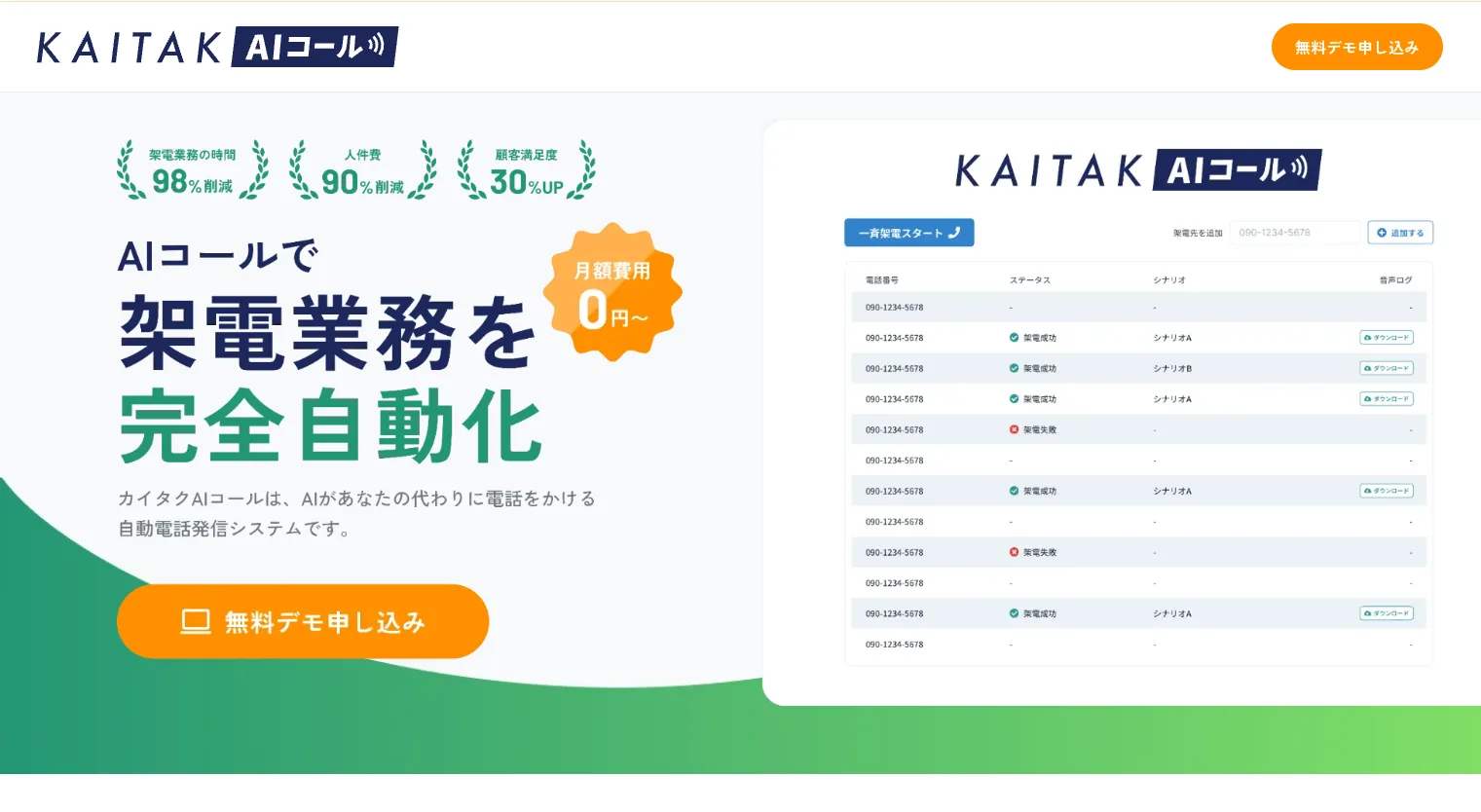
Reaching customers by phone is indispensable in sales. But making large numbers of calls and recording what was said takes a lot of work. Kaitak AI Call, an automated outbound calling system released early by Kaitak Inc., is a groundbreaking service in which AI makes calls in a natural voice and automatically adjusts and records the conversations. (An inbound call feature is scheduled to be added later.)
AI “Automates” Phone Sales and Phone Support for Greater Efficiency
Kaitak AI Call does more than place calls: it automates the recording and analysis that follow, dramatically streamlining sales and customer support work.
Automatic outbound calls in a natural AI voice, with many integrations: The AI automatically makes calls in a natural voice, just like a person. It also offers call recording and transcription, as well as automatic generation of reports summarizing the calls. Scenario branching and script management let it handle many situations. With rich features such as SMS and email integration, transfer to operators, calendar integration and API integration, it should greatly improve sales efficiency.
Handling many inquiries at once with the inbound feature: With the added inbound feature, the AI can handle multiple inquiries at the same time (branching responses), so customers are served smoothly without waiting. A transfer feature to operators lets people handle complex inquiries. Features such as integration with internal business systems (in development), voice transcription and recording of all calls with cloud management also greatly improve efficiency.
Kaitak’s Kaitak AI Call uses AI to automate phone work and helps companies raise productivity in both sales and support.
Direct Marketing Mix Inc.

Labor shortages and rising labor costs in call center work are serious problems for many companies. And customer inquiries can come at any time, 24/7. Direct Marketing Mix Inc. has launched an “AI call center service” through partnerships with AI agent providers.
AI “Elevates” Customer Support and Streamlines Operations as a Whole
The service does more than understand what customers say and provide the best answers: by automating multiple business processes such as CRM (customer relationship management) integration and booking, it helps make call center operations as a whole more efficient and more sophisticated.
Natural, advanced conversations and 24/7 availability: Because the AI agent can hold natural, advanced conversations that feel like talking to a person, customers can get in touch anytime without worrying about the time or day.
Balancing efficiency and quality by automating business processes: The AI automates not only customer interactions but also related tasks such as entering information into the CRM and taking bookings, improving the efficiency of operations as a whole.
High security and reliability: For safety and reliability, the service complies with ISO 27001, the international standard for information security management systems, and SOC 2, an international standard for the security of cloud services, and data is reportedly stored securely on AWS in Japan. Strong security is a very important point when handling highly confidential customer information.
Arini
Dental clinics handle a lot of patient communication by phone and text, such as taking appointments, checking insurance and providing various kinds of information. Arini is an “AI receptionist for dental clinics” developed to solve these problems specific to dental practices.
The AI receptionist communicates with patients by phone and text message and automatically handles scheduling, insurance verification and even providing the information they need. It can integrate with existing dental practice management software and phone systems and offers HIPAA-compliant security, so clinics can use it with confidence. With AI taking over reception work, staff should be able to focus more on direct patient care.
The AI Receptionist Arini: Smartly Transforming Dental Clinic Operations
Arini has already produced concrete results at many dental clinics.
Improving both efficiency and revenue: In the case of Unified Dental Care, it was reported that after adopting Arini, revenue rose 12% and profit rose as much as 24%, even with 17% fewer staff. This result shows that AI can streamline operations and contribute to revenue.
Higher answer rates and fewer lost opportunities: At Normandy Lake Dentistry, the answer rate reached 90%, and at Kare Mobile Inc, missed calls fell by 80%. They also say staff saved two hours a day.
Arini is a good example of AI streamlining reception work in a highly specialized medical setting, improving service for patients and helping clinics run better.
GetVocal
In call center work, conversations with customers are an important part of the company’s public face. GetVocal offers GetVocal, an AI phone agent built on a graph-based Agent OS (operating system).
The AI phone agent enhances cutting-edge LLMs (large language models) and uses proprietary technology for structuring, storing and retrieving conversation data to achieve high accuracy, transparency, learning ability and cost efficiency. Designed for call operations, it can handle a variety of use cases, from customer qualification (judging the quality of prospects) to booking meetings, customer onboarding (support when customers start using a service) and even cross-selling (selling related products) and upselling (selling higher-end products). It is amazing how much AI can handle over the phone.
The AI Phone Agent GetVocal: Streamlining Call Work with Natural, Accurate Conversations
One of GetVocal’s key features is its approach to preventing AI from “making up” information (hallucination).
Conversational Maps, a proprietary technology that avoids hallucination: Rather than relying on the unpredictability of prompts, it guides the flow of conversation with its own technology called “Conversational Maps.” This technology reportedly avoids “hallucination,” in which AI presents inaccurate or nonexistent information, enabling more reliable conversations.
Through the power of AI phone agents, GetVocal aims to streamline call center work and give customers a more natural and accurate communication experience.
Upsell Technologies Inc. and pluszero Inc. “miraio”
Call centers face many challenges, including lost opportunities when calls do not get through, the workload on operators and customer harassment, which has become a recognized problem in recent years. Upsell Technologies Inc. and pluszero Inc. have begun official sales of miraio, an AI operator they developed together to solve these problems.
The AI Operator miraio: Solving Call Center Problems with Human-Like Responses
miraio was created by combining Upsell Technologies’ patented technology for “automatic talk script generation by AI,” pluszero’s AEI (Artificial Elastic Intelligence), an AI that can understand meaning like a person, and call center operating know-how built up over many years.
Responses that are both accurate and flexible: Thanks to this combination of technologies, miraio can respond very accurately and flexibly. Because it keeps the risk of AI “making up” information (hallucination) to an absolute minimum, customers can use it with confidence.
Smooth cooperation with human operators: miraio is designed with cooperation with human operators in mind. Calls can be smoothly transferred from the AI to a human operator when customers ask, so AI and people can each use their strengths and support customers together.
Helping solve call center problems: It is expected to help solve serious problems call centers face, such as the limits of answer rates, lost opportunities when calls do not get through, and customer harassment.
Plans to expand into face-to-face service: The companies also plan to work with the digital human virddy to expand into face-to-face customer service. It is exciting to see AI opening up the future of customer service in so many forms.
nocall Inc. “nocall.ai”
Phone work at companies covers a wide range, including inside sales, customer support and reservations, and cutting labor costs and improving efficiency are constant challenges. nocall Inc. offers nocall.ai, a SaaS that automates phone work with a focus on outbound calls, using generative AI and speech synthesis.
nocall.ai, an Outbound-Focused SaaS for Automating Phone Work: Streamlining Calls with Generative AI
The goal of nocall.ai is to automate this phone work and cut labor costs.
High automation rates through natural conversation and flexible responses: The AI holds natural conversations that feel like talking to a person and responds flexibly to whatever customers say. Through a webhook feature, it can also connect with external systems in real time, fully automating everything from handling the call to the workflow that follows. In fact, it reportedly has an impressive track record of achieving a 98% automation rate.
Retell AI
Handling customers by phone is very important as the company’s “voice,” but slow responses and mechanical handling hurt the customer experience. To solve these problems, Retell AI provides a platform for building, testing, deploying and monitoring AI voice agents at scale in production.
The AI Voice Agent Retell AI: Transforming Customer Support with Natural Conversation
AI voice agents built on Retell AI’s platform achieve natural conversations with low latency (little lag in the conversation), as if talking to a person. They also offer a range of features, such as automatic syncing with the company’s knowledge base, call transfers to other staff, taking bookings and navigating IVR (interactive voice response) systems.
Deployable across many channels with high reliability: They can be deployed not only on phone lines but across many channels, including web calls and SMS, so customers can talk with the AI in the ways they are used to. They also comply with international security and privacy standards such as SOC 2, HIPAA and GDPR and support more than 18 languages, a major strength that lets companies use them globally with confidence.
Notable results at companies that adopted it: At companies that adopted Retell AI, the resolution rate for customer inquiries rose to 45–50%, and AI bots now handle 65% of voice calls. Results have also been reported in which profitability per lead (prospect) tripled and abandoned calls (customers hanging up partway) fell by 80%.
Retell AI will be a powerful solution that uses AI voice agents to streamline customer support and improve the customer experience.
Lifenet Insurance Company
In life insurance, customers’ inquiries must be answered with accurate information quickly. To meet this need, Lifenet Insurance Company has launched a joint project with Spark+ Inc. and Dyna.Ai to apply the voice agent VoiceGPT to insurance sales.
The project’s goal is to introduce a Japanese voice model specialized for call center work that uses the capabilities of large language models (LLMs). In this way, it aims to achieve the highly accurate and fast customer support the insurance industry requires, real-time speech recognition and analysis, and high-quality, consistent responses, maximizing the return on investment in call center DX (digital transformation).
The AI Voice Agent VoiceGPT: Transforming Customer Support in the Insurance Industry
Through the AI voice agent VoiceGPT, Lifenet Insurance aims to improve the quality and efficiency of its customer support.
Highly accurate and fast customer support: By using LLMs, the AI can answer a wide range of customer inquiries quickly and accurately, which is expected to shorten wait times and resolve problems smoothly.
Deeper customer understanding through real-time speech recognition and analysis: The AI recognizes conversations with customers in real time and analyzes their content, enabling a deeper understanding of customers’ intentions and emotions. If AI can grasp even the fine nuances of a conversation, it should enable personalized responses and more appropriate information.
Higher brand value through high-quality, consistent responses: With AI agents handling inquiries, every customer can receive consistent, high-quality information, eliminating variation in service quality and helping improve the company’s brand image.
Technical validation starting with peripheral work: In this joint project, the partners plan to first validate the technology in peripheral use cases that are not directly part of insurance sales (such as handling general inquiries), and then explore its potential for more advanced use in insurance sales. The step-by-step introduction of AI shows a commitment to delivering steady results.
This Lifenet Insurance initiative should be a good example of how AI agents can improve the customer experience and efficiency in industries that require advanced expertise.
Medialink Co., Ltd.
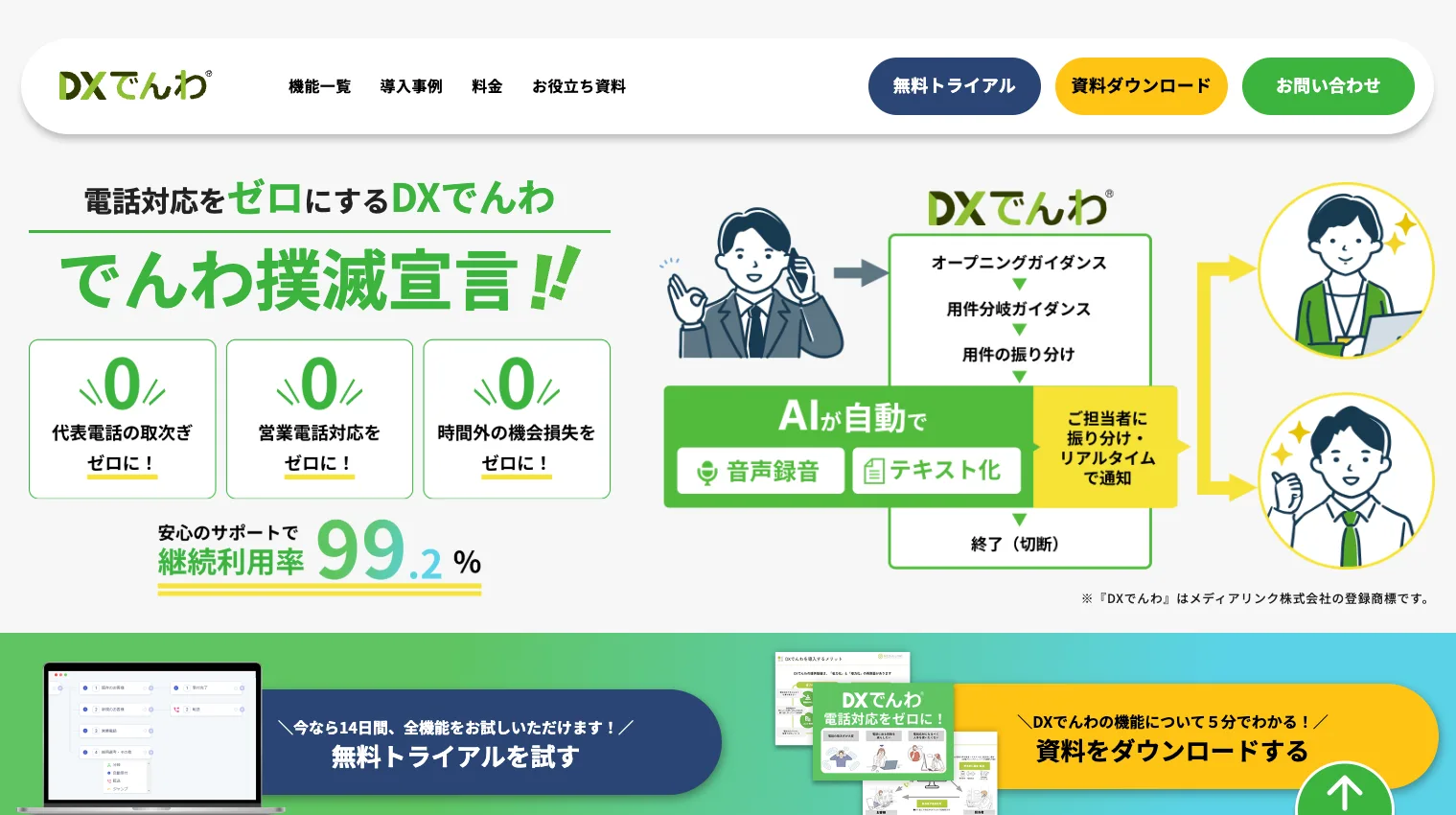
Corporate phone work is on the front line of customer service, yet it is an area that needs to become more efficient and less labor-intensive. DX Denwa, offered by Medialink Co., Ltd., has been adopted by many companies as an automated telephone answering service (IVR) that brings DX (digital transformation) to phone work and makes human handling more efficient and less labor-intensive.
DX Denwa has now evolved further and been reborn as an “AI agent” that delivers smoother phone support closer to that of a person.
DX Denwa Evolves with AI Agents: Smarter, Smoother Phone Support
DX Denwa already came standard with features such as 24/7 automated reception through voice guidance, routing to staff, automatic speech-to-text and SMS sending. With the addition of AI agent features, it can now branch flows more flexibly and ask back about transfer destinations based on what the customer says.
Greater accuracy and smoothness with AI automated guidance: “AI automated guidance,” released as an official version, offers even greater AI accuracy. A feature that states the transfer destination in advance has also been added, so the AI understands customers’ intentions more accurately and transfers them smoothly to the right department or person. This seems very effective for reducing customer wait times and stress.
Efficiency gains proven by a case study: At Synchro Food, it has been reported that adopting DX Denwa cut the number of calls handled on the main line to less than one-third, greatly improving efficiency.
Medialink’s DX Denwa will be a powerful solution that uses AI agents to streamline companies’ phone work and improve the customer experience.
TIGEREYE Inc. “TIGEREYE AGENT”
Today’s customer touchpoints span phone, chat, websites, social media and more. Providing consistent, high-quality service on each channel is a major challenge for companies. TIGEREYE AGENT, a multichannel AI agent announced by TIGEREYE Inc., solves this problem and provides next-generation customer touchpoints.
The Multichannel AI Agent TIGEREYE AGENT: AI That Even Understands Customers’ Emotions
TIGEREYE AGENT can analyze and control the context, emotions and goals of a conversation with a customer in real time. With this technology, it delivers attentive customer service that feels like talking to a person across three main channels: an “AI call center (phone),” an “AI chatbot (web)” and an “AI avatar (web).”
Advanced phone support with the AI call center feature: By combining speech recognition, speech synthesis and large language models (LLMs), it deeply understands calls with customers and automatically handles appropriate responses, records, summaries and even call scoring. It can also automate work through integration with CRM (customer relationship management) systems.
Optimal responses with its own “conversation-adaptive AI technology”: Its patent-pending “conversation-adaptive AI technology” scores the user’s level of understanding, interest and emotional state in real time and dynamically optimizes the AI’s responses accordingly. Because it automatically recognizes the customer’s “call intent” and optimally controls the flow of conversation, customers can resolve their problems smoothly.
Adoption across a wide range of industries: This innovative AI agent is already being adopted in many fields, including local governments, healthcare, finance and retail, proving its practicality and effectiveness.
AI Agents in Chat, Email, Social Media and More
AI agents are spreading rapidly not only in phone support but also in text-based channels such as chat, email and social media. These AI agents do more than answer FAQs (frequently asked questions): they are expanding to handle more complex inquiries that involve looking up customer data and connecting with external systems. Thanks to AI agents, customers can get fast, accurate support on the channels they are used to.
IBM “watsonx Customer Care Agents”
IBM offers watsonx Customer Care Agents to solve the problems that companies’ customer service teams face. These AI agents are used for many purposes, such as digital self-service (systems that let customers solve problems themselves) and “agent assist,” which supports human agents.
watsonx Customer Care Agents: AI That Strongly Supports Customer Service
IBM’s AI agents provide features that handle customer questions efficiently and raise the productivity of support teams.
Classifying customer questions and gathering information: The AI agents accurately classify what kind of question a customer is asking and automatically gather the related information. As a result, when an inquiry is passed to the support team, the information needed is already compiled, enabling smooth handling.
Strong assistance for human agents: The AI agents provide human customer service agents with real-time insights such as the customer’s intent, related information and past interaction history. With AI as a powerful assistant, human agents can quickly grasp the customer’s situation and respond more accurately and personally.
Deployable across many channels: The AI agents can be deployed across many channels, including chatbots on websites, support features in mobile apps and even social media messaging apps such as Facebook Messenger and X (formerly Twitter). Being able to get support on the channels customers already use should translate directly into a better customer experience.
Zendesk “Zendesk Resolution Platform”
Zendesk, widely known as a customer service platform, has announced the “Zendesk Resolution Platform,” an AI service platform aimed at next-generation customer engagement powered by AI and data. The platform includes an “AI agent builder” that lets companies create and customize AI agents to fit their customers’ unique needs. It also strengthens its “Copilot” feature, which automates work procedures by connecting with existing knowledge bases and external systems, so companies can benefit from AI in every part of customer service.
Zendesk Resolution Platform: AI That “Resolves” Customer Issues
By combining advanced AI technology with a rich set of features, the Zendesk Resolution Platform dramatically improves the efficiency and quality of customer service.
A “knowledge graph” that taps a large knowledge base, plus generative AI By using a “knowledge graph” that covers the information needed for customer service, the AI can provide fast, accurate information. Generative AI features such as the “knowledge builder” and “generative AI search” also make it easier to create knowledge bases and search for information.
Workflow automation and no-code development: It also includes an “action builder” that automates workflows and an “app builder” that lets users develop custom apps without programming knowledge. Being able to flexibly customize AI agents without code to fit your own business processes should be a big advantage.
Strategic partnerships and abundant pretraining data: Zendesk has also announced a strategic partnership with NICE, aiming to deliver AI-driven customer service across entire enterprises. In addition, because it is pretrained on a huge volume of more than 18 billion customer interactions, it can detect intent with very high accuracy, which is said to greatly shorten the time needed to resolve customer inquiries (ticket resolution time).
Intercom Fin
As startups grow, customer inquiries increase and handling them becomes more complex. Intercom Fin is a conversational AI agent ideal for startups at this stage of scaling. The AI does more than answer questions: it can deeply understand the context and nuance of a conversation.
A key feature of Intercom Fin is that it uses a “pay-per-resolution” model, in which fees are charged only for successful resolutions. This lets startups deliver high-quality customer support while keeping unnecessary costs down. Cost-effective customer support is very attractive.
Intercom Fin’s Conversational AI Accelerates Startup Growth
Intercom Fin is designed to handle complex customer inquiries, especially the following.
Questions about complex products: Even for detailed, complex questions about products and services, the AI understands the context and provides accurate information.
Onboarding support: The AI efficiently helps new customers with questions and setup when they start using a service, so they can get started smoothly and early churn is prevented.
Billing inquiries: The AI also handles sensitive matters appropriately, such as questions about payment information and invoices, and resolves customers’ questions.
Intercom Fin will be a powerful tool that uses AI to automate customer service and solve the customer support challenges startups face in their growth phase.
Forethought
For large companies and call centers that receive a high volume of inquiries, the challenge is handling complex customer interactions efficiently and accurately. Forethought provides an advanced AI agent platform for these large enterprises and high-volume contact centers.
The platform combines automation of complex workflows, predictive ticket routing (assigning inquiries to the right owner) and robust enterprise-grade security.
AI Handles Complex Customer Processes Autonomously with “Autoflows”
A key feature of Forethought is its own “Autoflows” capability. It is a groundbreaking feature that lets AI autonomously handle complex multistep processes.
Automating complex customer support: For example, the AI seamlessly handles complex processes spanning multiple steps, such as receiving a customer inquiry, gathering information from several related databases, connecting systems and automatically taking the necessary action.
Greater efficiency with predictive ticket routing: The AI predicts the most suitable person or department based on the content of the customer’s inquiry and past history and automatically routes the inquiry. This prevents customers from being passed around and leads them quickly to a resolution, which should also raise customer satisfaction.
Ada
For companies operating globally and for a wide range of consumer brands, multilingual customer support is an unavoidable challenge. Ada provides AI agents capable of natural multilingual conversation for these global companies and consumer brands.
Ada’s strengths are that it can hold natural multilingual conversations that feel like talking to a person, it can customize the AI’s conversational style to match the company’s brand voice, and it offers a “visual conversation builder” for designing conversation flows intuitively. However, it should be kept in mind that it still has limits when it comes to highly specialized inquiries, such as technical troubleshooting.
AI Talks with Customers “in Many Languages” and “True to the Brand”
Ada is especially strong at multilingual customer support and maintaining brand consistency.
Natural multilingual conversation: The AI speaks multiple languages naturally and responds smoothly in whatever language customers use, providing a customer experience free of language barriers and efficiently handling inquiries from a global customer base.
Brand voice customization: The AI can adjust its conversational style to match the company’s brand image and tone, so every customer gets a consistent brand experience. AI that expresses a company’s personality is a wonderful feature.
Freshworks Freddy AI
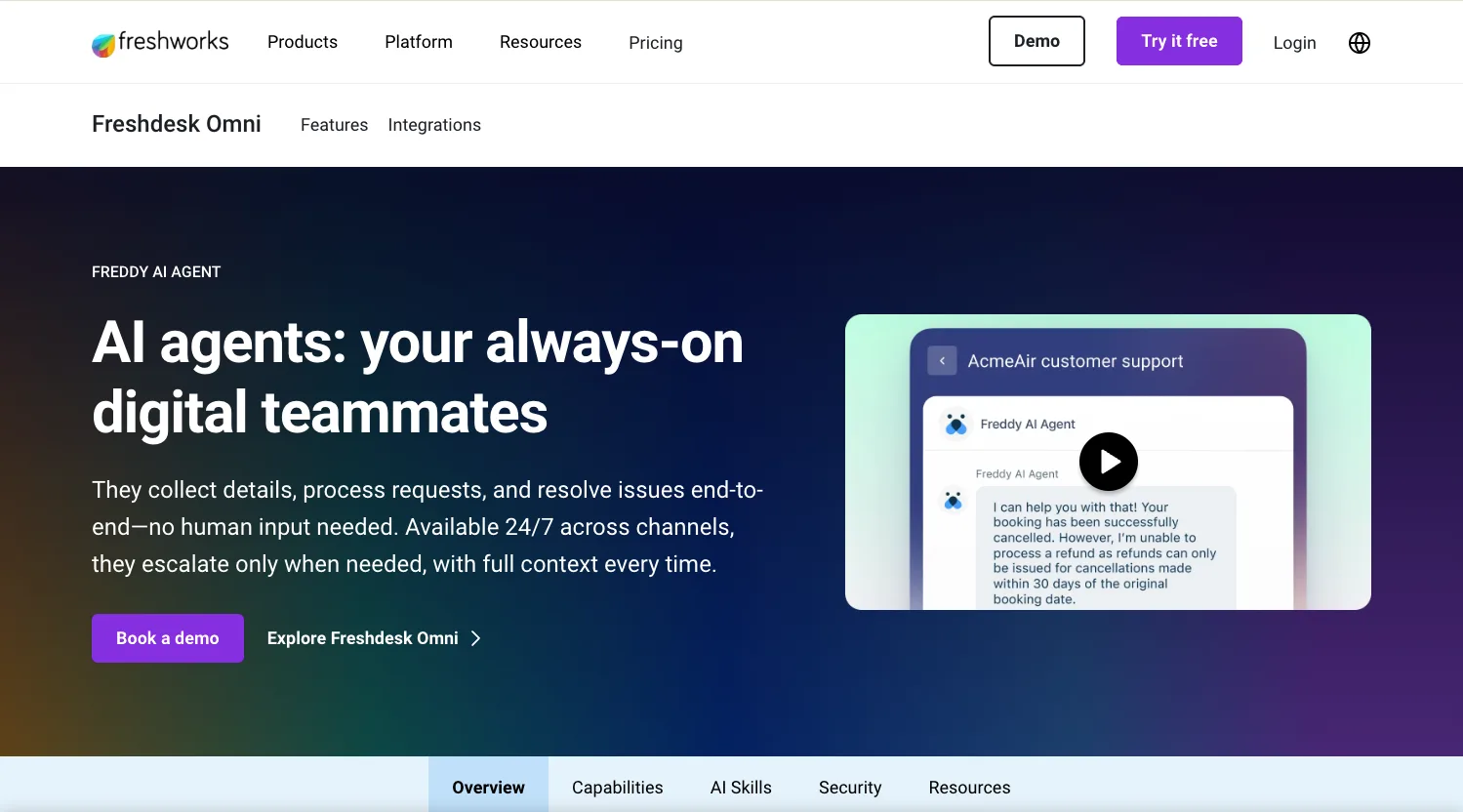
For companies already using Freshworks products, compatibility and cost are important considerations when introducing a new AI agent. Freshworks Freddy AI is an AI agent known for its deep integration with the Freshworks ecosystem and its affordable price range.
Deep Integration with Existing Systems Makes AI Easy to Adopt
A major benefit of Freshworks Freddy AI is that existing Freshworks users can adopt AI smoothly.
Deep integration with the Freshworks ecosystem: Because the AI agent integrates deeply with existing systems such as Freshworks’ CRM and customer service platform, data flows smoothly and personalized responses based on customer information become possible.
Affordable and easy to adopt: By sticking to basic automation features rather than specializing in advanced ones, it is offered at a more affordable price. This makes it easier for companies adopting AI agents for the first time, and even small teams, to benefit from AI and try it out easily.
Freshworks Freddy AI will be a cost-effective option for existing Freshworks users who want to automate basic customer support efficiently.
RAKUS Co., Ltd. “Mail Dealer”
Handling customer inquiries is important work for every company, but making it more efficient is a constant challenge. Mail Dealer, offered by RAKUS Co., Ltd., aims for “full automation” of inquiry handling and plans to release AI agent features in stages.
Mail Dealer Moves Toward “Full Automation” of Inquiry Handling with AI Agents
Mail Dealer uses AI to streamline responses to customer emails and ultimately aims for full automation with no human involvement.
An “email drafting agent” speeds up initial responses: Around June 2025, an “email drafting agent” is scheduled to arrive, in which the AI understands customer emails and helps write appropriate replies. This AI agent should greatly reduce the work operators spend writing emails.
An “automatic answer generation agent” makes the most of know-how: In October 2025, an “automatic answer generation agent” is scheduled for release, in which the AI learns from past response know-how and automatically generates the best answers to customer inquiries. AI that draws on past experience to respond intelligently and further raise customer satisfaction is very reassuring.
Continuous evolution with self-learning and automatic FAQ display: Further enhancements are planned after that, including a “self-learning feature” in which the AI learns on its own to improve its responses and an agent that automatically displays related FAQs (frequently asked questions).
Niusia Inc.
E-commerce is seeing lively new developments, such as the arrival of TikTok Shop in Japan. Users of platforms like TikTok in particular have distinctive traits: many make impulse purchases at night and late at night, inquiries flood in all at once during live streams, and Gen Z uses a wide range of communication tools with ease. To meet these needs in e-commerce, Niusia Inc. has launched a full-scale next-generation AI call center service.
A Next-Generation AI Call Center Service: “Five Innovations” for TikTok Users
The AI agent service from Niusia features capabilities tailored to the traits of TikTok users.
100% answer rate with unlimited concurrent handling: No matter how many inquiries flood in, the AI maintains a 100% answer rate and can handle an unlimited number of customers at the same time, so service is always smooth and customers never wait.
24/7 support: The AI can respond to customer inquiries anytime, 24/7, including nights, late nights and holidays. That means it can answer questions after impulse purchases and meet support needs outside business hours.
Multichannel support including LINE, email, X and Instagram DMs: Beyond phone, it supports a wide range of communication channels, including LINE, email, X (formerly Twitter) and Instagram DMs (direct messages). Letting customers reach out easily on the channels they already use should translate directly into a better customer experience.
Keeping up with trends with no training required and instant updates: Unlike human operators, AI agents do not need training: they learn new information and trends immediately and reflect them in their responses. In the fast-moving e-commerce industry, responding quickly to new information is very important.
Faster use of data: The AI quickly analyzes conversation data with customers and provides insights into their needs and behavior patterns, which can be applied quickly to marketing strategy and product improvements.
Support for 105 languages to aid global expansion: It also supports 105 languages, making it strong support for companies pursuing cross-border e-commerce or global expansion.
Medialink Co., Ltd. “Alto”
Customer support plays an important role in customer satisfaction, but making it more efficient is a constant challenge. Alto, offered by Medialink Co., Ltd., is an AI agent that automates customer support.
The Customer Support AI Agent Alto: Unifying Every Channel with AI
Alto is an AI agent that integrates a chatbot, an FAQ search system, an email bot and a voicebot. Built around a centrally managed knowledge database (a collection of knowledge), the AI supports customers on every support channel.
Consistent responses through an integrated knowledge database: Because every channel uses the same knowledge database, the AI can give customers consistent, accurate information on any channel. From the customer’s point of view, getting the same answer even when switching channels should mean less stress.
A “human handoff feature” added to the voicebot AltoVoice: AltoVoice now has an added “human handoff feature” that smoothly transfers callers to a human operator when the AI judges it cannot handle a request. This feature connects customers to the right human support without making them wait, even for complex problems the AI cannot solve.
Customer Service: AI Agents Create “Human-Like” Customer Experiences
In interactions with customers in stores and online, there is a growing movement for AI agents to provide natural, human-like conversations and personalized experiences for each person. The aim is to raise customer satisfaction while also improving operational efficiency.
Kasanare Inc.
Kasanare Inc., together with Canon Marketing Japan Inc. and AI model Inc., has begun a pilot test of a “conversational AI model” capable of natural, real-time conversation. The initiative aims to have AI hold human-like interactive conversations and raise the quality of the customer service experience.
Transforming Customer Service at Stores and Tourist Sites with AI Models and Natural Conversation Technology
This conversational AI model combines AI model’s model generation technology with Kasanare’s natural conversation technology (LLMs, RAG, natural language processing, speech recognition, speech synthesis, multilingual support and context understanding). By combining these technologies, the partners aim to reduce the workload at stores, facilities and tourist sites while delivering high-quality customer service.
Natural conversation in real time: Because the AI talks with customers in real time, in natural language, just like a person, customers can get the information they need and ask questions without stress.
Advanced conversation made possible by combining many technologies: By combining a range of cutting-edge technologies, including context understanding with large language models (LLMs), accurate information retrieval with RAG (retrieval-augmented generation), natural language processing, speech recognition, speech synthesis and multilingual support, it accurately grasps customers’ intentions and delivers high-quality conversations.
Reducing workloads while delivering high-quality service: With AI taking on part of customer service, employees can focus on solving more complex problems and building deeper relationships with customers, which is expected to raise customer satisfaction while improving efficiency.
Kasanare’s conversational AI model aims to use AI to change the very idea of customer service and provide more personal, higher-quality customer experiences.
ZEALS Co., Ltd.
In today’s digital age, LINE official accounts and web chat have become important points of contact with customers. ZEALS Co., Ltd. provides “customer service AI agents” that automate and enhance customer interactions through these channels.
ZEALS’s goal is to build customer service AI agents that embody the values and personality of a company, service or brand. In this way, the AI conducts autonomous, personalized conversations with customers and provides a consistent, high-quality customer experience, aiming to drive business growth and higher customer satisfaction. Having AI talk with customers as the “face” of the brand is very attractive for companies.
Customer Service AI Agents: Embodying Company Values and Elevating Customer Conversations
ZEALS’s customer service AI agents have already proven their effectiveness in many deployments.
Automated responses on LINE official accounts and web chat: As deployments at the LINE official accounts of Ekimae Ryugaku NOVA and Gaba and at Dr. Tsurukame Kitchen show, many companies now respond to customer inquiries around the clock with automated responses from AI agents.
Personalized conversations that embody the brand voice: Because the AI agents learn the company’s values and personality and talk with customers in a matching tone and style, customers get a “human-like” communication experience with the brand rather than an exchange of stock phrases.
Responding to overseas trends and recommendations: ZEALS’s analysis is that overseas, customer service AI agents are more widely used than in Japan, serving as the linchpin of “customer success” and appearing in forms such as conversational commerce and the rise of voice AI. In light of this, it recommends that Japanese companies pursue “designs that drive sales,” data integration and continuous tracking of overseas trends, emphasizing the importance of adopting AI.
Sales Support: AI Agents Set a New Standard for Sales
Sales activities such as outbound telemarketing, inside sales and lead nurturing (developing prospects) are essential for business growth. In recent years, companies have begun adopting AI agents in earnest to raise the efficiency and quality of this work. AI is becoming a powerful partner for salespeople and is rewriting the conventional wisdom of sales.
FlashIntel Japan K.K. “FlashRev”
Winning new customers is important for every company, but it takes a great deal of effort. FlashIntel Japan K.K. offers FlashRev, which uses AI to make new-business sales more efficient. Together with FlashAI, the phone automation solution introduced earlier, it proposes a transformation of sales and the customer experience (CX).
AI Strengthens Sales Strategy: Accelerating New Business with FlashRev
FlashRev uses AI to streamline many processes in sales and supports more effective new-business development.
Understanding customers deeply with AI sales intelligence The AI analyzes vast amounts of customer data and provides “sales intelligence” that identifies potential prospects and makes their interests and purchase intent visible. This lets salespeople understand target customers deeply in advance and approach them more precisely.
Maximizing contact opportunities with a multichannel approach: The AI decides the best channel for contacting each customer (email, social media, phone and so on) and supports an effective approach, increasing touchpoints with customers and maximizing sales opportunities.
Centralized management of sales activities through CRM integration By connecting with existing CRM (customer relationship management) systems, it lets teams manage sales activity history and customer information centrally. Because AI-generated insights and activity data are automatically reflected in the CRM, sales teams can always act on the latest information.
Mazrica Inc. “DealAgent”
Sales is a complex process of building good relationships with customers and turning them into contracts. Mazrica Inc. has launched DealAgent, a sales AI agent in which AI autonomously assists with sales activities.
DealAgent’s goal is to have AI take on work in place of salespeople at each phase of the sales process and move the process forward autonomously. This lets salespeople focus on conversations and relationship building with the customers in front of them and raises the productivity of sales as a whole.
The Sales AI Agent DealAgent: AI Autonomously Drives the Sales Process
DealAgent uses AI to provide features that help salespeople deeply understand customer needs and approach them more effectively.
Visualizing customer interests with “engagement reports”: The AI analyzes customers’ behavior data on the website and their conversations with an AI chat, and visualizes what customers are interested in and what information they are looking for as an “engagement report.” Because salespeople can understand customer needs in advance, they can make more precise proposals and approaches.
Deep customer understanding by collecting and analyzing zero-party data A distinctive feature is that, through conversations with the AI chat, it can also collect and analyze “zero-party data” that customers provide voluntarily (such as products they are interested in, their challenges and the information they want). This data is extremely valuable for helping companies understand customer needs more deeply and take a personalized approach.
Lancers, Inc. “Lancers Rakuapo AI”
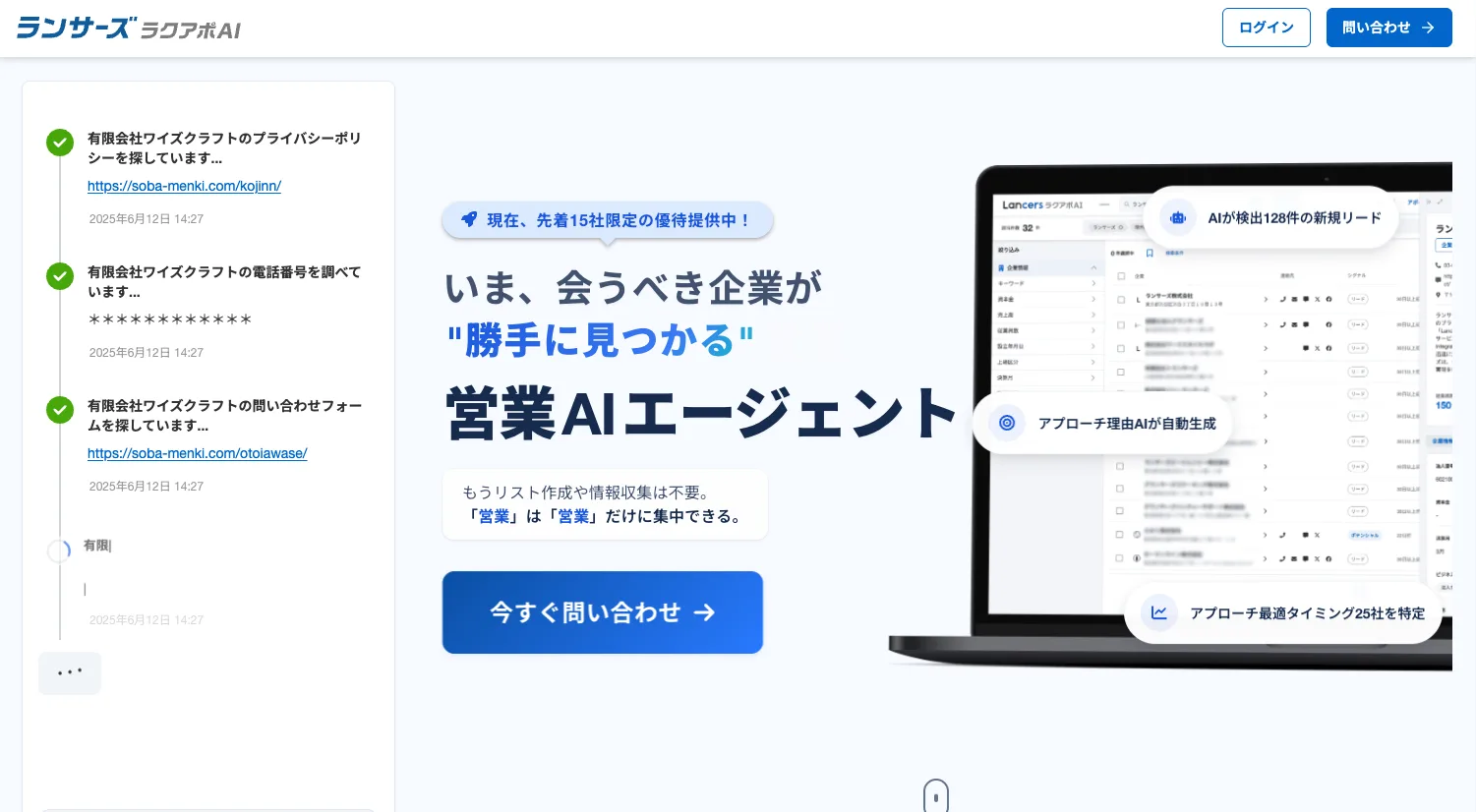
In sales, research to gather prospect information and build lists is very time-consuming and laborious. To solve this problem, Lancers, Inc. has entered the AI agent business and, as its first offering, launched Lancers Rakuapo AI, a web-exploring sales AI agent.
The service’s goal is to free salespeople from tedious research and help them focus on more value-creating sales activities, such as building relationships with customers and making proposals. AI that “finds” potential customers seems like a new form of sales.
The Web-Exploring Sales AI Agent Lancers Rakuapo AI: Uncovering Hidden Leads
The biggest feature of Lancers Rakuapo AI is that it is “web-exploring”: instead of relying on existing corporate databases, the AI autonomously collects and analyzes vast information on the web to build and update its own lead database.
Automating research and generating high-quality lists: The AI automatically carries out research that would normally take a long time, such as gathering information on target companies, identifying key people (contacts) and understanding industry trends. By combining highly accurate context understanding with web exploration technology, it brings potential leads (prospects) that were hard to find before “close to the surface,” and it can generate unique lists that meet even niche custom conditions, which is very powerful.
Uncovering prospects through SFA/CRM integration: Because it can connect with SFA (sales force automation) and CRM (customer relationship management) systems, lists of prospects generated by the AI can be imported smoothly into existing systems and used in sales.
Planned evolution into a hybrid “sales AI agent”: Going forward, Lancers plans to release a series of “hybrid” sales AI agents for inside sales and field sales that make use of its database of professional talent and its crowdsourcing. By combining the strengths of AI and people, more advanced sales support can be expected.
AldeaLab Inc. “AI Teleapo-kun”
Telemarketing appointment setting is an effective way to win new customers, but labor shortages and inefficiency can be problems. AldeaLab Inc. has officially released AI Teleapo-kun, a phone AI agent SaaS that uses conversational AI to automate everything up to securing appointments through flexible dialogue.
The service’s goal is to solve corporate problems such as labor shortages and the inefficiency of telemarketing. AI that makes calls as naturally as a person and automatically secures appointments is truly innovative.
AI Teleapo-kun: Automating Appointment Setting with Natural, Human-Like Conversation
AI Teleapo-kun makes outbound calls with natural, human-like voice and conversation. An AI that has learned talk scripts for each product and industry thinks through its responses in real time based on what the customer says, enabling highly flexible conversations.
High-volume calling 24/7 and automatic handoff of high-quality leads: The AI agent can make large numbers of calls 24/7 without rest. The AI then identifies “high-quality leads” with a strong chance of turning into appointments from the conversations and automatically hands them off to a person (a salesperson), so salespeople can focus on high-quality prospects.
Automatic recording and analysis of calls: All calls are automatically recorded and analyzed by the AI, so telemarketing results can be evaluated objectively and used for the next strategy, such as improving talk scripts.
Plans to support AI and automation across call center operations: The company plans to support AI adoption and automation not only for telemarketing but across call center operations as a whole. It will be exciting to see how AI changes the future of phone work.
Internal Operations: AI Agents Smartly Transform the Back Office
The use of AI agents is spreading beyond customer service to improving efficiency and the employee experience in internal departments such as IT, human resources (HR) and finance. With AI supporting the routine tasks and information searches employees do every day, more productive and more comfortable workplaces are taking shape.
ServiceNow
ServiceNow provides an AI platform that automates workflows across the enterprise, and it positions AI agents as a way to “take action with autonomous AI agents that work for you.” This shows that AI functions not as a mere tool but as a “worker” that thinks and acts on its own inside the company.
AI Agents Automate Workflows Across the Enterprise
ServiceNow offers a range of AI-powered products for many kinds of workflows, including IT Service Management, Customer Service Management and HR Service Delivery.
MyNow, an AI-driven personalized experience: In the personalized experience called MyNow, AI acts as a guide and provides recommendations tailored to each employee. For example, based on the content of a question to the IT department, the AI might suggest related knowledge articles or direct the employee to the inquiry form for the right department.
An integrated framework connecting the front office to the back office: NICE and ServiceNow have formed a strategic partnership aimed at delivering AI-driven customer service across entire enterprises. By connecting NICE’s CXone with ServiceNow’s AI platform and CSM solutions, they provide a framework that seamlessly links customer interactions (front office), the related administrative work (middle office) and the final processing (back office).
Higher employee productivity and continuous optimization through AI: ServiceNow’s AI agents raise productivity by automating the tedious tasks employees do every day. They also continuously and proactively optimize business processes, so services can always be delivered at the highest quality.
ServiceNow aims to use AI agents to automate and optimize workflows in every department of the company and provide a better experience for both employees and customers.
Leena AI
Companies generate many “tickets” (inquiries) every day, such as questions to IT, HR questions, financial processing and purchase requests. Leena AI offers a service that uses agentic AI to reduce these internal tickets.
The Agentic AI Leena AI Reduces Internal Inquiries
Leena AI’s AI agents can automate hundreds of use cases across a wide range of departments, including IT, HR, finance, procurement and sales.
Integrating company knowledge with agentic RAG to provide accurate answers: Using a technology called “agentic RAG (retrieval-augmented generation),” it integrates the company’s vast knowledge base into the AI, so the AI can give employees personalized, accurate search results and answers to their questions. Because the AI makes smart use of company information, employees can get the information they need quickly.
Remarkable results at companies that adopted it: Companies that adopted Leena AI achieved a 96% user adoption rate and a high employee satisfaction rate of 99%. They also reportedly cut IT-related inquiries (queries) by 80%, with an inquiry resolution rate as high as 99%. This shows that AI is contributing greatly to internal efficiency and a better employee experience.
Latest Developments and Trends for AI Agents in Customer Service and Call Centers
So far, we have looked at specific companies’ AI agent cases. These cases reveal the direction in which AI agents in customer service and call center work are evolving.
1. Greater Autonomy and Advanced Conversational Ability
AI agents are dramatically improving their ability not just to answer routine questions but to deeply understand the context of a conversation, reason according to the situation and carry on complex conversations with human-like naturalness.
Understanding emotions and human-like conversation: Voice AI has emerged, such as Hume AI’s Empathic Voice Interface (EVI), that understands emotions from the tone of a customer’s voice and way of speaking and responds accordingly.
Achieving both accuracy and flexibility: miraio, the AI operator jointly developed by Upsell Technologies Inc. and pluszero Inc., uses pluszero’s own AEI (Artificial Elastic Intelligence) technology to understand meaning like a person and respond accurately and flexibly while keeping the risk of hallucination (AI generating information not based on facts) to an absolute minimum.
2. Expanding Multichannel Support
“Multichannel support,” in which AI agents provide consistent support across the many touchpoints customers use, such as phone, chat, email, SMS and social media, is becoming increasingly important.
Supporting customers on every channel: TIGEREYE Inc.’s TIGEREYE AGENT covers three main channels, an AI call center (phone), an AI avatar (web) and an AI chatbot (web), so it can provide consistent, high-quality AI support however customers get in touch. Multichannel support seems very important for improving customer convenience.
3. Advances in System Integration and Workflow Automation
By connecting with existing CRM (customer relationship management) systems, help desk systems, knowledge bases and various internal systems, AI agents can now automate entire business processes, such as gathering information, updating data, creating tickets and taking bookings.
Seamless automation of business processes: ServiceNow’s “Agentforce” and Zendesk’s “Resolution Platform” focus especially on this kind of system integration and workflow automation.
Maximizing efficiency through real-time integration: nocall Inc.’s nocall.ai connects with external systems in real time through a webhook feature and has a track record of fully automating everything from handling calls to the workflows that follow. With AI connecting systems, waste in operations drops dramatically.
4. Establishing Hybrid Human–AI Operations
A “human–AI collaboration (hybrid) model” is becoming mainstream: AI agents handle routine inquiries and information gathering, so human agents can focus on more complex problem solving, support that attends to customers’ feelings and strategic work.
Making the most of the strengths of AI and people: Many companies emphasize the value of this hybrid model. With AI bringing efficiency and speed and people bringing empathy and creativity, it is expected to improve the quality of the customer experience while also making work more rewarding for employees.
5. Specialization in Particular Industries and Tasks, with Attention to Safety
Beyond general-purpose AI, AI agents deeply specialized in particular industries and tasks are emerging, aiming for greater impact by offering solutions optimized for the expertise and workflows of those fields.
The rise of industry-specific AI: For example, like Arini, the AI receptionist for dental clinics, more AI agents are addressing the specific needs of individual industries, such as hospitality, finance and e-commerce.
Attention to security and ethics: Because AI agents increasingly handle confidential customer data, addressing issues such as data privacy, security, AI bias and hallucination (AI generating information not based on facts) is considered important. Many platforms tend to be obtaining security certifications (such as SOC 2, HIPAA and GDPR) and introducing data protection mechanisms and guidelines for ethical AI development.
Where AI Agents Stand Today, Supported by Technological Progress
Multimodal AI agents, systems that process data in many formats such as text, images, audio and video and carry out tasks autonomously, are shaping the future of customer service. The “voice domain,” which enables natural communication by phone and face to face, is at the center of this evolution in particular. Thanks to remarkable progress in foundational technologies such as speech recognition (STT), natural language processing (NLP/NLU) and speech synthesis (TTS), AI agents are acquiring advanced, human-like conversational abilities.
Advanced Natural Language Understanding and Generation
By using large language models (LLMs), AI agents have gone far beyond traditional rule-based and scenario-based systems, improving their ability to accurately understand the context of a conversation and the customer’s intent and to generate varied, natural responses. Retrieval-augmented generation (RAG) also lets them refer to a company’s own knowledge base and documents and respond based on accurate, up-to-date information. For example, AEI (Artificial Elastic Intelligence), an AI technology developed by pluszero Inc., mimics human cognitive processes so that AI understands meaning more like a person, enabling accurate responses that keep the risk of hallucination (generating incorrect information) to an absolute minimum. GetVocal overcomes the unpredictability of LLMs with its own technologies, such as the “Conversational Graph DB” and “Vocal’s Conversational Engine,” to build reliable conversational agents. In addition, TIGEREYE Inc.’s “conversation-adaptive AI technology” can reportedly estimate a customer’s level of understanding and emotional state in real time and dynamically adjust the best response.
High-Quality Speech Synthesis and Real-Time Response
Speech synthesis (TTS) technology has advanced remarkably, and AI can now reproduce voice quality, intonation and emotional expression so natural they are indistinguishable from a person’s. ElevenLabs’ “Octave TTS” and “Flash v2.5” and Hume AI’s “EVI 3” provide high-quality, low-latency voice generation and are increasingly used as natural conversational agents. Achieving real-time conversation also requires keeping response latency to an absolute minimum. Retell AI delivers conversations with latency as low as 500 ms (0.5 seconds), and AldeaLab Inc.’s AI Teleapo-kun also achieves natural, human-like conversations through highly accurate speech synthesis and real-time conversation technology.
Deeper Multimodal Processing
AI agents are improving their ability to process multiple formats of information at once, not only voice but also text, images and video, and to reflect them in conversations. ElevenLabs has announced a multimodal conversational AI that processes voice and text input at the same time, and TIGEREYE Inc. offers AI avatars on the web that combine facial expressions, voice and gestures, both aiming for richer multimodal experiences. In addition, real-time voice-to-voice AI technology such as Sanas provides voice processing such as accent translation and noise removal, lowering barriers to international communication.
Key Demands and Trends Accelerating the Spread of AI Agents
Against the backdrop of these technological advances, the adoption of AI agents in customer service and call centers is being accelerated by a range of market demands and trends.
The need to address labor shortages and cut costs As labor shortages caused by a declining birthrate and aging population, along with rising costs for hiring and training operators and running operations, become more serious, AI agents can operate 24/7, reduce hiring and training costs and turnover risk, and greatly improve operational efficiency.
The pursuit of a better customer experience (CX) Customers’ “stress of waiting for help,” which conventional interactive voice response (IVR) and FAQs alone cannot solve, is a major problem. AI agents greatly improve the customer experience by providing natural, personalized conversations and reducing wait times.
Responding to new customer segments and buying behavior As symbolized by the arrival of TikTok Shop, impulse purchases by young people and inquiries at night and late at night are surging. For these needs, which traditional call center setups cannot fully handle, there is strong demand for AI agents that support multiple channels and can respond instantly at any hour.
Autonomous task execution and system integration AI agents are improving their ability to understand customers’ intentions and autonomously carry out entire business processes, such as bookings, order processing, data entry, handoffs to staff and integration with existing systems. Integration with CRMs and core systems enables more personalized responses and automation of follow-up work, which seems very efficient.
Hybrid human–AI operations Many companies aim for “hybrid” operations, in which AI handles routine first-line responses and information gathering, and human agents focus on more complex problem solving, emotional support and strategic work. AI agents need to hand off smoothly to human operators, and AI also functions as a “copilot” that supports people’s work, contributing to higher productivity.
Attention to safety and ethics Because AI agents increasingly handle confidential customer data, addressing issues such as data privacy, security, AI bias and hallucination is considered important. Many platforms are creating environments where AI can be used with confidence by obtaining security certifications and introducing data protection mechanisms.
Key Trends for AI Agents in Customer Service and Call Centers
- AI agents’ conversational abilities have improved dramatically, enabling more “human-like,” natural conversations and an understanding of complex context: Technologies for suppressing hallucination, understanding emotions and grasping meaning like a person are advancing.
- Consistent customer support across “multiple channels,” including phone, chat, email and social media: Whatever channel customers use to get in touch, AI provides consistent, high-quality support.
- Driving “end-to-end workflow automation” from inquiry to follow-up work: By deepening integration with existing systems such as CRMs and knowledge bases, AI automates entire business processes, such as gathering information, updating data, creating tickets and taking bookings.
- A “hybrid collaboration model,” in which AI handles routine work and people focus on more strategic and emotional interactions, is becoming mainstream: Smooth transfer from AI to human operators is emphasized, and AI works as a “copilot” for people.
- The emergence of AI agents specialized in particular industries and tasks: More specialized AI, such as AI receptionists for dental clinics and agents specialized in insurance sales, is contributing to concrete business results and proving high returns (lower costs, higher sales, higher resolution rates and more).
Manufacturing: AI Agents Make the Factory Floor Run “Smarter”
On the manufacturing floor, the many processes involved in making products are intricately intertwined. In this setting, AI agents are attracting attention as “smart software” and systems that use AI technology to carry out many aspects of manufacturing processes autonomously and efficiently.
Unlike large language models (LLMs) that simply provide information, these AI agents learn from data, make decisions based on algorithms and even use real tools to adapt to complex situations on the manufacturing floor and deal with problems. For example, machine learning algorithms improve their performance over time, and deep learning processes complex data such as images and video, making it possible to address a wide range of manufacturing challenges.
The adoption of these AI agents is now being actively pursued by manufacturers around the world. Let’s continue with specific company cases.
MakinaRocks
In manufacturing, “AI transformation (AX),” which uses AI technology to raise productivity and transform entire business processes, is attracting attention. It is a movement to build AI deeply into every stage of manufacturing, such as production planning, quality control and equipment maintenance, and run factories more intelligently and efficiently. To support this AX, MakinaRocks provides an industry-specific AI solutions platform.
MakinaRocks’ Industry-Specific AI Solutions: The Value of Compound AI
At MakinaRocks, where AI engineers make up 75% of all employees, the core is “compound AI,” which combines cutting-edge AI technologies such as machine learning, deep learning and reinforcement learning. This strong technical capability is recognized worldwide and contributes in particular to solving concrete problems in manufacturing.
Predictive maintenance: The AI detects early signs of equipment failure and prompts planned maintenance, helping raise uptime.
Quality control: It contributes to higher product quality and lower costs through features such as automatic detection of defective products.
Process optimization: It analyzes production processes and suggests the best production conditions, raising productivity and cutting costs.
Battery diagnostics: It can also run specialized diagnostics, such as diagnosing battery condition and predicting remaining life.
Through these AI solutions, MakinaRocks helps manufacturers make intelligent, data-driven decisions and achieve sustainable growth.
Authentise
Manufacturing floors generate huge amounts of data every day, but using that data in real time and turning it into accurate decisions is not easy. Authentise solves this problem by building AI into the core of manufacturing workflows, enabling real-time, data-driven decisions.
AI Builds “Intelligence” into Manufacturing Workflows and Supports Real-Time Decisions
Authentise’s core “Threads platform” can accurately capture intent and understand context from many kinds of information, including conversations between people, design drawings and data streams from machines. It can also connect directly to machines and sensors on the factory floor, so it grasps the “now” of the floor in real time and the AI can issue the best instructions. AI that understands the situation on the floor this deeply feels like a capability that will bring the factory of the future to life.
Real-time, data-driven decisions: The AI instantly analyzes many kinds of data from the floor and makes judgments in real time, such as “this machine may need maintenance” or “this part may have a quality problem.”
Extracting insights from diverse information: Because it can integrate and analyze information in different formats, such as conversations, design drawings and sensor data, the AI finds the causes of complex problems and hints for improvement that people alone would struggle to spot.
By building AI deeply into every aspect of the manufacturing floor, Authentise is an innovative solution that supports higher productivity, stable quality and faster decisions.
Qsee
Product quality is critical in manufacturing, but predicting it and pinpointing problems can require seasoned experience. To solve this problem, Qsee is developing predictive and prescriptive analytics tools for manufacturing.
AI “Predicts” Manufacturing Quality and Suggests “Improvements”
A key feature of Qsee’s service is that AI can predict the quality outcome of each production batch or individual product. This makes it possible to detect quality problems that may arise during the manufacturing process in advance and take countermeasures.
Reducing defects by predicting quality outcomes in advance: The AI analyzes past data and current production conditions to predict what the final quality of a product will be. Because processes can be adjusted and causes identified before defects occur, it helps stabilize quality and cut costs. Having AI tell you in advance is a big help.
Suggesting concrete improvements with “prescriptive” analytics: “Prescriptive” analytics goes beyond prediction: based on the prediction, it suggests concrete improvements, telling you “what to do.” Frontline staff can take action to improve quality without hesitation.
Qsee’s tools use the predictive power of AI and will be a powerful ally in making quality control on the manufacturing floor smarter and more efficient.
Hitachi and Daikin Industries
Equipment failures in a factory can stop production lines and cause major losses. Hitachi, Ltd. is using AI agents to solve this kind of problem on the manufacturing floor. Especially notable is the “factory equipment failure diagnosis AI agent” developed in co-creation with Daikin Industries, Ltd. Trial operation of this AI agent began in April 2025 at Daikin’s Sakai Plant Rinkai Factory, with completion targeted by September 2025.
AI Agents Become the Factory’s “Doctor”: Keeping Production Running with Equipment Failure Diagnosis
This equipment failure diagnosis AI agent was developed by combining Daikin’s OT (operational technology, the technology for running factories) knowledge built up over many years with Hitachi’s advanced IT technologies, such as generative AI and STAMP (an accident analysis method based on systems theory).
Early detection of failures with high accuracy and fast responses: It has been confirmed that the AI agent can diagnose equipment failures with 90% accuracy and fast responses of under 10 seconds. Because it catches signs of failure early and allows a response before they become major problems, it prevents production line stoppages and helps raise uptime.
Rollout to production sites in Japan and overseas, and a Lumada solution: The results are scheduled to be rolled out to Daikin’s production sites in Japan and overseas. Hitachi also plans to offer the equipment failure diagnosis AI agent to manufacturers in general as one of the solutions of its IoT platform Lumada. As an “AI agent development, operation and environment provision service,” it will help frontline workers work more efficiently.
Passing on the skills of experienced engineers using IoT: Using IoT data such as equipment logs and maintenance records, the companies are also working to establish a next-generation production model by having AI learn the skills and know-how of experienced engineers. This lets less experienced workers diagnose and respond at the level of experts, helping solve the challenge of passing on skills. Being able to quickly provide AI agents dedicated to each customer is another major strength.
Cantier Systems
On the manufacturing floor, many machines run and generate huge amounts of data every day. Collecting and analyzing this data in real time to make production visible is essential for running a factory efficiently. Cantier Systems meets this need with “Cantier MES 4.0,” a cloud computing solution.
Cantier MES 4.0: Making the Manufacturing Floor Visible in Real Time with AI and IIoT
Cantier MES 4.0 is a solution that integrates AI-enabled features, IIoT (Industrial Internet of Things) and manufacturing intelligence (knowledge about manufacturing). It can collect data from the manufacturing floor in real time and analyze it instantly.
Visualizing production through real-time data collection and analysis: It collects data directly from machines and sensors in the factory, and the AI analyzes it in real time, so teams can always accurately understand the current production situation, equipment status and quality trends. Seeing the “now” of production at a glance is a very convenient feature.
Toward smart manufacturing by integrating AI and IIoT: The AI analyzes the vast data gathered through IIoT to support more advanced decisions, such as finding bottlenecks in production processes, identifying the causes of quality defects and creating the best production plans.
Ubisoftware
On the manufacturing floor, many machines and sensors generate huge amounts of data every day. Collecting and using this data efficiently is essential for raising productivity and solving problems. ResIOT, offered by Ubisoftware, is an ecosystem of hardware and software for industrial LoRaWAN (a low-power wide-area network) and LPWAN networks.
ResIOT: Streamlining Data Collection with Industrial IoT Networks
ResIOT provides features that integrate the sensors in a factory and collect the necessary data efficiently. Communication technologies such as LoRaWAN and LPWAN can send data over wide areas with little power, making them especially suitable for collecting data from large factories and remote equipment.
Centralized management of sensor data: It centrally manages the data sent from the many different sensors in a factory and prepares it in a form AI can analyze. This connects data that used to be scattered and makes it easier to see the big picture of the manufacturing process.
Coretigo
Machines and equipment on the manufacturing floor are often plagued by complex wiring. To solve this problem, Coretigo provides wireless IIoT (Industrial Internet of Things) communication services based on the IO-Link Wireless standard.
Making the Manufacturing Floor More Flexible with Wireless IIoT Communication
Coretigo’s services enable wireless communication between devices such as sensors, actuators (devices that move machines) and controllers. Eliminating the need for wired connections makes it easier to rearrange equipment and change layouts, greatly increasing the flexibility of production lines.
Stronger links between equipment, wirelessly: Based on data collected by AI, machines can be controlled wirelessly and real-time information can be obtained from sensors, so production processes can be optimized more smoothly. Lower wiring costs and more freedom in installation are big advantages for the factory floor.
Coretigo plays an important role by providing the wireless communication infrastructure for efficient, AI-powered manufacturing processes.
Hubbox
In manufacturing, there is a growing need for “remote connectivity” to monitor factories and equipment from afar and respond quickly when problems occur. Hubbox meets this need by providing secure industrial remote connectivity devices for manufacturers.
Building “Shop Floor IoT Solutions” with Secure Remote Connectivity
Hubbox’s services form the foundation for building IoT solutions on the factory floor (shop floor). Through secure remote connectivity devices, users can access, monitor and control data from machines and sensors in the factory even from remote locations.
Remote monitoring and troubleshooting: Based on data collected by AI, equipment status can be monitored remotely, and the AI automatically issues alerts when anomalies occur, enabling fast troubleshooting.
To support smart, AI-powered factory operations, Hubbox provides a secure and reliable remote connectivity environment.
Geminus
To maximize efficiency on the manufacturing floor, “digital twins,” which recreate real physical processes in digital space and run simulations, are attracting attention. Geminus applies a unique technology called “physics-constrained AI” to digital twins to optimize industrial processes.
Optimizing Processes by Making Digital Twins More Accurate with Physics-Constrained AI
Geminus’s technology brings operational data into the digital twin from many existing systems, such as SCADA systems (supervisory control systems), historian software, sensor gateways and enterprise asset management tools, and integrates it for use.
Highly accurate simulations that account for the laws of physics: “Physics-constrained AI” is a technology in which AI does not simply learn from data but learns and predicts while taking the laws of physics (such as thermodynamics and fluid dynamics) into account. With this technology, the simulation accuracy of digital twins improves dramatically, enabling predictions and optimization closer to the real world. AI that understands and works with the laws of physics is a truly groundbreaking technology.
Driving optimization through multidimensional data integration: By integrating different types of operational data into the digital twin, the AI deeply understands the complex relationships across the whole production process and suggests the best process improvements, such as “producing under these conditions yields the most efficient, highest-quality product.”
Agribusiness Academy
Maintaining quality is very important when transporting and storing food and agricultural products. Temperature, humidity and microbial contamination in particular are major factors in product quality. To address these challenges, Agribusiness Academy provides AI-integrated IoT devices.
AI-Integrated IoT Devices: Monitoring Quality During Storage and Transport in Real Time
Agribusiness Academy’s IoT devices can monitor conditions in storage and in transit in detail.
Monitoring quality-related data in real time: IoT devices with built-in AI collect and analyze data directly tied to quality, such as temperature, humidity and microbial contamination, in real time. Because the AI is always watching over quality, anomalies can be detected immediately and appropriate measures taken. That is very reassuring.
Data-driven quality control and improvement: The AI analyzes the collected data and provides insights such as “certain microbes grow easily under these storage conditions.” This can be used to improve quality control processes and optimize future transport and storage methods.
Seaqure Labs
In aquaculture, preventing fish diseases and microbial contamination during processing is very important for stable production and maintaining quality. To solve problems in this field, Seaqure Labs is developing “AI biosensors for aquaculture.”
AI Biosensors Monitor Safety and Quality in Aquaculture in Real Time
Seaqure Labs’ AI biosensors detect pathogens in real time at aquaculture sites and processing plants. This makes it possible to prevent microbial contamination early and improve the safety of seafood. It is very reassuring that AI can quickly detect invisible dangers.
Real-time detection enables early action: Sensors constantly monitor the environment, and the AI detects any anomaly immediately so it can be addressed before the problem grows, helping prevent large-scale damage.
Helping prevent microbial contamination at processing plants: Microbial contamination during seafood processing directly affects food safety. AI biosensors play an important role in identifying contamination risks at this stage early and ensuring thorough quality control.
Seaqure Labs’ technology uses AI to improve productivity and safety in aquaculture and contributes to a sustainable food supply.
Siemens
Adopting AI in manufacturing is no longer optional. To demonstrate its leadership in this field, the global technology company Siemens announced “Industrial AI agents” at the Automate 2025 trade show. Its AI agent strategy aims to build AI deeply into industrial automation and carry out entire industrial workflows autonomously.
AI Agents Shape the Future of Industrial Automation
Siemens’ Industrial AI agents are built into its Industrial Copilot ecosystem. The aim is to strengthen a range of copilots, including design (Design Copilot), planning (Planning Copilot), engineering (Engineering Copilot), operations (Operations Copilot) and services (Services Copilot), with AI, contributing to optimized production planning, predictive maintenance and more.
A comprehensive AI system that includes physical agents: Siemens is working to build a more comprehensive multi-AI-agent system by developing and integrating digital agents that include “physical agents” such as mobile robots, not just software-based AI agents. This means AI actually doing work in the physical world. It also has AI-driven predictive maintenance in view, which should make it possible to detect failures of factory equipment in advance and prevent them. AI that smartly manages the whole factory is a capability that truly brings the factory of the future to life.
Third-party integration and a marketplace vision: Besides its own AI agents, Siemens enables integration with AI agents from other companies (third parties) and is advancing a vision for an “Industrial AI agent marketplace hub.” This should let various AI agents work together freely and let companies flexibly build the best AI solutions for their needs.
Siemens’ initiatives show the potential for AI agents to work across every aspect of manufacturing and dramatically raise productivity.
Figure AI
On the manufacturing floor, labor shortages are worsening while higher productivity is always in demand. To meet this challenge, Figure AI offers “Figure 02,” a robot with a humanlike form.
The Humanoid Robot Figure 02 Tackles Productivity and Labor Shortages on the Factory Floor
Figure 02’s goal is to raise productivity on the manufacturing floor while addressing the major challenge of labor shortages. Humanoid robots that can move like people may be able to handle complex tasks that have been hard to automate.
Human-like work capabilities for a wide range of tasks As a humanoid robot, Figure 02 is expected to use tools and perform complex assembly work, just like human workers. By handing dangerous or highly repetitive work to robots, human workers can focus on safer, higher-value work.
Helping solve labor shortages: As the birthrate declines and the population ages, labor shortages in manufacturing are serious. Introducing humanoid robots should make up for these shortages and help maintain and strengthen production.
As a physical agent equipped with AI, Figure AI’s Figure 02 has the potential to greatly change the future of the manufacturing floor.
YOUIBOT
Humanoid robots and autonomous mobile robots (AMRs) are increasingly being introduced on manufacturing floors. YOUIBOT, a major Chinese AMR maker, combines these robot technologies with AI and aims for industrial deployment in fields such as smart manufacturing and automated patrol inspections.
AI Agents Become the Robot’s “Brain”: YOUIBOT’s Next-Generation Robots
YOUIBOT is developing the “Tianyan” series of humanoid robots and “Vortex,” a wheeled humanoid robot that works in semiconductor manufacturing and the energy industry. These robots are not mere machines: they are equipped with an AI agent platform that integrates the company’s own AI model, “One Brain, Multiple Forms,” with industry knowledge graphs.
Advanced autonomy through MAIC Notably, the company is developing “MAIC,” an AI brain for multimodal dialogue (the ability to understand both voice and visual information), visual and language recognition, and decision-making. This “ability to think” lets robots perceive their surroundings, communicate naturally with people and carry out complex tasks autonomously.
Accelerating the practical use of embodied AI: “Embodied AI” means AI that has a robot body (embodiment) and acts in the physical world. By accelerating the practical use of embodied AI, YOUIBOT aims to have robots take on dangerous and highly repetitive work that people used to do, dramatically raising productivity on the manufacturing floor.
YOUIBOT’s efforts show the potential for AI agents, fused with physical robots, to greatly change the future of manufacturing.
Sesto Robotics
Inside manufacturing facilities, many kinds of work take place, such as transporting parts and products and carrying out inspections. Sesto Robotics provides “autonomous mobile robots (AMRs)” that are becoming indispensable to these industrial automation facilities.
SESTO Robots: Dependable “Legs” for Industrial Automation Facilities
Sesto Robotics offers “SESTO Element,” a robot that moves autonomously, and “SESTO Prime,” which carries a seven-axis robot arm. These robots move freely around factories and warehouses under AI control and handle a variety of tasks efficiently.
Streamlining transport through autonomous movement: AMRs such as SESTO Element move autonomously along preset routes and transport materials and products automatically. Human workers are freed from transport work and can focus on higher-value tasks.
More functions with a robot arm: Models with a robot arm, such as SESTO Prime, can handle more complex work, such as picking up and placing items, not just transport. This further expands the scope of automation on the manufacturing floor and should also help ease labor shortages.
Tutor Intelligence
Certain repetitive tasks on the manufacturing floor, such as loading parts onto conveyors, can become much more efficient through automation. To meet this need, Tutor Intelligence offers “industrial AI cobots” that use 3D AI vision.
Industrial AI Cobots with 3D AI Vision: Automating Complex Work
A “cobot” (collaborative robot) is a robot that can work safely in the same space as people. Tutor Intelligence’s industrial AI cobots are equipped with 3D AI vision (AI-based three-dimensional image recognition), which makes complex work that has been hard to automate possible.
Automating conveyor loading and more: For example, the AI accurately recognizes parts of various shapes and orientations coming down a conveyor and automatically loads them in the right position. AI and robots that respond as flexibly as human eyes and hands are very efficient.
AMBOTS
“Additive manufacturing” (also called 3D printing) is attracting attention as a new technology in manufacturing. In this field, AMBOTS provides autonomous solutions that use “swarm robots,” in which multiple robots cooperate to carry out the work.
Swarm Robots Carry Out Additive Manufacturing “Autonomously”
Swarm robots are systems in which multiple small robots work together and cooperate like a swarm. AMBOTS’ solution uses these swarm robots to carry out the additive manufacturing process autonomously.
Large-scale, flexible manufacturing with multiple robots: With multiple robots cooperating, it becomes possible to efficiently manufacture large builds and products with more complex shapes that would be difficult for a single robot. Being able to respond flexibly to changes in production volume by adjusting the number of robots is also a major advantage.
Efficiency through autonomous processes: Because AI controls the entire swarm and can advance the manufacturing process autonomously based on design data, it reduces the need for human intervention and helps make production more efficient and quality more stable.
By combining AI and swarm robots, AMBOTS is expanding the possibilities of additive manufacturing and proposing a new form of manufacturing.
Alias Robotics
As robots are used more on manufacturing floors, new security threats have emerged. Just as computers can be infected with viruses, robots can become targets of cyberattacks. To address this important challenge, Alias Robotics is developing “RIS (Robot Immune System),” an endpoint protection platform that protects robots and robot components from malware (malicious software).
RIS (Robot Immune System): Protecting Robot Security
As the use of robots in industry expands, this kind of security solution is becoming increasingly important. RIS acts like an “immune system” that keeps robots running safely and stably.
Supporting stable operation by protecting against malware: The AI monitors robot systems and communications and detects and blocks unauthorized access and malware intrusions in real time, preventing robots from malfunctioning or stopping because of cyberattacks and keeping production lines running stably.
Security that is essential as industrial use expands: As robots take on more important roles on the manufacturing floor, their security ties directly to a company’s productivity and data protection. Specialized security solutions such as RIS are essential for broadening the use of robots.
With AI-powered security technology, Alias Robotics supports the safe and reliable operation of robots on the manufacturing floor.
OMRON
On the manufacturing floor, there are many tasks, such as moving and transporting parts, that are burdensome or inefficient to do by hand. To solve these problems, OMRON provides “autonomous mobile robots (AMRs).”
Autonomous Mobile Robots Transform Logistics on the Factory Floor
OMRON’s autonomous mobile robots move around factories and warehouses using their own judgment, delivering loads to designated locations and making rounds between the processes on a production line. There are many cases of smooth integration into existing manufacturing floors, and companies that adopt them see major gains in efficiency.
Higher productivity through efficient transport: Because the AI calculates the best route and moves autonomously while avoiding obstacles, materials and products can be transported efficiently without human involvement. With AI smoothing logistics inside the factory, workers are freed from transport work and can focus on higher-value tasks.
Adapting to flexible layout changes: Autonomous mobile robots make it easy to change or add routes, so they adapt flexibly to changes in production line layouts. This also means companies can respond quickly to changes in production plans and the introduction of new products.
1X Technologies

In recent years, as AI technology has advanced, the development of “humanoid robots” with humanlike forms has drawn attention around the world. 1X Technologies is developing NEO Gamma, a next-generation “home robot,” in research collaboration with NVIDIA, a world leader in AI.
NEO Gamma: A Next-Generation Humanoid Robot That Fuses AI and Robotics
NEO Gamma is initially being developed for homes, but its technology may eventually be applied in industrial fields such as manufacturing. Humanoid robots with humanlike movement and dexterity may be able to handle complex tasks that have been hard to automate, as well as tasks that involve irregular movements.
Potential for many uses: The AI and robotics technology designed to handle a variety of household tasks could eventually be applied to a wide range of work in manufacturing, such as assembly, inspection and transport. AI that can learn and reproduce human movements is a fascinating technology.
Helping address labor shortages: As the birthrate declines and the population ages, labor shortages in manufacturing are a serious problem. If humanoid robots become widespread, robots could take over some of the work people have done, potentially helping ease labor shortages.
1X Technologies’ efforts show that AI-powered humanoid robots could become not just machines but partners in many areas of our lives and industries in the future.
Advantech
Inspecting power grids requires accurately checking equipment spread over wide areas and is very labor-intensive. Advantech solves this problem by providing a “power grid inspection system” that uses AI and computer vision (technology that lets AI “see” images and video).
AI and Computer Vision Act as “Eyes” That Keep Industrial Facilities Safe
Advantech’s power grid inspection system integrates a range of devices, such as drones, cameras and autonomous robots, and processes high-resolution images in real time to detect defects in power equipment with a high accuracy of 85%. It is very reassuring to have AI take over inspections in dangerous places.
More efficient equipment management through highly accurate defect detection: The AI analyzes image data and accurately detects small cracks, damage and anomalies that the human eye can easily miss, preventing equipment failures and reducing the risk of major accidents.
Applications in many industries: This AI and computer vision technology is used not only for power grid inspections but in many industries, including safety systems for factory workers and monitoring at unmanned gas stations. For example, the AI detects and warns when a worker enters a hazardous area in a factory, or senses anomalies at unmanned sites and notifies the people concerned, contributing to both safety and efficiency.
Spore.Bio
Food safety and quality are very important for protecting consumers’ health. Food inspection during manufacturing is a key step in guaranteeing quality, but it takes time and effort. To solve this problem, Spore.Bio is providing AI-powered vision tools that drive the automation of food inspection.
AI-Powered Vision Tools Automate Food Inspection
With Spore.Bio’s AI-powered vision tools, AI analyzes images of food and carries out inspections automatically, reducing the burden of human visual inspection and improving the accuracy and speed of inspections.
More efficient and accurate quality control: Because the AI can quickly and accurately identify foreign matter and defects in food, quality control can be carried out more efficiently and accurately. Detecting problems such as microbial contamination on the production line early leads to delivering safe, high-quality products to customers.
Using AI’s visual recognition, Spore.Bio’s AI-powered vision tools automate quality control in food manufacturing and improve food safety and reliability.
Microsoft
In manufacturing, improving factory operating efficiency and raising productivity are always important challenges. Microsoft provides a wide range of AI-powered solutions to these challenges. One that stands out in particular is the Factory Operations Agent.
AI Agents Smartly Transform Factory Operations: Factory Operations Agent
In addition to analyzing factory data, Microsoft’s Factory Operations Agent strengthens quality inspection with AI-driven machine vision systems.
AI-driven process automation and higher productivity: Microsoft provides AI-powered process automation solutions such as Microsoft Copilot and AI agents and aims to raise productivity by 30%. With many tasks on the manufacturing floor automated, employees can focus on higher-value work.
Seamless integration with existing systems: By extending the Azure AI Agent Platform to integrate with a wide range of enterprise solutions, existing systems and AI agents work together seamlessly, accelerating data use and automation across the whole factory.
An environment that makes AI accessible: Microsoft is also expanding its lineup of AI PCs, aiming to create an environment in which AI is more accessible. It is also promoting the use of ERP (enterprise resource planning) systems such as Dynamics 365 Business Central as AI-powered ERP, so AI supports every aspect of factory operations, from production planning to inventory management and finance.
NVIDIA “NVIDIA Cosmos”
NVIDIA, a world leader in AI, is focusing on “physical AI” as the next frontier of AI. This means AI that understands the laws of physics in the real world, not just in digital space, and actually performs physical work through robots and other means. To advance this vision, NVIDIA has announced NVIDIA Cosmos, a platform for developing physical AI systems.
NVIDIA Cosmos Opens the Era of “Physical AI”
NVIDIA Cosmos accelerates the generation of physics-based synthetic data (virtual data for training AI) and the testing and refinement of AI systems in virtual environments.
The “Isaac GR00T Blueprint” for training humanoid robots: It provides the Isaac GR00T Blueprint, specialized for training humanoid robots, with the aim of letting robots learn complex movements just as people do and handle a wide range of tasks on the manufacturing floor. AI teaching robots human movements feels like science fiction becoming reality.
The “Mega” Omniverse Blueprint for developing and testing large-scale AI and robot fleets: NVIDIA has also announced “Mega,” an Omniverse Blueprint that enables large-scale development, testing and optimization of physical AI and robot fleets. It is a groundbreaking tool that simulates multiple AI agents and robots working together in a virtual space and verifies the results. It can also test video analytics AI agents and more, contributing to higher productivity and better safety management across the factory.
A vision of realizing “AI factories”: NVIDIA envisions a future in which every company becomes an “AI factory” focused on training and deploying AI models. This points to a future in which AI is deeply built into every manufacturing process and production itself is optimized by AI.
NVIDIA’s efforts expand the possibilities of “physical AI,” in which AI works in the physical world, and will greatly transform the future of manufacturing.
Cadence
In manufacturing, accelerating “physical AI” applications, in which AI-powered systems actually function in the physical world, is a very important challenge. Cadence leads technological innovation in this field and has announced the Tensilica NeuroEdge 130 AI Co-Processor (AICP) for accelerating physical AI applications.
Tensilica NeuroEdge 130 AI Co-Processor: Accelerating Physical AI Applications
This AICP is designed to complement NPUs (neural processing units) specialized for AI processing and is built to run AI agents and physical AI networks efficiently from end to end. A key feature is that it maintains high performance while also reducing power consumption.
High reliability for the automotive market: In particular, it complies with ISO 26262, the international safety standard for the automotive market, and is already generally available. It contributes to the use of AI in in-vehicle systems, where high reliability and safety are required.
Support for diverse AI/ML workloads: The company is working on efficient, flexible processor innovation so that it can handle major AI/ML (machine learning) workloads, including NVIDIA’s.
Support for computer vision, radar and sensor fusion: It provides an AI co-processor that supports technologies essential to autonomous driving and advanced robotics, such as computer vision (technology that lets AI see images), radar and sensor fusion, which combines information from multiple sensors.
Panasonic Holdings
Making manufacturing floors more efficient and raising quality are always important themes for Panasonic Holdings. Its DX & CPS division, the company’s technology development arm, is actively developing solutions that use digital technologies such as AI and CPS (cyber-physical systems).
AI Agents Make the Floor “Visible” and Move It Toward “Autonomy”: “Genba CPS” in Development
In Genba CPS (CPS for the factory floor), currently under development at Panasonic, multiple AI agents work together to analyze many kinds of data from the factory floor in real time and prompt autonomous action.
Automating everything from describing camera footage in text to diagnosing failures and recommending countermeasures: For example, AI agents automatically carry out, in real time, a series of tasks such as describing the situation on the floor in text from camera footage, judging equipment failures and even recommending specific countermeasures. With AI serving as the floor’s “eyes” and “brain,” anomalies can be detected quickly and dealt with promptly.
Raising productivity by automating design drawings: Panasonic Electric Works is working with EpicAI on an initiative to automate the creation of design drawings. It aims for full automation with AI agents in view, and its results have been highly rated, including winning a President’s Award. Using AI to streamline design work should also shorten development periods.
Panasonic Holdings’ initiatives show AI agents working in every aspect of the manufacturing floor and contributing to greater operational efficiency and major productivity gains.
indie
Advanced driver-assistance systems (ADAS) are advanced technologies that support driving by integrating information from computer vision, radar and multiple sensors. indie provides automotive SoC (system-on-chip) solutions that meet the requirements of these ADAS systems.
Strengthening In-Vehicle Systems with AI: SoC Solutions for ADAS
indie’s automotive SoC solutions use AI to strengthen the core functions of ADAS systems, such as computer vision, radar and sensor fusion. This helps vehicles perceive their surroundings more accurately and supports safe driving.
Enabling high-performance ADAS: With AI-integrated SoCs, vehicles can achieve more advanced image recognition, obstacle detection and highly accurate environmental perception that integrates data from multiple sensors. This technology improves the performance of many ADAS features, such as automatic emergency braking and lane-keeping assistance.
Open to partnerships with AI chipmakers: indie also welcomes integration with AI co-processors such as Cadence’s NeuroEdge AICP and aims to contribute to next-generation autonomous driving by building more powerful AI processing into in-vehicle systems.
By building AI deeply into in-vehicle systems, indie’s solutions will create smarter, safer driving experiences and shape the future of the automotive industry.
NEC
“DX (digital transformation),” in which companies digitize and transform their businesses, is very important in today’s competitive environment. NEC is promoting “agentic AI” as a core technology for strengthening its DX business. Agentic AI is not just an AI assistant but an “autonomous AI” that thinks and acts on its own and can complete complex tasks.
By using agentic AI and identifying 15 areas focused on strengthening operations and on specific industries, NEC aims to make complex processes more efficient, raise quality and improve productivity.
NEC’s Strategy for Transforming Industries and Operations with AI Agents
NEC aims to place autonomous AI agents at the core of companies and contribute to the growth of its customers’ businesses.
Creating new value through “collaboration” between AI and people: NEC introduces concrete results, such as a case in which AI and brewers worked together to create the best beer, and a case in which work hours for preparing TNFD (Taskforce on Nature-related Financial Disclosures) reports were cut by 92%.
A roadmap for the evolution of AI agents: NEC has drawn up a roadmap for introducing agentic AI in stages. In fiscal 2025, it plans to begin proposing business process transformation using AI agents specialized for individual company data and specific tasks. From fiscal 2026 onward, it aims to achieve larger-scale business transformation with multiple AI agents working together.
The in-house LLM cotomi and AI agent services: NEC offers a range of AI agent services built on its in-house large language model (LLM), cotomi. It is also developing frameworks for using AI agents and data utilization modeling, creating an environment in which companies can easily adopt agentic AI.
Agentic AI at the core of the BluStellar model: Agentic AI is positioned as a core technology of the “BluStellar value creation model” that NEC advocates. This reflects NEC’s strong goal of taking customers’ businesses to the next level by making AI agents more advanced and expanding them across industries.
Customer Cloud Co., Ltd.
On manufacturing floors, much work is still done in analog ways using paper and Excel, which can be a major barrier to efficiency. To solve this problem on the floor, Customer Cloud Co., Ltd. offers “.Ai Brain (LBAI),” which builds a company’s “AI brain,” as its core solution and supports the use of AI agents.
Building an “AI Brain” for the Manufacturing Floor and Helping It Move Beyond Analog
Customer Cloud proposes AI adoption support focused specifically on problems on the manufacturing floor. By combining the communication tool Lark with AI, it helps make floor data “visible” and “automated,” aiming to move beyond “paper and Excel,” a long-standing problem.
Turning floor knowledge into explicit knowledge with AI and promoting automation: On floors with frequent change, such as high-mix, low-volume production, experienced workers’ “floor knowledge” (tacit knowledge based on experience) is very important. Customer Cloud uses AI to turn this floor knowledge into explicit knowledge (organized in a form anyone can understand) and supports AI integration. For example, AI automatically handles tasks such as summarizing daily work reports, accumulating floor knowledge and optimizing work instruction templates.
“.Ai Agent,” a digital workforce that runs 24/7: The company also offers .Ai Agent, a digital workforce that runs 24/7, so work can be carried out continuously and automatically without human involvement.
A track record with companies selected by METI, and free consulting: It has been adopted by more than 200 companies, including companies selected for the “DX Selection” of the Ministry of Economy, Trade and Industry, which proves its effectiveness. It also offers free AI adoption consulting for manufacturers, which should be reassuring support for companies considering AI.
EpicAI Inc.
In manufacturing and construction, creating design drawings is highly specialized, time-consuming work. EpicAI Inc., a startup spun out of the Matsuo Lab at the University of Tokyo, is strong in image recognition and multimodal generative AI. The company uses this cutting-edge AI technology to work on automating design and drafting work.
AI Agents Move Design Drawing Toward “Full Automation”
Working with Panasonic Electric Works, EpicAI has been automating the creation of design drawings, and the results have been highly rated, including winning a President’s Award. It is a groundbreaking initiative that aims for full automation with AI agents in view.
Understanding and generating drawings with image recognition and multimodal generative AI: EpicAI’s AI agents use image recognition to understand existing design drawings and use multimodal generative AI to generate or revise drawings based on text instructions. Because the AI understands even complex drawings, it automates much of the drafting work that used to be done by hand, greatly reducing the time and effort spent on design.
Solutions for using drawings and design data in manufacturing and construction: The company provides solutions that use AI with drawings and design data not only in manufacturing but also in construction. They contribute not only to more efficient design processes but also to higher quality and lower costs.
Expanding across manufacturing and focusing on full automation: Building on its co-creation with Panasonic, the company plans to expand its efforts across manufacturing as a whole and focus on fully automating drafting work with AI agents.
Five Toyota Group Companies
The manufacturing floor is always changing and evolving. The Toyota Group is at the forefront of this change and has launched Global AI Accelerator (GAIA), a large-scale AI strategy to accelerate its use of AI. It aims to make the most of AI in every area, including the manufacturing floor, and create new value.
The Philosophy of “Jidoka” and the Future of Manufacturing Opened by AI Agents
GAIA focuses on 11 categories, including AI agents, and, based on the philosophy of “jidoka” (Toyota’s own concept of adding “human wisdom” to automation), aims to raise productivity across teams and create new AI-enabled products.
Integrating AI across manufacturing workflows: By building AI deeply into the core of manufacturing workflows, the Toyota Group enables real-time, data-driven decisions. For example, an AI-driven technology called “Threads” contextualizes intent in engineering collaboration and supports smoother cooperation. Another AI technology, “Flows,” automates documentation and traceability, increasing transparency and efficiency. It is truly innovative for AI to be involved this deeply in business processes.
More efficient materials management through predictive intelligence: The group also uses AI’s predictive capabilities to make materials management more efficient. Preparing the necessary materials at the right time reduces waste and makes production planning more accurate.
AI agents accelerate “smart manufacturing”: Integrating AI agents further accelerates the Toyota Group’s vision of smart manufacturing. AI helps optimize the whole factory and creates an environment where human workers can focus on more creative, higher-value work.
The Toyota Group’s GAIA strategy envisions a future in which AI agents work in every aspect of manufacturing and contribute to higher productivity and new product development.
eBASE Co., Ltd. “eB-foods/AI Inspection”
In the food industry, products must be strictly checked for legal compliance (whether they conform to laws and regulations) to protect consumer safety. This compliance assessment is highly specialized and laborious. eBASE Co., Ltd., which provides product information database solutions for the food industry, has now developed and released eB-foods/AI Inspection, an AI inspection option that solves this problem.
AI Agents Automate “Legal Compliance Assessment” for Food and Streamline the Work
eB-foods/AI Inspection uses an “AI agent” (implemented as a multi-agent, agentic workflow) that combines generative AI (such as GPT-4 and reasoning models), eBASE’s own data and know-how built up over many years to automate assessments of compliance with laws such as the Food Labeling Act. This makes the work more efficient and the assessments more accurate.
Highly accurate assessments that fuse generative AI with expertise: The AI agent has learned from cutting-edge generative AI technology, eBASE’s vast data specialized for the food industry and the know-how of experts. It can accurately interpret complex laws and judge the labeling of a wide variety of products.
Improving both efficiency and accuracy: By automating compliance assessments that people used to do by hand, AI greatly shortens working time. At the same time, the AI’s consistent judgments improve assessment accuracy and reduce the risk of human error. This also contributes greatly to stronger corporate compliance.
Further evolution through data use and future integrations: eBASE plans to make use of its data pool and integrate with other AI inspection options, further advancing DX across the food industry.
eBASE’s eB-foods/AI Inspection uses AI agents to streamline complex compliance assessments in the food industry and will contribute to stronger corporate compliance and a safe food supply.
Challenges and Outlook for AI Agents in Manufacturing
We have looked at concrete use cases of AI agents in manufacturing, but several challenges still stand in the way of their adoption and spread.
Main Challenges in Adopting AI Agents
Technical Complexity
Introducing AI agents to the manufacturing floor requires designing complex algorithms and integrating data across different existing systems (such as production management systems and sensor data). Securing enough computing power to run AI-equipped devices (edge AI) on the floor is another challenge.
Working with People and Transforming Skills
Adopting AI agents requires employees to learn new skills and adapt to working with AI. Education and a shift in mindset so that people can get the most out of AI and use it ethically are also becoming important.
Security and Compliance
AI systems on the manufacturing floor risk becoming targets of cyberattacks, and there are also concerns about vulnerabilities in IoT devices. Protecting corporate intellectual property and complying with each country’s regulations are also very important. Creating an environment where AI can be adopted with confidence will be the key to wider adoption.
Data and Cost Challenges
The data generated on the manufacturing floor is vast and often scattered in fragments across many places, so collecting and analyzing it efficiently is a major challenge. Adopting AI agents also requires upfront investment, and the cost of customizing them to specific needs must also be considered.
The Future of Manufacturing Opened by AI Agents
Despite these challenges, AI agents are attracting high expectations as a source of innovative possibilities in manufacturing.
“AI Factories” and the Evolution of Autonomy
Going forward, AI agents will make more advanced autonomous decisions in addition to automating routine work. This will give rise to “AI factories,” in which AI judges situations on its own and takes appropriate action without instructions from people. This has the potential to deepen collaboration between people and AI even further and lead to new business models.
Individual Productivity Gains and Data Use
AI agents will help individual workers become more productive and, through interactive, data-driven analysis, solve problems on the floor in real time. Integration with robotics will also advance further, and with AI carrying out physical work autonomously, the efficiency and flexibility of the manufacturing floor will improve dramatically.
Expansion Across Industries and Faster Full Automation
More advanced agentic AI capabilities will drive expansion not just in specific industries but across many industrial fields, achieving near-full automation for certain tasks. For example, a wide range of work, such as quality inspection, equipment maintenance and production planning optimization, will be streamlined by AI agents.
Ultimately, these advances are expected to dramatically improve the efficiency, flexibility and sustainability of manufacturing and move it toward a more intelligent future.
Key Trends for AI Agents in Manufacturing
- Faster “autonomy” and “efficiency” in manufacturing workflows: AI agents autonomously carry out a wide range of manufacturing tasks, such as quality inspection, production planning and maintenance inspections, dramatically improving operational efficiency.
- AI’s contribution to predictive maintenance and quality control becomes prominent: AI plays an essential role in stabilizing production and improving product quality, from detecting signs of equipment failure to predicting quality defects in real time and preventing them early.
- The evolution of “physical AI” and its fusion with robotics: AI agents are increasingly built into humanoid robots and autonomous mobile robots (AMRs), expanding the automation of physical work and the application to more complex manufacturing processes.
- “Real-time insights” through the integration of diverse data sources: AI agents integrate and analyze many kinds of data, such as from IoT devices, SCADA systems and design data, making the “now” of the manufacturing floor visible and supporting fast decisions.
- A shift to a model of “collaboration” between people and AI: “AI factories” are taking shape, in which AI agents handle routine work and data analysis while people focus on more strategic decisions, creative problem solving and higher-value work.
In this article, we showed how AI agents are automating work, raising efficiency and bringing innovations that overturn conventional wisdom in HR, marketing, customer service and manufacturing. We hope it has given you a real sense of how AI is becoming a dependable partner in business.
Next time, we will take a close look at the latest developments at the “front line” of AI agents: the groundbreaking services and technologies that startups are creating. Stay tuned.
Q&AQuestions and answers
- What are AI agents used for in HR and recruiting?
- They answer employee questions about leave, payroll and benefits, help write job postings and find candidates, schedule interviews and support new-hire onboarding. Chief human resources officers (CHROs) expect a full rollout to raise employee productivity by 30% on average and cut labor costs by 19%.
- What is holding back the adoption of AI agents?
- In a Neo Marketing survey, 52.1% of respondents said they "don't know" about AI agents, so awareness is still low. The main concerns are "accuracy and reliability of judgments" (25.4%) and "security and privacy" (23.3%). Even so, more than half of people in HR and labor management roles are positive about using them.
- What is AEO, which is drawing attention in marketing?
- AEO is the work of optimizing information and site structure so that AI search and generative AI such as ChatGPT correctly recognize and choose your brand and products. The article covers Goodie AI's Answer Engine Optimization platform and Ureru Net Advertising Group's AI Engine Optimization support service.
- How do call center AI agents deal with wrong answers (hallucinations)?
- GetVocal says it avoids hallucinations by guiding the flow of conversation with its own technology, Conversational Maps. miraio, the AI operator from Upsell Technologies and pluszero, combines AEI, an AI that understands meaning like a person, with automatically generated talk scripts to keep the risk to an absolute minimum.
- What results are AI agents delivering in manufacturing?
- The equipment failure diagnosis AI agent co-developed by Hitachi and Daikin Industries can diagnose failures with 90% accuracy in under 10 seconds and has been in trial operation at Daikin's Sakai Plant Rinkai Factory since April 2025. Advantech's power grid inspection system detects defects in power equipment with 85% accuracy.