Tourism DX in Awara Onsen, Fukui: The Tourism Marketing Program That Unlocks the Region's Earning Power (Part 2)
- In Part 2, we built a cooperation model in which the Awara City Tourism Association acts as a "translator" that puts each inn's efforts into words and reconnects them, and set up regular discussions on promotion based on area PMS lodging data.
- Reviews mention cleanliness far more than anything else, yet the inns' own messaging rarely says anything about it, so participants agreed on the importance of communicating what guests actually value.
- The program produced three results: knowledge built through lectures and Q&A, a PDCA cycle for ads that runs from goals and metrics to evaluation and improvement, and staff who can describe their challenges in their own words.
We have been running the Tourism Marketing Program with the Awara Onsen Ryokan Cooperative. In Part 1, we shared how lodging data is handled and how marketing initiatives are being approached, and we sorted out the differing assumptions and concerns of the tourism association and the individual inns. What emerged was why marketing struggles to rise in priority and the structural difficulties of moving cooperation and co-creation forward.
In Part 2, we introduce the concrete measures we worked on while supporting the program. They include building systems so that what participants learned can be put to use on the ground and trying out a cooperation model with the tourism association as a hub. Participants also shared ideas on driving marketing initiatives based on lodging data and on communicating the “value that has not come across” that guest reviews reveal. Through this trial and error, efforts toward region-wide promotion and systems for ongoing operation have started to move.
This article shares the practical process of tourism DX and hints for sustainability, drawing on the work built up on the ground in Awara Onsen.
1. Turning Learning into Practice
How to Face the Challenges of Low Priority and Limited Resources
In Part 1, while the importance of tourism DX and marketing was widely shared, we heard from many places that “we are too busy with daily work to get to it” and “guest service and cleaning come first.” Many inns felt that “we know we should do it, but time and staffing constraints are severe.” This reminded everyone that the low priority stems less from individual awareness than from structural circumstances.
With this in mind, in the second phase participants discussed responses from two angles. One was to make visible, including to management, “why we are doing this now” and “which numbers will change.” For example, if an inn that worked on social media posts could track the rise in its direct booking ratio and changes in page views and share those results across the area, the effect could spread to other inns and lead them to rethink the priority of marketing and the premises of their efforts. In reality, however, each inn is busy with daily work, so such success stories are hard to share fully.
The other was building systems that can continue even with limited resources. Participants shared several concrete ideas to reduce the workload for inns, such as using AI to generate article headlines and outlines automatically, drafting by voice input and designing templates for social media posts. As these practical ideas are gradually put into action in ways that fit how people work on the ground, they help lower the resource barrier that information sharing and marketing require.
Putting New Skills to Use on the Ground
In the program, we shared skills and ways of thinking directly tied to daily work, such as reading lodging data, setting targets and improving communication. However, participants discussed again and again that individual effort alone is not enough to use these continuously in daily operations, and that understanding and support from the organization are essential.
What stood out in particular was that whether frontline staff find it easy to take action depends on whether management understands and backs them. When management recognizes “how social media and articles lead to sales” and “why this effort is needed,” frontline staff act with confidence and conviction, and this helps secure the budget needed for advertising and other initiatives.
Incentive design is also an important perspective for keeping up the cycle of trying what was learned and producing results. For example, a system that gives some recognition or reward, regardless of position or department, for concrete results such as more bookings from social media posts or inquiries triggered by an article makes it easier to keep people motivated. This perspective was shared as a direction for future improvement: a structural measure to keep learning and practice on the ground from being a one-off and to use them continuously within the organization.
2. A New Form of Regional Cooperation Centered on the Tourism Association
Designing a Cooperation Model Centered on the Awara City Tourism Association
In this program, the tourism association acted not as a cheerleader but as a kind of “translator” that organizes each business’s efforts and reconnects them in ways that matter to the whole region. When the small improvements and ideas each inn puts into practice every day are put into words from an outside perspective and shared by the tourism association, strengths the inns themselves may not notice become visible, and this can also help show visitors how each inn differs from the others.
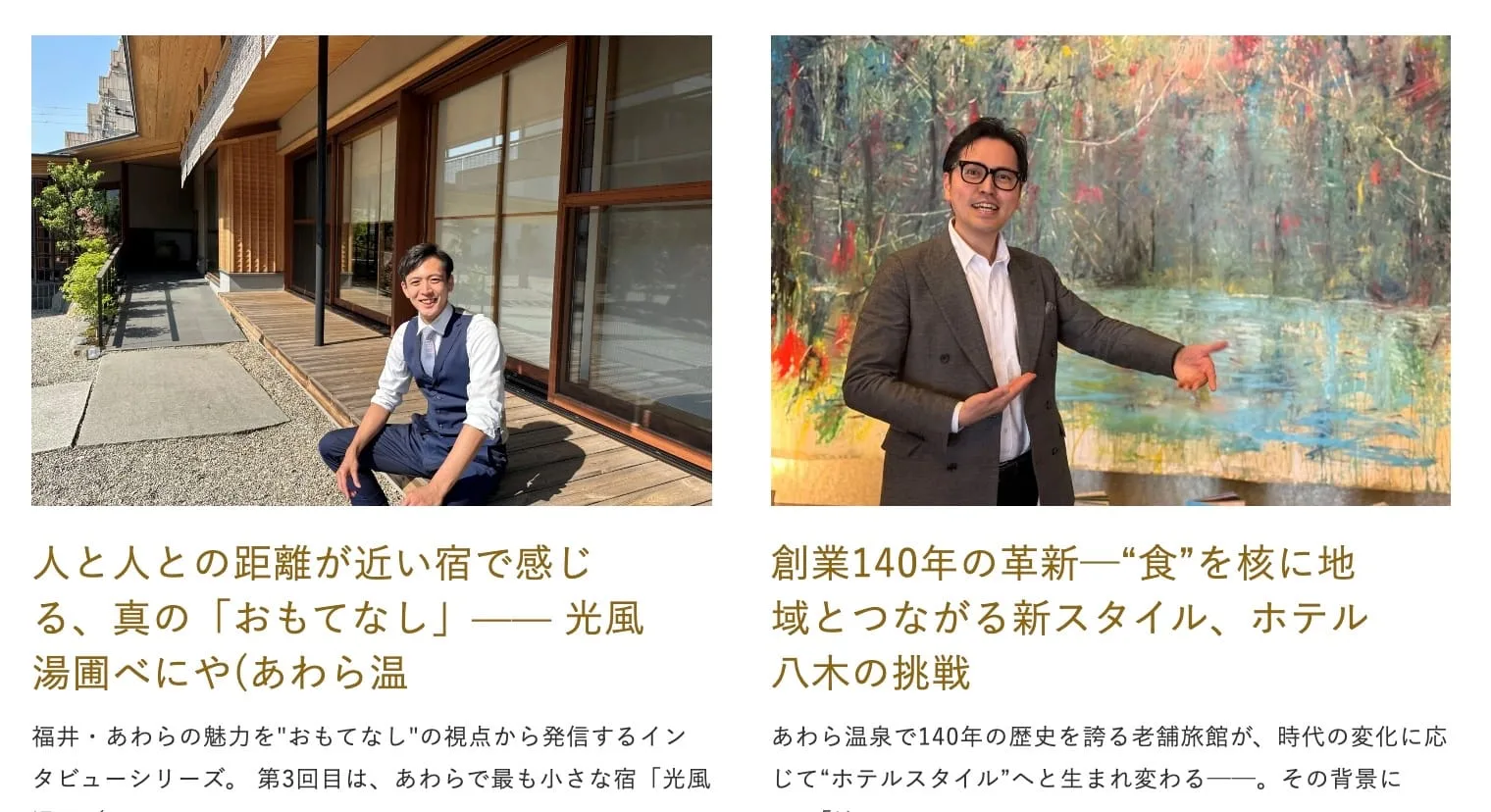
Reference: HAPPY Column, Awara City Tourism Association official website (Japanese) For example, one inn offers value rooted in the SDGs through efforts toward carbon zero and by hosting environmental education. Other inns communicate around their commitment to cuisine and the quality of their hospitality. We needed everyone involved to recognize again that the values and thinking unique to each inn are an important attraction that can become guests’ “reason to choose that inn.”
Beyond each inn sharing these features on its own, the tourism association worked from a neutral position to organize and edit the information and put its value into words from an outside perspective, so that the appeal comes across more clearly to visitors. Through this process, the quality and accuracy of the content are improving, and the way information reaches people is starting to change. Together with the Awara City Tourism Association’s staff, basicmath supported steps such as designing interview questions for inns and proofreading articles, helping build a system for communicating the region’s appeal in a structured way.
Changes are also beginning to appear in how initiatives spread across businesses and how quickly decisions are made, with communication on Slack at the center, and regional cooperation in Awara Onsen is gradually taking shape.
Ongoing Discussions Based on Lodging Data
Throughout the program, a system was developed for planning promotions based on monthly lodging results using area PMS data. In each session, participants formed hypotheses based on actual bookings, such as comparisons with the same month of the previous year, changes in direct booking rates and comparisons with nearby hot spring resorts. Concrete questions such as “which guest segments are declining?” and “how do we fill the off-season?” came to be shared among businesses.
When everyone shares the same data, they also notice trends that are hard to see from a single inn, such as “which guest segments are declining, and when?” and “are booking lead times changing?” For example, when analysis results such as “booking lead times from the Tokyo area are shorter in this period” or “visitor numbers from the Kansai region are weak this season” are shared, participants can discuss concrete actions, such as “should we concentrate ad spending in this period?” or “should we switch the content of our social media posts earlier?”
In these settings, it is important not to rely only on individual intuition and experience but to understand the current situation from shared data and discuss the direction of promotion. We believe building this kind of system is essential for improving the speed and quality of decision-making.
3. Communicating “Value That Has Not Yet Come Across”
Is Our Messaging Meeting Guests’ Needs?
In the Awara Onsen area, each inn’s communication is gradually progressing, but there is still room to grow in terms of content. We therefore created an opportunity to rethink how to communicate from the guest’s point of view. For example, nationwide, many inns focus their messaging on attractions such as hot springs and food. Yet actual reviews overwhelmingly mention things like cleanliness and whether rooms were well cleaned, which clearly shows that guests place great importance on hygiene.
However, when we asked staff at the participating inns in the Awara Onsen area, many said that while they personally felt “the cleanliness of an inn shapes guests’ impressions,” looking back at their own messaging, they had never put this into words. Daily efforts such as how often air conditioner filters are cleaned, hygiene in the baths and the care of amenities are taken for granted, so they tend to be left out of messaging. For guests, however, these are exactly the points that matter most in judging whether they can stay with peace of mind. Are businesses really aware of this perspective?
What Value Are Guests Really Looking For?
Cleaning is only one example. What matters is to correctly understand what guests value and how they choose an inn, and to carefully communicate information that responds to it. If an inn wants to increase guest numbers, raise customer satisfaction and ultimately increase revenue, it needs to look at what guests actually value and communicate it, rather than one-sidedly promoting only what it puts effort into.
If messaging is skewed toward the business’s own perceptions, the appeal that should be communicated may not get through, and the inn may miss chances to be chosen. That is why it is important to read guests’ needs through their voices, such as reviews, and communicate in a way that makes people think, “This inn will probably meet my expectations.” In addition, delivering the voices of guests whose needs were met to the next prospective guests links expectations with actual experience and builds trust over time.
We believe that gradually building up this perspective will be an important foundation for lodging management going forward, turning communication from mere publicity into a “reason to be chosen” and linking it to lasting results.
4. What the Marketing Program Achieved
In this program, we alternated between classroom learning and practice, carefully building a process in which participants thought, acted and reflected in relation to their own work. The results that emerged can be grouped into three main areas.
Building Knowledge through Lectures and Deepening Understanding through Q&A
The program provided ongoing time to deepen understanding of areas such as SEO, advertising and PMS data, which participants had “been curious about but had not been able to use,” through repeated lectures and Q&A. On advertising, for example, participants asked concrete questions such as “what CVR should we aim for?” and “is there a way to run ads that fits our budget?”, which turned out to be concerns shared with other inns.
Even in situations that assume working with outside partners, everyone confirmed the importance of “organizing your goals and understanding the basic terms before starting the conversation,” and small changes are appearing in how participants approach communication and advertising. A flow has also taken shape in which participants do not keep learning as personal knowledge but actually write posts and articles, bring the results back, report on them and improve. We feel this can be a solid foundation for future practice.
Staff feeling that “I can do this too” and “next I want to try changing this” means a great deal as a base of motivation for continuing.
A Cycle of Understanding and Collaborative Practice in Advertising
Participants repeatedly practiced the PDCA cycle, treating marketing initiatives, including ads, not as “place it and you’re done” but as a flow of goals, metrics, evaluation and improvement. For example, a flow is taking hold in which participants set evaluation metrics such as CVR and direct booking ratio in advance, run the initiative, review the actual results with PMS data and other sources, and then share improvements for the next round at meetings.
The tourism association and the hot spring ryokan cooperative following these efforts together created opportunities to share and examine, from the perspective of the whole region, decisions and reviews that would have been difficult for a single inn. Advertising and promotion became not just individual efforts but an experience of thinking, with a real sense of it, about how to design and run them as a region. We believe this will also become a foundation for continued collaboration.
One participant said, “We had never looked back at the effectiveness of our ads in numbers before.” Being able to compare their efforts and results with other inns using KPIs as a common language made it easier to put into words “what our inn should prioritize” and “what to try next,” and a perspective of continuous improvement is gradually growing.
Staff Putting Their Challenges into Words
At the start of the program, many participants had vague feelings such as “things just aren’t going well” or “I don’t know what to improve.” But with each session, each participant’s understanding of their challenges became clearer, and by the final session they were expressing them concretely, in words such as “we weren’t communicating the appeal of our cleaning and service” and “the division of roles with our agency was unclear.”
Even if each realization was small, being able to say in their own words “where the problems lie in my work” and “how I can move forward even a little” is one of the most tangible results of this program. Being able to describe even the structure of their challenges shows that participants are developing a perspective for seeing where there is room for improvement across their work. In future efforts, too, this experience-based understanding of challenges should become the force that sustains improvement on the ground.
We also think that having opportunities to share each staff member’s thinking about their business and its structure with people who have an objective perspective, as in this program, can be a way for them to evaluate their own ideas objectively and check the direction of their thinking at that point. When there are few such opportunities, evaluation tends to be biased toward internal views, which may have made it harder to refine communication and plans from the customer’s and a long-term perspective.
Participants’ Voices (Excerpts)
On the program
- Success stories are hard to learn from, but failures are highly reproducible, so I want to share failure cases. I haven’t explained it well enough yet to get others involved.
- Looking at the ad results (from the campaign run in this program), I understood that averages differ by business, so I will keep collecting data and work out our own averages.
On cooperation in the area
- A lack of human resources leads to a lack of commitment to this program and to each initiative. Developing people takes time, so we should start early.
- We need a fundamental solution to the process of getting all the inns moving in step.
On building systems and developing people to become self-sustaining
- The problem is that staff work has become just tasks, and people can’t create the purpose or meaning of their work themselves. I want to include staff development in our initiatives.
- We need to narrow down to one theme, turn it into concrete initiatives, set specific KPIs for a separate event and work toward achieving them.
5. Wrapping Up the Program and Looking Ahead
Ongoing Systems for Self-Sustaining Operation and Making It Part of Daily Work
For example, the monthly report meetings, which review each month based on lodging data and KPI progress, are gradually becoming established as a place to track busy and quiet periods and responses to ads and to define the next moves. Participants shared the idea that keeping this system in place secures time for the whole region to focus on marketing, even while busy with daily work.
The tourism association and various committees are also working together to bring a marketing perspective into activities such as exchange, publicity and creating local buzz. The groundwork is being laid to connect efforts across fields, such as talks at elementary schools, booths at local events and SDGs-themed communication, and to share them as a direction for the whole region.
Calls are also emerging to improve the accuracy of lodging data and strengthen the analysis environment. Once this groundwork is in place, it will be possible to look beyond short-term promotion to medium- and long-term strategies for attracting visitors. We hope that the knowledge and awareness built in this program will not stay with a few staff members but continue as part of the cooperative’s activities.
Potential as a Model of Local Cooperation for Japan
In this marketing program, we repeatedly built up small, practical steps rooted in the realities of the region. Participants used lodging data and reviews as clues to rethink their work and the value they can offer, and started with what they could do. We feel this accumulation has worked as a process that builds the ability to “think in our own words” rather than leaving marketing to specialists.
This kind of trial and error can become a general foundation for many fields, such as DX at destinations, staff development and the division of roles within a region. In fact, efforts like Awara Onsen’s to find “systems we can run ourselves” are gradually attracting interest in Japan. Across Fukui Prefecture, area PMS systems are steadily being introduced and used in various places, and data sharing across multiple areas and wide-area marketing infrastructure are expected in the future. A system in which participants share goals and KPIs and run the PDCA cycle contains many elements that other regions can learn from.
If local businesses want to work together to revitalize their region and improve their marketing, why not start by identifying challenges that everyone can share? For example, try putting into words questions and challenges such as “which guest segments are declining?” and “who is our appeal actually reaching?”, connecting them with data and everyday experience. Gradually building up these conversations should be the starting point for cooperation and collaboration within the region.
We believe this program, as a case that gave shape to this approach in one region, the Awara Onsen area, can offer hints for many other regions.
Q&AQuestions and answers
- What did Part 2 of the Tourism Marketing Program focus on?
- It focused on building systems that let staff apply what they learned, trying out a cooperation model with the Awara City Tourism Association as a hub, planning promotions based on area PMS lodging data, and communicating "value that has not yet come across" as revealed by guest reviews.
- How did the program address the low priority of marketing and the lack of resources?
- Participants discussed two approaches. One was to make visible, including to management, why the work matters now and which numbers it will change. The other was to build systems that can continue with limited resources, such as AI-generated article headlines and outlines, drafting by voice input and templates for social media posts.
- What role did the tourism association play in local cooperation?
- Rather than acting as a cheerleader, it acted as a "translator" that organized each business's efforts, put their value into words from an outside perspective and reconnected them in ways that matter to the whole region. basicmath supported the association in designing interview questions for inns and proofreading articles.
- What did guest reviews reveal?
- Many inns focus their messaging on hot springs and food, but reviews mention cleanliness and how well rooms were cleaned far more often, showing that guests place great importance on hygiene. Because these daily efforts are taken for granted, they tend to be left out of the inns' own messaging.
- Where should other regions start if they want to build similar cooperation?
- We suggest starting by identifying challenges everyone can share. The starting point is to keep having conversations that put questions such as "which guest segments are declining?" and "who is our appeal actually reaching?" into words, connecting them with data and everyday experience.