High School Students Take On Tourism Data Analysis: How Fukuoka Prefectural Itoshima High School Used Social Media and Reviews to Reveal Their Region
- Students at Fukuoka Prefectural Itoshima High School analyzed more than 3,000 Instagram posts tagged "#糸島" (Itoshima) and 288 Google reviews to reveal the strengths and challenges of tourism in Itoshima.
- The results were reported to Itoshima City Hall and the Itoshima City Tourism Association, and the project was selected for the International Symposium for High School Students.
- Drawing on its tourism DX work in Fukui, basicmath supported the students by providing an analysis platform free of charge with EmbedSocial and by speaking at a study session.
- 3,000+
- Instagram posts tagged #糸島 analyzed
- 288
- Google reviews analyzed
- 350,000+
- EmbedSocial users worldwide
How to make use of the “real voices” found on social media and in reviews has become a major theme in tourism. Visitors’ honest opinions, which are usually hard to see, accumulate every day on social media such as Instagram posts and Google reviews, and they are drawing attention as input for tourism strategy.
Since joining a Japan Tourism Agency program in 2022 as a member of the Fukui Prefecture Tourism DX Promotion Marketing Data Consortium, basicmath has supported tourism analysis using social data such as social media posts and reviews, in Fukui Prefecture and across Japan.
Then in 2024, students at Fukuoka Prefectural Itoshima High School took on social data analysis focused on tourist spots in Itoshima. They used AI and text mining to visualize Instagram hashtags and Google reviews, and presented the challenges and strengths they found as recommendations to the city government and tourism association. Their results were presented at the International Symposium for High School Students. basicmath supported this project: drawing on the know-how and field insights gained through tourism DX in Fukui Prefecture, we helped organize analysis methods and perspectives, and provided tools in partnership with EmbedSocial.
In this article, we use the high school students’ data analysis to consider what “visitors’ voices” on social media and in reviews can do for regional tourism.
The Challenge at Fukuoka Prefectural Itoshima High School: The “Itoko Shigaku” Inquiry Program
For nine years, Fukuoka Prefectural Itoshima High School has used its “Period for Integrated Inquiry” to run its own class, “Itoko Shigaku,” in which students tackle local issues. In recent years, however, problems had emerged: “the data available is limited” and “the findings are similar every year.” In particular, existing information such as statistics provided by the city hall led to overlapping angles of analysis, making it hard to produce original results.
To break out of this situation, from fiscal 2023 the school moved to a seminar format in which teachers set the themes and apply their own expertise. This created a structure for exploring themes more rooted in the real world. Within it, Nagae, a teacher at the school, launched the project “Analyzing Itoshima Tourism Using Social Media Data.” It was a new attempt to re-examine Itoshima’s tourism issues through data, with the perspectives of local governments and the Japan Tourism Agency in mind.
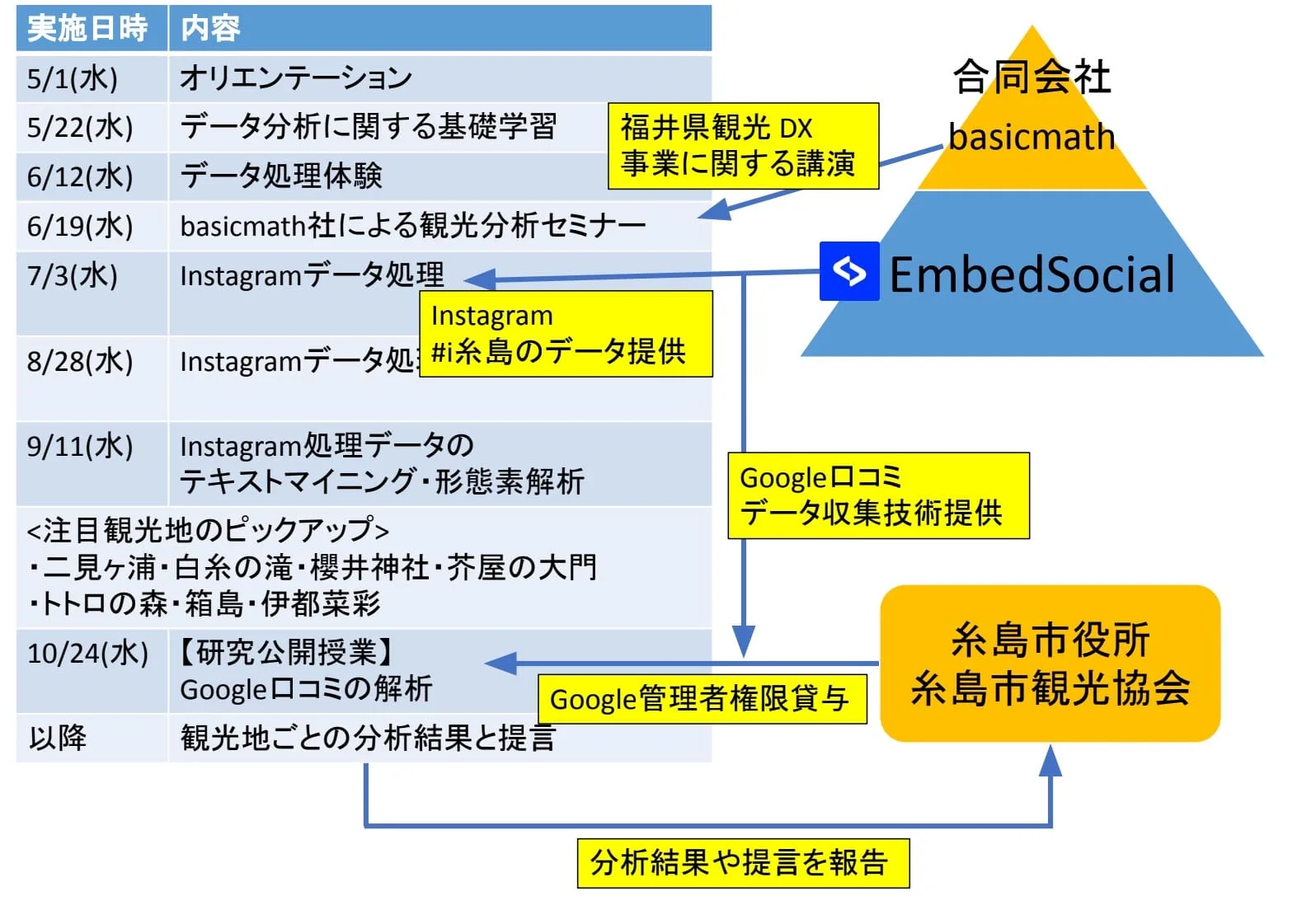
Excerpt from materials provided by Itoshima High School
The Hint for Regional DX Came from Tourism Analysis in Fukui
The inspiration for this plan was “Fukui tourism DX,” carried out in Fukui Prefecture. After learning about these efforts to visualize and analyze regional tourism using social data such as social media posts and reviews, Nagae became strongly interested in whether the approach could be applied by high school students too, and set out to make the project happen.
Support from EmbedSocial and basicmath
Working with its affiliate EmbedSocial, basicmath provided a platform for collecting and analyzing user posts and reviews from Instagram and Google Business Profile (GBP). EmbedSocial is a system for using UGC (user-generated content) with more than 350,000 users worldwide and more than 5,000 in Japan, and its features were provided free of charge for this project.
In addition, with the cooperation of Itoshima City Hall and the Itoshima City Tourism Association, Itoshima High School was temporarily granted administrator rights to GBP locations managed by those organizations, so students could access review data for those locations directly. basicmath provided full support in setting this up, including coordination with the organizations involved and lessons on how to use the tools, so the students could take the lead in their data analysis.
The Students’ Analysis and Findings
Instagram Hashtag Analysis
In the first stage of the project, the students collected and analyzed Instagram posts tagged “#糸島” (Itoshima). The period covered was May 2023 to June 2024, and more than 3,000 posts were analyzed.
The analysis focused on hashtags rather than post text, extracting frequent words using text mining and morphological analysis. By creating word maps with an AI tool, the students visualized what visitors find attractive about Itoshima. For example, words such as “#海カフェ” (seaside café) and “#自然がいっぱい” (full of nature) appeared often, showing strong support for Itoshima’s photogenic scenery and relaxing atmosphere.
Google Review Analysis
Instagram posts tend to lean positive, while Google reviews collect more candid opinions. The students therefore collected and analyzed reviews of Itoshima Totoro Forest, Keya no Oto Park and the Keya observation deck to dig into visitors’ real voices.
After sorting 288 reviews by hand into positive and negative opinions, they found that comments such as “the natural atmosphere is great” and “the view from the observation deck is beautiful” stood out, but issues such as “hard to climb” and “the observation deck is small” also emerged. These opinions were valuable clues for understanding the strengths of Itoshima’s tourism resources and what could be improved.
What Made the Data Analysis Possible
A Foundation for Data Analysis That Connects School and Society
As part of this project, basicmath spoke at a “data analysis study session,” sharing with students examples of tourist destination data analysis from our tourism DX work in Fukui Prefecture, along with key points and ways of thinking about analysis.
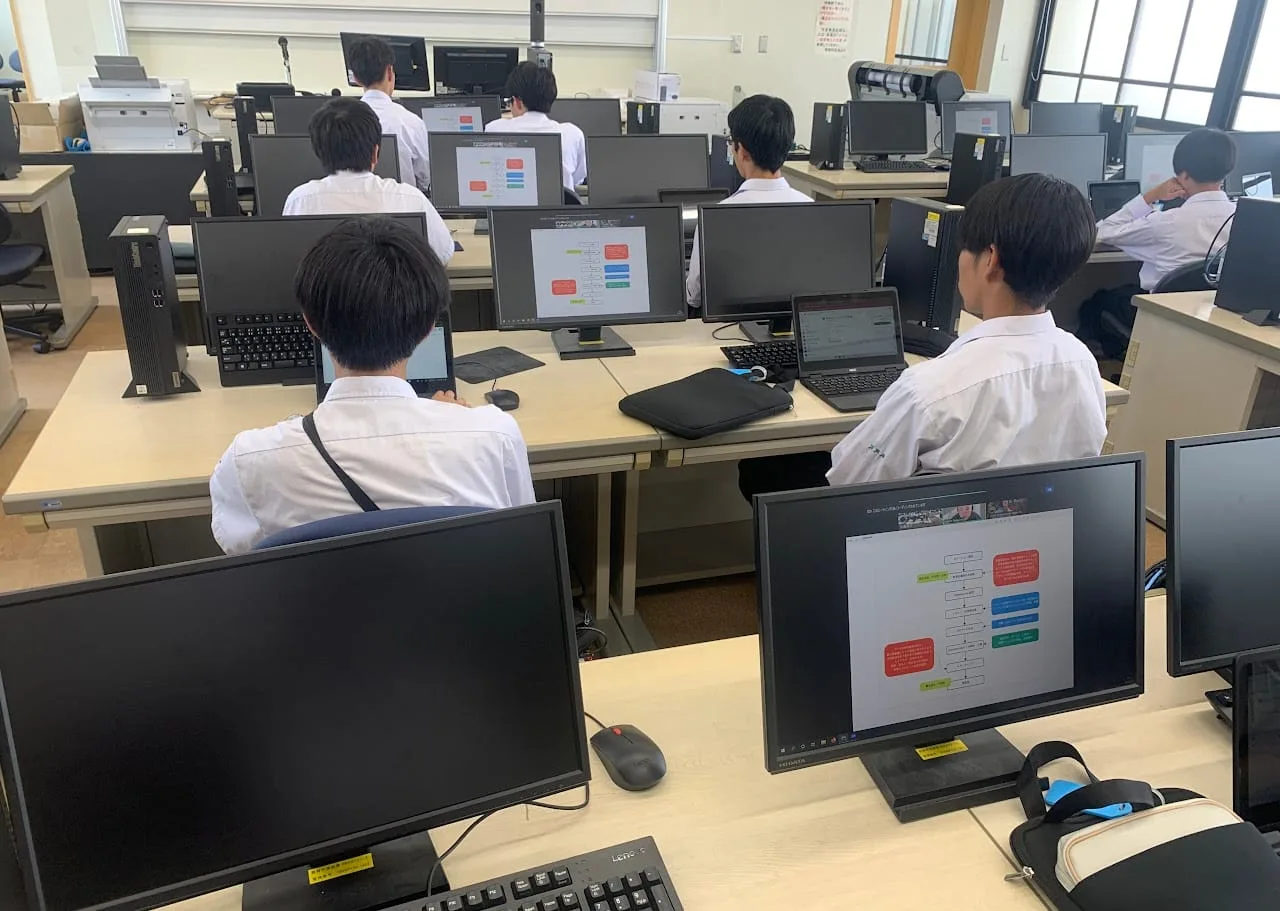
The study session, provided by Itoshima High School
The data in front of you is not just a string of characters. For tourism businesses, it is an important resource that could be called the “key to success,” shaping tomorrow’s revenue. What moved the travelers who actually visited, what did they value, and where were they dissatisfied? By noticing these honest voices early and reflecting them in improvements to services and content, a region can bring out its full appeal and keep evolving into a destination that continues to be chosen.
The starting point for this is “collecting and analyzing data.” Which data to look at, when, and from what perspective: this design greatly changes both the insights you draw and the strategy you pursue next. Data analysis makes “scientific destination management” possible without relying only on intuition and experience, and it is an essential capability for the next generation of tourism DX.
We emphasized to the students the importance of reading data from multiple perspectives: taking the viewpoint of actual users and of tourism businesses, and asking what analysis results would help a business grow or lead to concrete improvements. Simply collecting data does not create value. You need to be clear about “for whom” and “for what purpose” the information will be used, and connect it to concrete action. We believe this whole flow is what raises a destination’s appeal and creates value for the entire region.
An Objective Perspective as Social Media Users
For high school students, social media is part of everyday life, so they naturally felt at home working with information on social media such as Instagram hashtag posts and Google reviews.
Before the session, the students had already collected and analyzed Instagram posts tagged “#糸島” on their own. Because of that experience, the session drew many comments such as “the way I look at posts has changed,” along with many specific questions about the analysis. We feel this session, which connected their sensibilities as social media users with the perspective of data analysis, was a practical and deep learning experience for the students.
Flexible Thinking That Adults Should Learn From
What was striking about this project was how naturally the students explained their results in their own words and conveyed them to others. Partly because the subject of analysis was social media, which is close to their daily lives, they expressed what they noticed and felt not only with logic but also with intuition.
This is an ability that is hard to develop through textbook knowledge and technical skills alone. Rather, it was their experience of “asking questions” and “communicating” based on familiar data that made this flexible thinking and proactive output possible. For basicmath, too, there was much to learn from this attitude of taking information that working adults and local government staff treat as “a given,” looking at it from a different angle, and giving it meaning.
The Results
Working with City Hall and the Tourism Association
The students’ data analysis went beyond inquiry-based learning and developed into collaboration with local government. The evaluations and issues for tourist spots drawn from Instagram hashtag posts and Google reviews were reported to Itoshima City Hall and the tourism association, which received them as a new perspective for thinking about local tourism policy.
Because the report included concrete recommendations from the students’ point of view, it had a sense of reality and persuasiveness that conventional surveys lack, making it a good example of linking education and the community.
Selected for the International Symposium for High School Students
The project’s results were highly regarded and led to its selection for the International Symposium for High School Students. Its practical approach to local issues and its communication with society in partnership with companies were recognized as advanced work.
For the students, it was a valuable experience of turning knowledge from everyday classes into action and presentations in the real world, and a chance to feel that “learning connects to society.”
International Symposium for High School Students (Japanese)
What Lies Beyond “Visualization”
What we consistently told the students is that “the purpose of data analysis is not to visualize results, but how businesses use those results.” Organizing social data such as social media posts and reviews into numbers and graphs has meaning in itself, but unless it leads to actual measures and improvements, it creates no essential value.
In this project, the students took on the role of delivering their analysis to the “people on the ground,” the city government and tourism association. How the strengths and issues of tourist spots that the students visualized will be used in the region and lead to change: that outcome is what tests the true meaning of data analysis.
This project was the first step in an ideal cycle in which the results of learning are returned to the region. And we believe the greatest value of the project is that the students involved built the ability to connect with society and grew significantly.
Summary
With support from Itoshima City Hall, the Itoshima City Tourism Association, basicmath and EmbedSocial, the students of Fukuoka Prefectural Itoshima High School took on the analysis of social data in tourism. Collecting and visualizing “visitors’ voices” on Instagram and Google reviews, organizing the region’s strengths and challenges that emerged, and feeding them back to the city government and tourism association: this whole process is tourism DX in miniature.
What this project showed is that even when specialized tools are used, what is needed is not advanced skills but a clear sense of purpose and motivation. With the right steps and appropriate support, anyone can visualize the voices of their region or their own customers and turn them into next actions.
The students turned to the social media they use every day and took a fresh look at their region from a familiar perspective. They then went all the way to carefully communicating the data they had collected and analyzed in their own words. Adults can go even further, using their field experience and expertise for more practical and deeper applications. The hints that will shape a region’s future are already accumulating online. Social data analysis is the starting point for understanding a region’s “now” and designing the next action.
This project is a practical example of high school students capturing visitors’ voices and connecting them to the growth of their region, and a model case of “learning that moves a region” in which anyone can take part. We hope this case becomes widely known and spreads to many other regions.
Q&AQuestions and answers
- What data did the Itoshima High School students analyze?
- More than 3,000 Instagram posts tagged "#糸島" (Itoshima) from May 2023 to June 2024, and 288 Google reviews of Itoshima Totoro Forest, Keya no Oto Park and the Keya observation deck.
- What did the analysis reveal?
- On Instagram, tags such as "#海カフェ" (seaside café) and "#自然がいっぱい" (full of nature) appeared often, showing strong support for the scenery and relaxing atmosphere. Google reviews praised the beautiful views but also pointed out issues such as "hard to climb" and "the observation deck is small."
- How did basicmath support the project?
- Working with its affiliate EmbedSocial, basicmath provided a free platform for collecting and analyzing posts and reviews from Instagram and Google Business Profile. It also coordinated with the organizations involved, taught the students how to use the tools, and spoke at a data analysis study session.
- What did the project achieve?
- The results were reported to Itoshima City Hall and the tourism association, which received them as a new perspective for local tourism policy. The project was also recognized and selected for the International Symposium for High School Students.